
“WizardOfVR: Emotion-Adaptive Virtual Wizard Experience” by Gupta, Zhang, Pai and Billinghurst
Conference:
Experience Type(s):
Title:
- WizardOfVR: Emotion-Adaptive Virtual Wizard Experience
Presenter(s):
Description:
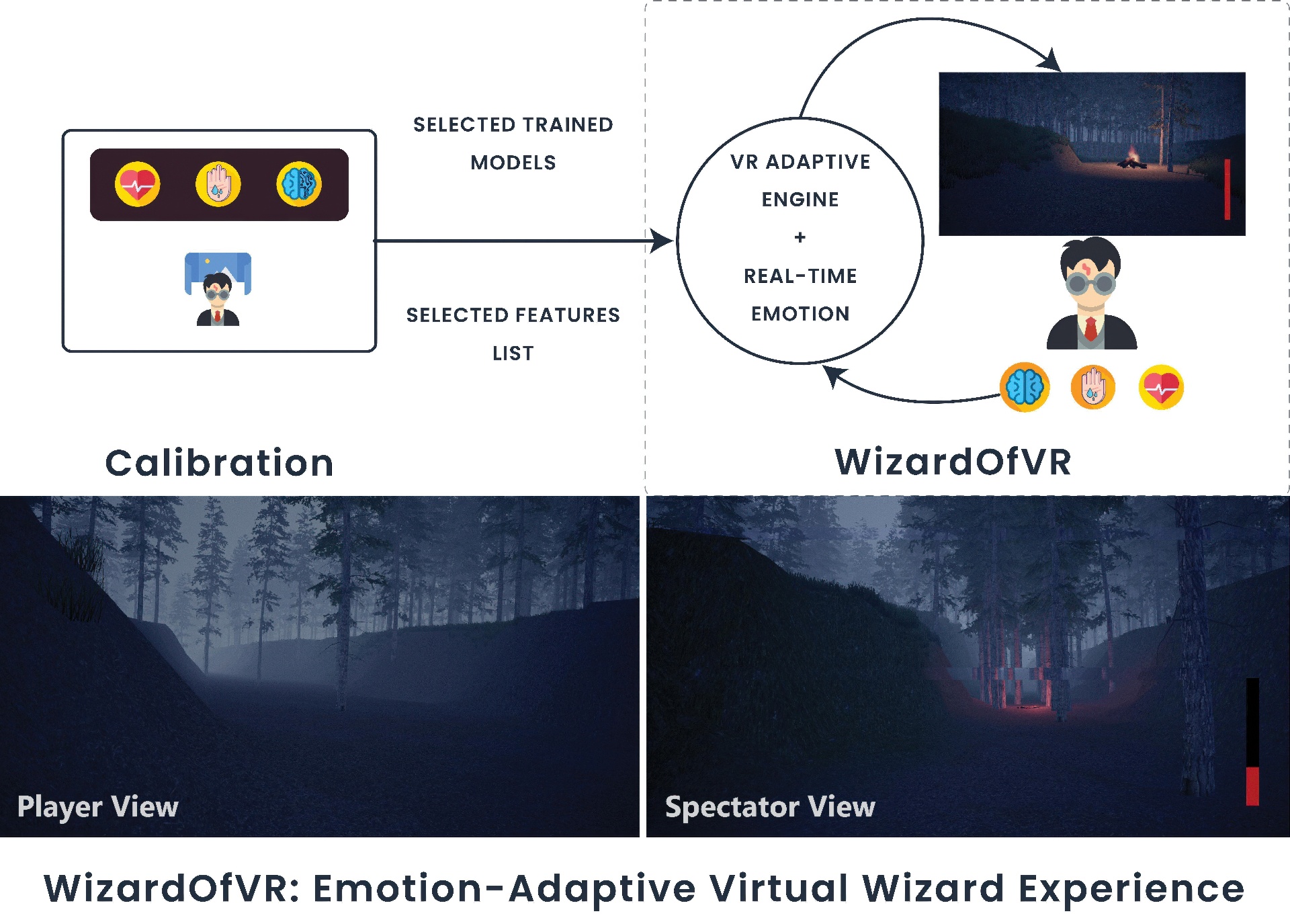
We demonstrate WizardOfVR, a personalized emotion-adaptive virtual reality (VR) Wizard akin to the Harry Potter experience, highlighting a use-case scenario of a real-time biofeedback loop between the user’s emotional state and adaptive VR environments (VREs) using off-the-shelf physiological sensors. In our demo, the user initially trains the system with a calibration process using physiological signals such as Electroencephalogram (EEG), Electrodermal Activity (EDA), and Heart Rate Variability (HRV). After calibration, they will indulge in a Harry Potter Series’s Forbidden Forest-like experience with adapting environmental factors based on ‘SanityMeter’ indicating the user’s real-time emotional states. The overall goal of this demo is to provide more balanced, immersive, and optimal emotional virtual experiences.
References:
[1] Guillermo Bernal and Pattie Maes. 2017. Emotional beasts: visually expressing emotions through avatars in VR. In Proceedings of the 2017 CHI conference extended abstracts on human factors in computing systems. 2395–2402.
[2] Margaret M Bradley and Peter J Lang. 1994. Measuring emotion: the self-assessment manikin and the semantic differential. Journal of behavior therapy and experimental psychiatry 25, 1(1994), 49–59.
[3] Arindam Dey, Hao Chen, Mark Billinghurst, and Robert W Lindeman. 2018. Effects of Manipulating Physiological Feedback in Immersive Virtual Environments. In Proceedings of the 2018 Annual Symposium on Computer-Human Interaction in Play. ACM, 101–111.
[4] Paul Ed Ekman and Richard J Davidson. 1994. The nature of emotion: Fundamental questions.Oxford University Press.
[5] Barbara L Fredrickson. 2001. The role of positive emotions in positive psychology: the broaden-and-build theory of positive emotions.American psychologist 56, 3 (2001), 218.
[6] Kunal Gupta, Jovana Lazarevic, Yun Suen Pai, and Mark Billinghurst. 2020. AffectivelyVR: Towards VR Personalized Emotion Recognition. In 26th ACM Symposium on Virtual Reality Software and Technology. 1–3.
[7] Javier Marín-Morales, Carmen Llinares, Jaime Guixeres, and Mariano Alcañiz. 2020. Emotion recognition in immersive virtual reality: From statistics to affective computing. Sensors 20, 18 (2020), 5163.
[8] Justin Munafo, Meg Diedrick, and Thomas A Stoffregen. 2017. The virtual reality head-mounted display Oculus Rift induces motion sickness and is sexist in its effects. Experimental brain research 235, 3 (2017), 889–901.



