
“Who You Are is What You Tell: Effects of Perspectives on Virtual Reality Story Experiences” by Garcia-Godos, Eguiguren and Dey
Conference:
Experience Type(s):
Title:
- Who You Are is What You Tell: Effects of Perspectives on Virtual Reality Story Experiences
Presenter(s):
Description:
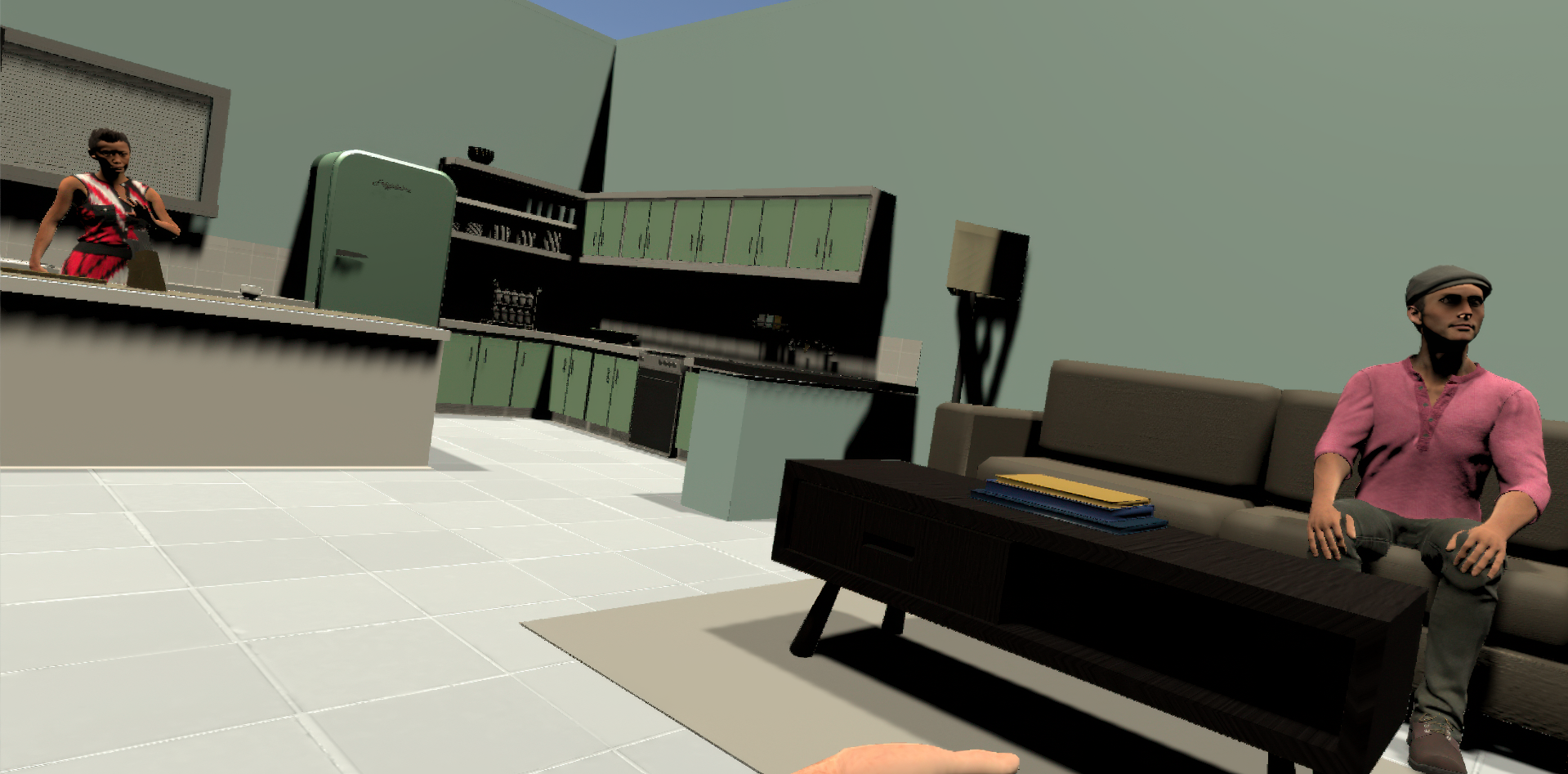
Virtual reality (VR) stories provide an immersive and interactive medium to present narrative content. While it provides an immersive way to present the content, it is challenging to present the story in a way that matches the intention of the producer. There are several aspects of the VR environment that may affect the way the viewer experiences and perceives the content including the inhabited character by the viewer, the available interactive objects, areas of interest in the scene and their salience to receive attention. This presented demonstration is part of a project where we are investigating the ways a VR story can be presented—in other words, how the VR environment can be designed—to provide affordances that will help the viewer to perceive the story as intended by the producer, without explicitly guiding the viewer for particular interactions.
References:
[1] Konstantina Kilteni, Raphaela Groten, and Mel Slater. 2012. The sense of embodiment in virtual reality. Presence: Teleoperators and Virtual Environments 21, 4(2012), 373–387.
[2] Nicolas Mollet and Bruno Arnaldi. 2006. Storytelling in virtual reality for training. In International Conference on Technologies for E-Learning and Digital Entertainment. Springer, 334–347.
[3] Luke Phipps, Victor Alvarez, Sara de Freitas, Kevin Wong, Michael Baker, and Justin Pettit. 2016. Conserv-AR: A virtual and augmented reality mobile game to enhance students’ awareness of wildlife conservation in Western Australia. Mobile Learning Futures–Sustaining Quality Research and Practice in Mobile Learning (2016), 214.
[4] Kimiko Ryokai, Cati Vaucelle, and Justine Cassell. 2003. Virtual peers as partners in storytelling and literacy learning. Journal of computer assisted learning 19, 2 (2003), 195–208.
[5] Donghee Shin. 2018. Empathy and embodied experience in virtual environment: To what extent can virtual reality stimulate empathy and embodied experience?Computers in Human Behavior 78 (2018), 64–73.
[6] Dong-Hee Shin. 2017. The role of affordance in the experience of virtual reality learning: Technological and affective affordances in virtual reality. Telematics and Informatics 34, 8 (2017), 1826–1836.
[7] Ashima Thomas, Abhi Kumar, Race Krehel, Kay Vasey, Eng Tat Khoo, Tim Marsh, and Benjamin Li Junting. 2018. Oceans we make: immersive VR storytelling. In SIGGRAPH Asia 2018 Virtual & Augmented Reality. ACM, 13.
[8] David Weibel, Bartholomäus Wissmath, and Fred W Mast. 2010. Immersion in mediated environments: the role of personality traits. Cyberpsychology, Behavior, and Social Networking 13, 3(2010), 251–256.



