
“SmartSim: Combination of Vibro-Vestibular Wheelchair and Curved Pedestal of Self-Gravitational Acceleration for Road Property and Motion Feedback” by Yem, Yagi and Ikei
Conference:
Experience Type(s):
Title:
- SmartSim: Combination of Vibro-Vestibular Wheelchair and Curved Pedestal of Self-Gravitational Acceleration for Road Property and Motion Feedback
Presenter(s):
Description:
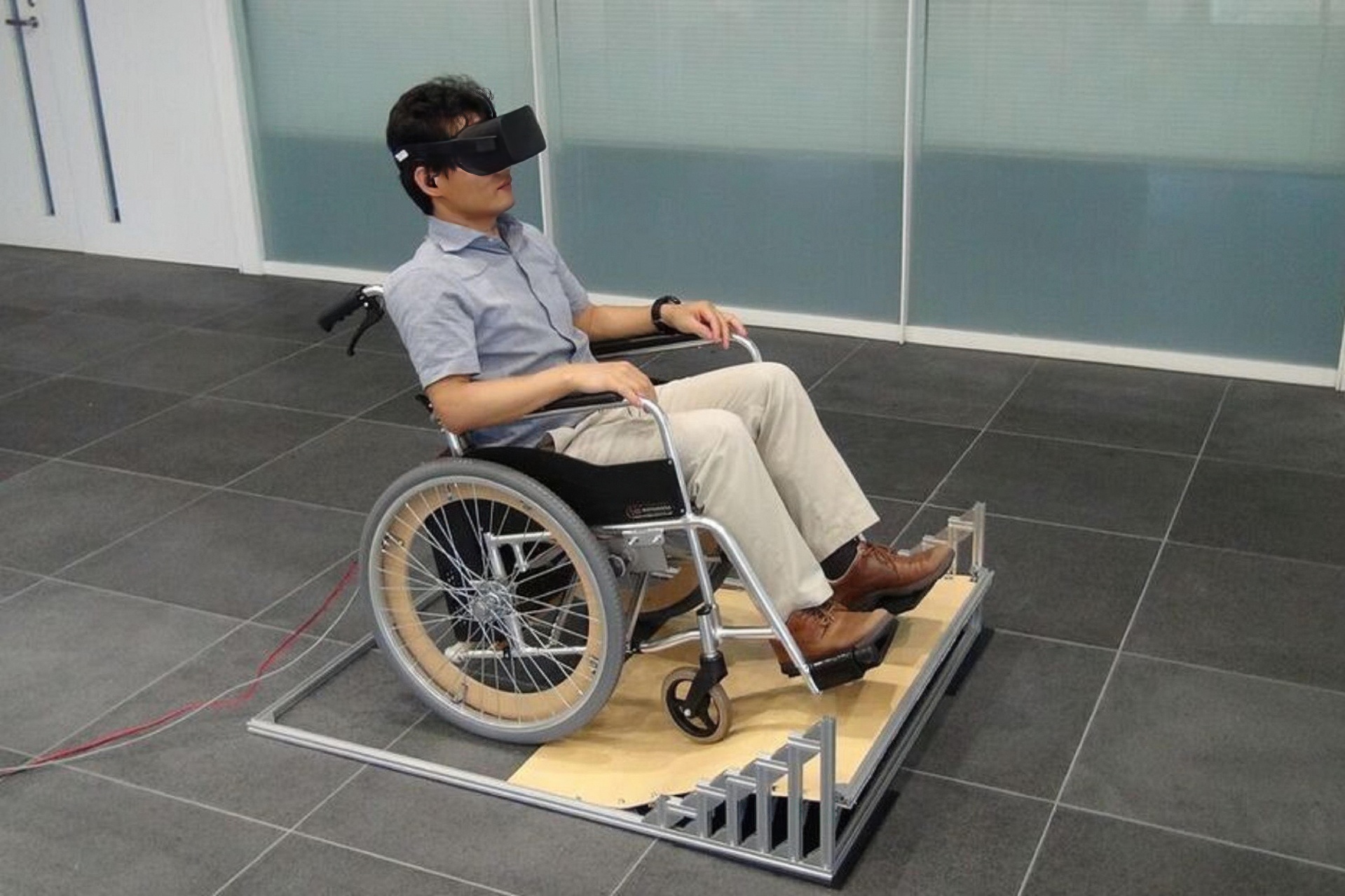
In recent years, virtual reality (VR) technologies have become popular for skill training or entertainment. VR allows a user to train driving a car or experience a roller coaster with low coast. To increase the quality of VR experience, various systems have been developed for motion sensation feedback. However, a 6 DOF motion platform is generally so expensive as to be used in many small but useful applications. Moreover, the lack of vestibular sensation in those applications often induces severe VR sickness and reduces the quality of experience. In this study, we developed a vehicle ride simulation system for immersive virtual reality. Our system mainly consists of a wheelchair for vibration and vestibular sensation, and a pedestal with a curve-shape surface for the wheelchair running on to utilize gravity component. We propose a vibration and acceleration feedback system using an electric wheelchair and a curved pedestal. This system allows presentation of variety of road property sensation as well as continuous acceleration of the vehicle motion by high bandwidth wheel torque of two DC motors. Our unique combination of a wheel and a pedestal can provide vibration and vestibular sensation of vehicle acceleration with a simple, light-weight, and low-cost mechanisms. In our demo experience, users can perceive sensation of road property such as uneven and continuous acceleration of a car or a roller coaster.
References:
[1] Matthias Hartmann, Luzia Grabherr, and Fred Mast. 2011. Moving Along the Mental Number Line: Interactions Between Whole-Body Motion and Numerical Cognition. Journal of experimental psychology. Human perception and performance 38 (12 2011). https://doi.org/10.1037/a0026706
[2] A. Miyata, H. Uno, and K. Go. 2019. Evaluation on a Wheelchair Simulator Using Limited-Motion Patterns and Vection-Inducing Movies. In 2019 IEEE Conference on Virtual Reality and 3D User Interfaces (VR). 1086–1087. https://doi.org/10.1109/VR.2019.8797726
[3] V. Yem, R. Okazaki, and H. Kajimoto. 2016. Vibrotactile and pseudo force presentation using motor rotational acceleration. In 2016 IEEE Haptics Symposium (HAPTICS). 47–51. https://doi.org/10.1109/HAPTICS.2016.7463154



