
“Restive Shadow: Animating Invisible Shadows for Expanding Shadowgraph Experience” by Sakaguchi, Tono, Tanaka and Matsushita
Conference:
Experience Type(s):
Title:
- Restive Shadow: Animating Invisible Shadows for Expanding Shadowgraph Experience
Organizer(s)/Presenter(s):
Description:
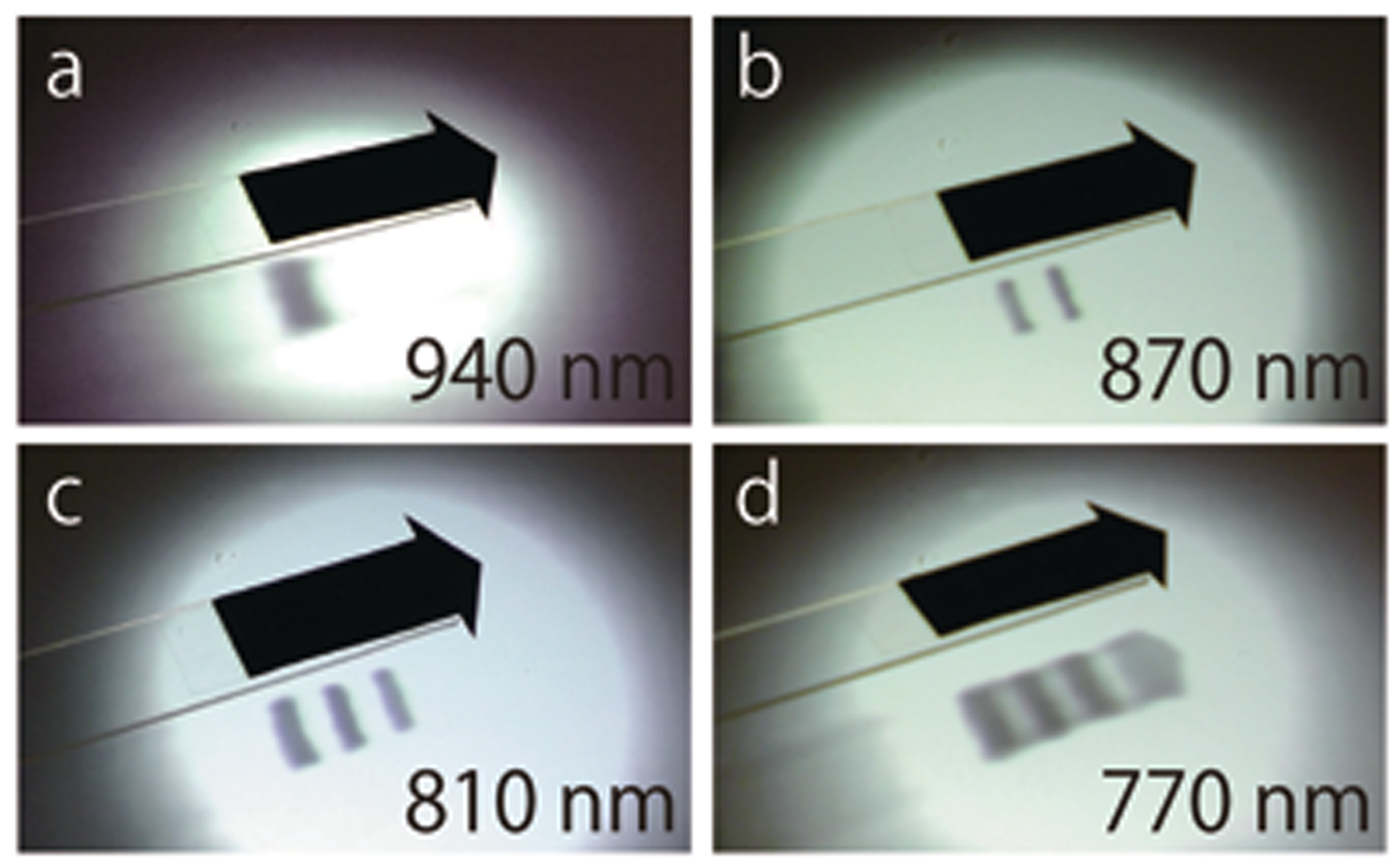
This paper proposes a multiplexing invisible shadow system named “Restive Shadow.” The proposed system uses infrared lights, each of which radiates a certain wavelength of infrared light, and an object to which two different types of IR filters are attached. Directing the light toward the object causes the object’s shadow to appear; the shape of the object then appears to change according to the wavelength of the radiated infrared light. With this system, a user is expected to attain a different viewpoint on shadows.
The primary contribution of this paper is to construct a system for entertainment with wonder shadows. In this system, shadows that behave different to these in our ordinary life. Though an object that is illuminated by a light looks like a black plate, its shadow is not the same as the shape of the object, that is, it has more details than the object. And the shadow also moves. (e.g. When a rectangular object are illuminated by the light, the shadow that is written characters. And the characters are appeared in order.) The system allows a user to become aware of a different viewpoint by intentionally shifting general awareness, that is, “the shadow is simpler than the object and has the same shape of the object” and “the shadow moves only same as the object movement.” In recent years, several studies have tried to extend shadows for applications in media arts. A lot of these systems create artificial shadows with image processing and sensing. In contrast, our system tried the different way of using a characteristic of infrared lights and IR filters. The proposed system generates moving shadows by changing wavelengths of infrared lights and attached IR filters, then achieves a “defamiliarization” of shadows.
References:
[1] Chikamori, M., and Kunoh, K. Kage. http://www.plaplax.com/legacy/artwork/minim++/artwork/kage.htm.
[2] Minomo, Y., Kakehi, Y., Iida, M., and Naemura, T. 2006. Transforming your shadow into colorful visual media: Multiprojection of complementary colors. ACM Computers in Entertainment 4, 3.
[3] Sakaguchi, S., Tanaka, T., Shinoki, R., and Matsushita, M., 2012. Shadow++: A system for generating artificial shadows based on object movement. ACM SIGGRAPH 2012, Posters, Article 119, August.



