“M-Hair: Extended Reality by Stimulating the Body Hair” by Boldu, Jain, Cortés, Zhang and Nanayakkara
Conference:
Experience Type(s):
Title:
- M-Hair: Extended Reality by Stimulating the Body Hair
Presenter(s):
Description:
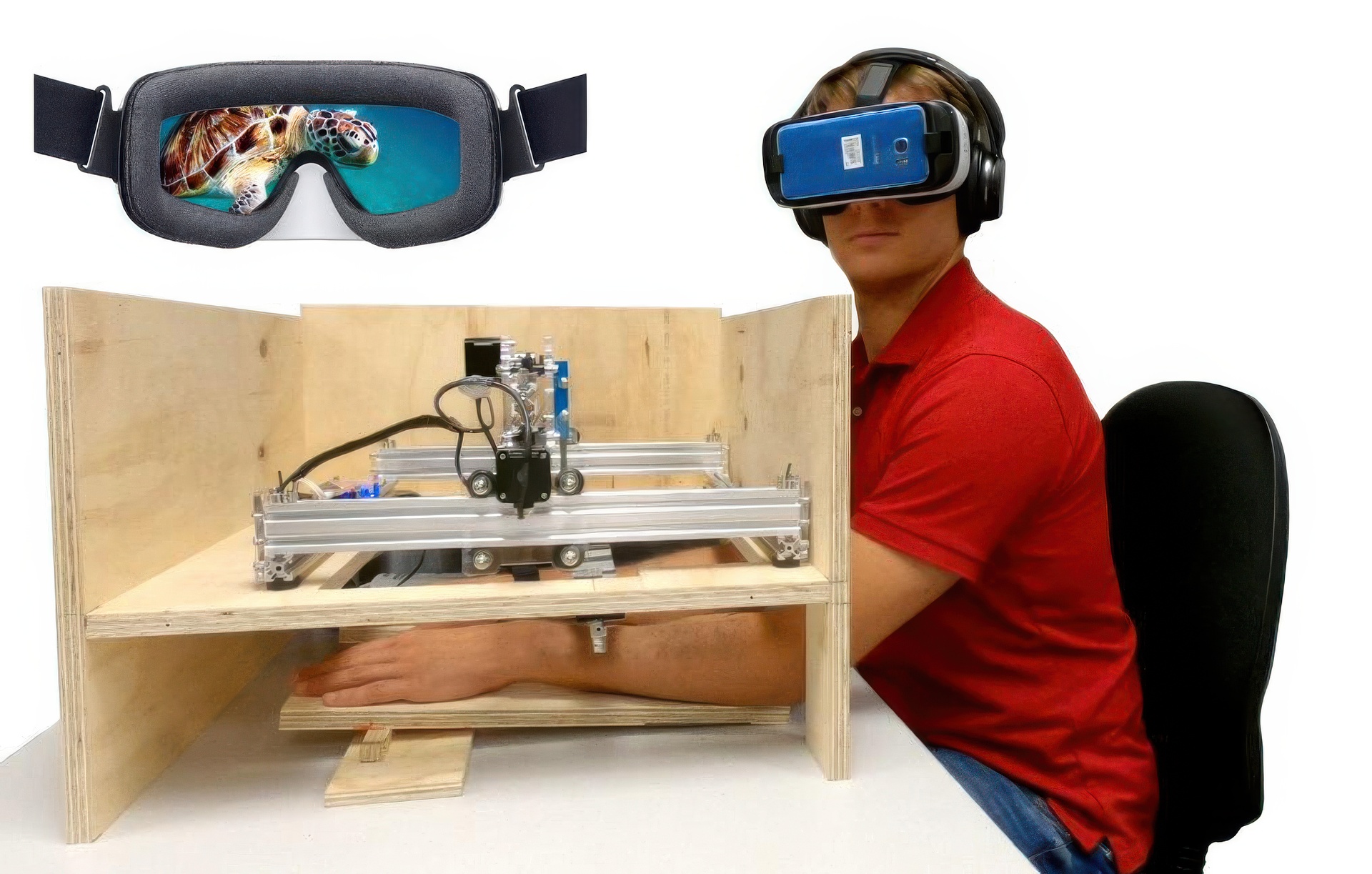
Human body hair (“androgenic hair”) extends the sense of touch beyond the skin’s surface. It detects minute contacts caused by e.g., airflow or insects, providing uniquely subtle sensations. In fact, Rich in C tactile (CT) neurons, a highly sensitive type of mechanoreceptor, has linked the human’s hairy skin to emotional touch (pleasantness, comfort, etc.) in previous research, while glabrous skin (hairless skin) has been more related to discriminative touch (pressure, vibration, slip, and texture). While most existing work on haptics address skin and hair without distinction, selectively addressing the hair alone might enable more targeted haptic display and enhance the sense of touch in applications, such as inducing emotional responses through this unique stimulation. M-Hair (Magnetic Hair) is a novel technique for creating tactile feedback by only stimulating body hair. The hair is augmented by mixing and applying hair products, such as hair gel, with magnetically responsive particles, such as iron. Then, the augmented hair is stimulated with an external magnetic field, which can be generated through electromagnets or permanent magnets. The movement or change of the magnetic field strength would induce varying sensations to the hair. This way, M-Hair generates a subtle tactile sensation without physical contact. We have developed a system to stimulate the hair and investigate these in the context of virtual reality applications. While most existing work on haptic feedback in VR has focused on presenting the shape, weight, or force of virtual objects, M-hair provides subtle and unique stimulation. We have conducted multiple user studies to understand this sensation and qualitatively described its potential effect in virtual reality experience. The participants described the sensation as a unique, subtle, and gentle touch and reported a more profound sense of immersion in virtual reality experiences.
References:
[1] Tom Carter, Sue Ann Seah, Benjamin Long, Bruce Drinkwater, and Sriram Subramanian. [n.d.]. UltraHaptics: Multi-point Mid-air Haptic Feedback for Touch Surfaces. In Proc. UIST’13 (2013). ACM, 505–514.
[2] Heather Culbertson, Samuel B. Schorr, and Allison M. Okamura. 2018. Haptics: The Present and Future of Artificial Touch Sensation. 1, 1 (2018), 385–409.
[3] Z. Halata. 1993. Sensory innervation of the hairy skin (light- and electronmicroscopic study. 101, 1 (1993), 75S–81S.
[4] Stefan G. Lechner and Gary R. Lewin. 2013. Hairy Sensation. 28, 3 (2013), 142–150.
[5] Lishi Li, Michael Rutlin, Victoria E. Abraira, Colleen Cassidy, Laura Kus, Shiaoching Gong, Michael P. Jankowski, Wenqin Luo, Nathaniel Heintz, H. Richard Koerber, C. Jeffery Woodbury, and David D. Ginty. 2011. The Functional Organization of Cutaneous Low-Threshold Mechanosensory Neurons. 147, 7 (2011), 1615–1627.
[6] Jaquette Liljencrantz, Mark Pitcher, M. Catherine Bushnell, and Håkan Olausson. [n.d.]. Pain and Touch: Roles for C-Tactile Afferents in Pain Inhibition and Tactile Allodynia. In Affective Touch and the Neurophysiology of CT Afferents, Håkan Olausson, Johan Wessberg, India Morrison, and Francis McGlone (Eds.). Springer New York, 409–420. https://doi.org/10.1007/978-1-4939-6418-5_24
[7] Rajinder Sodhi, Ivan Poupyrev, Matthew Glisson, and Ali Israr. 2013. AIREAL: Interactive Tactile Experiences in Free Air. 32, 4 (2013), 134:1–134:10.
[8] Mohamed Yacine Tsalamlal, Nizar Ouarti, and Mehdi Ammi. [n.d.]. Non-intrusive Haptic Interfaces: State-of-the Art Survey. In Haptic and Audio Interaction Design (2013) (Lecture Notes in Computer Science), Ian Oakley and Stephen Brewster (Eds.). Springer Berlin Heidelberg, 1–9.