
“Interactive Impossible Objects: Designing Physical Interaction with Impossible Objects Using Binocular Disparity Adjustment and Redirection” by Yokoi, Yoshida, Matsumoto and Narumi
Conference:
Experience Type(s):
Title:
- Interactive Impossible Objects: Designing Physical Interaction with Impossible Objects Using Binocular Disparity Adjustment and Redirection
Organizer(s)/Presenter(s):
Interest Areas(s):
- Art / Design
- Gaming & Entertainment
Description:
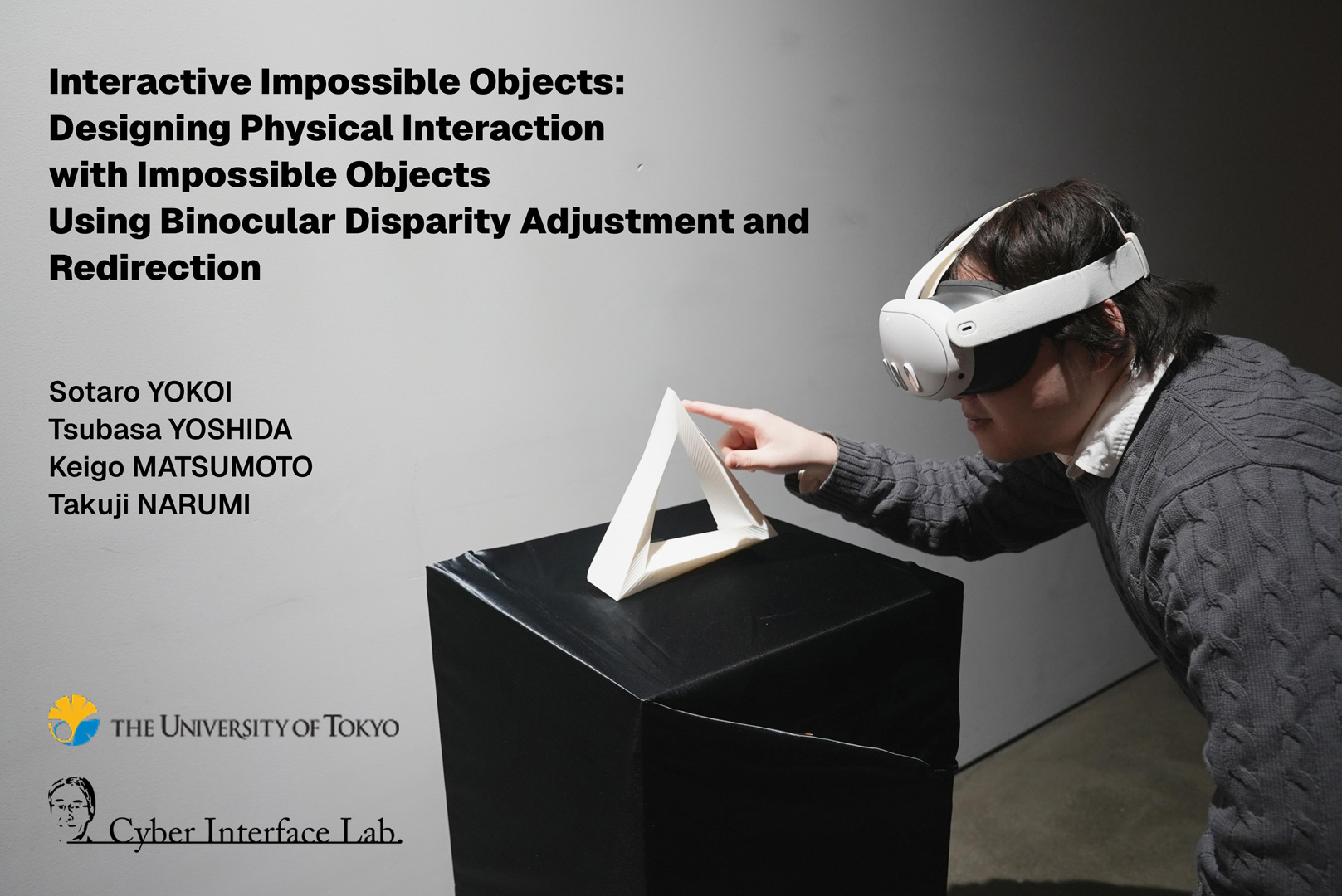
Impossible objects are optical illusions that appear structurally coherent in two-dimensional illustrations but cannot exist in conventional Euclidean space. Although widely admired for their paradoxical geometry, these objects have remained largely confined to flat images or single-viewpoint 3D renderings. We introduce Interactive Impossible Objects, a Virtual Reality (VR) framework that enables users to physically walk on and touch these paradoxical forms while maintaining the illusion of structural continuity. Our system addresses two significant challenges: preserving the illusion under binocular disparity and providing convincing haptic feedback. For the first challenge, we render separate 3D models for each eye, ensuring that each viewpoint perceives an impossible shape without visual contradictions. This technique allows both eyes to observe a seamless illusion, even when the user changes position. To tackle the second challenge, we employ redirected walking and hand redirection, carefully mapping limited physical steps and surfaces onto warped or discontinuous virtual geometries. Through these methods, users can ascend an “endless” staircase or reach out to feel a Penrose triangle, all while experiencing a coherent, unified environment. By transforming classic impossible objects into fully interactive and tangible installations, our work merges artistic expression with embodied user experiences. These interventions open up new avenues for immersive art, entertainment, and perceptual research, inviting users to explore—and question—the boundaries of spatial reality.
References:
[1] Vlad Alexeev. 2024. Impossible World: Impossible Figures. https://im-possible.info/english/index.html Accessed: 2024-09-17.
[2] Mahdi Azmandian, Mark Hancock, Hrvoje Benko, Eyal Ofek, and Andrew D. Wilson. 2016. Haptic Retargeting: Dynamic Repurposing of Passive Haptics for Enhanced Virtual Reality Experiences. In Proceedings of the 2016 CHI Conference on Human Factors in Computing Systems (San Jose, California, USA) (CHI ’16). Association for Computing Machinery, New York, NY, USA, 1968–1979. https://doi.org/10.1145/2858036.2858226
[3] Zenon Kulpa. 1983. Are impossible figures possible?Signal Processing 5, 3 (1983), 201–220. https://doi.org/10.1016/0165-1684(83)90069-5
[4] Ryohei Nagao, Keigo Matsumoto, Takuji Narumi, Tomohiro Tanikawa, and Michitaka Hirose. 2018. Ascending and descending in virtual reality: Simple and safe system using passive haptics. IEEE transactions on visualization and computer graphics 24, 4 (2018), 1584–1593.
[5] Kokichi Sugihara. 2008. Computer-Aided Creation of Impossible Objects and Impossible Motions. In Computational Geometry and Graph Theory, Hiro Ito, Mikio Kano, Naoki Katoh, and Yushi Uno (Eds.). Springer Berlin Heidelberg, Berlin, Heidelberg, 201–212.



