“HandsIn3D: Augmenting the Shared 3D Visual Space with Unmediated Hand Gestures” by Huang, Alem and Tecchia
Conference:
Experience Type(s):
Title:
- HandsIn3D: Augmenting the Shared 3D Visual Space with Unmediated Hand Gestures
Organizer(s)/Presenter(s):
Description:
Nowadays technologies used in equipment and machinery are becoming increasingly complex and ubiquitous. The technical complexities of the equipment often require specialized knowledge and expertise to operate and maintain. However, experts who have the required knowledge and expertise are not always locally available. When a machine breaks down, there is a need to arrange and fly an expert in and out to have the machine fixed, which can be time-consuming and is not cost effective. It is often seen that the lack of adequate skill sets and the cost of bringing an expert onsite translate to the loss in productivity [Alem et al. 2011]. Therefore, there is a high demand in industries for technologies that support remote collaboration in which a remote helper guides a local worker performing tasks on physical objects. With such technologies, the expert would no longer need to be flown onsite and is able to, for example, fix a machine remotely with assistance from a local technician.
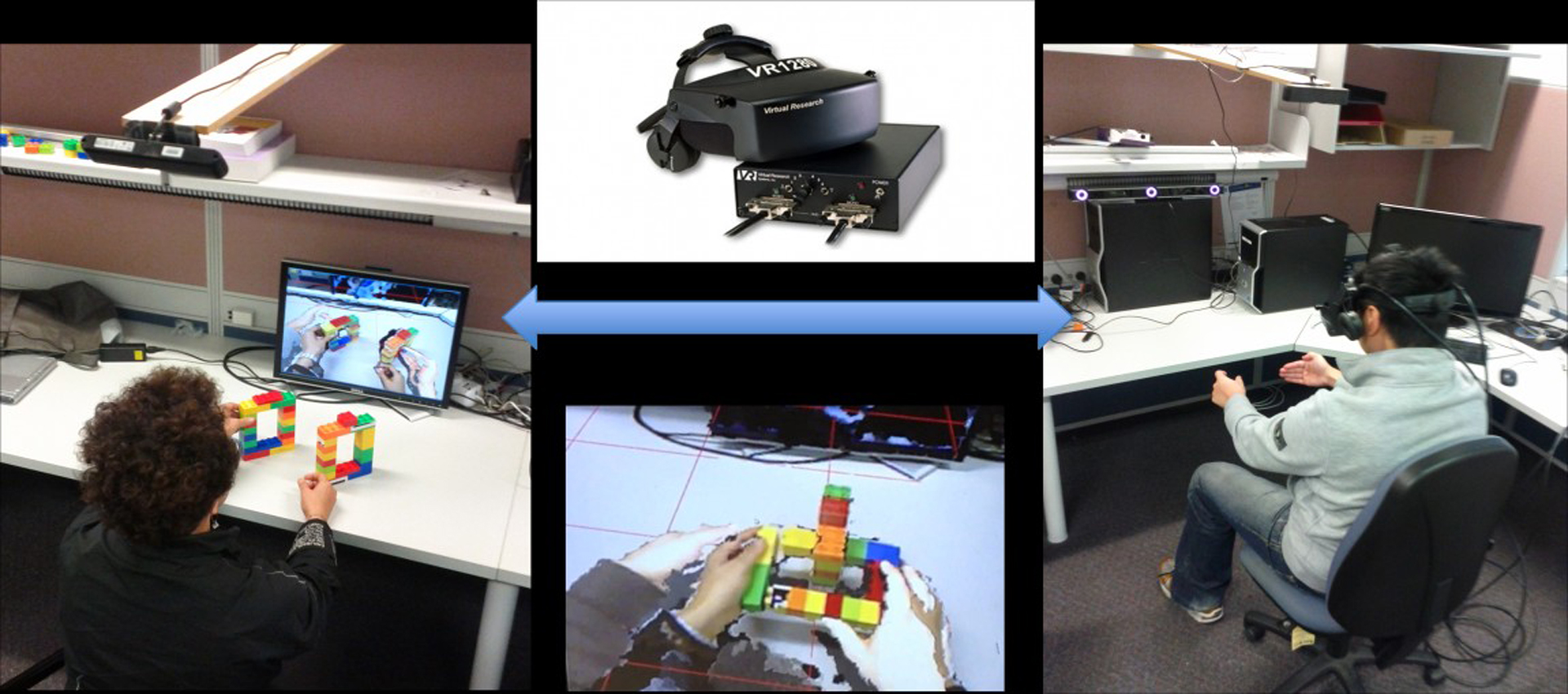
A collaboration scenario involving a remote helper guiding in real time a local worker in performing a task on physical objects is common in a wide range of industries including health, mining and manufacturing. An established ICT approach to supporting this type of collaboration is to provide a shared visual space and some form of remote gesture. The shared space and remote gesture are generally presented in a 2D video form. Recent research in tele-presence has indicated that technologies that support co-presence and immersion not only improve the process of collaboration but also improve spatial awareness of the remote participant. We therefore propose a novel approach to developing a 3D system based on a 3D shared space and 3D hand gestures. A proof of concept system for remote guidance called HandsIn3D has been developed. This system uses a head tracked stereoscopic HMD that allows the helper to be immersed in the virtual 3D space of the worker’s workspace. The system captures in 3D the hands of the helper and fuses the hands into the shared workspace. A user study has been conducted showing that the proposed 3D immersive interface is helpful for improving perception of spatial relation of helpers and sense of co-presence and that the system is generally useful and usable, particularly more so for complex tasks.
The unique feature of HandsIn3D is the integration of the projection of the helper’s hands into the 3D workspace of the worker. These hands and gesture projections provide rich, non-verbal communication which creates a sense of “working together of a helper and a worker side by side”. In reality, the helper and the worker can be separated by long distances.
References:
[1] Alem, L., Tecchia, F. and Huang, W. (2011) HandsOnVideo: Towards a gesture based mobile AR system for remote collaboration. In Recent Trends of Mobile Collaborative Augmented Reality. 127–138.
[2] Fussell, S. R., Setlock, L. D., Yang, J., Ou, J., Mauer, E. and Kramer, A. D. I. (2004) Gestures over video streams to support remote collaboration on physical tasks. Human-Computer Interaction, 19: 273–309.
[3] Huang, W. and Alem, L. (2011) Supporting Hand Gestures in Mobile Remote Collaboration: A Usability Evaluation. In Proceedings of the 25th BCS Conference on Human Computer Interaction. 211–216.
[4] Huang, W. and Alem, L. (2013a) HandsinAir: a wearable system for remote collaboration on physical tasks. In Proceedings of the 2013 conference on Computer supported cooperative work companion. 153–156.
[5] Huang, W. and Alem, L. (2013b) Gesturing in the Air: Supporting Full Mobility in Remote Collaboration on Physical Tasks. Journal of Universal Computer Science.
[6] Kraut, R. E., Gergle, D. and Fussell, S. R. (2002) The Use of Visual Information in Shared Visual Spaces: Informing the Development of Virtual Co-Presence. In CSCW’02, 31–40.
[7] Mortensen, J., Vinayagamoorthy, V., Slater, M., Steed, A., Lok, B. and Whitton, M. C. (2002) Collaboration in tele-immersive environments. In EGVE’02, 93–101.
[8] Schuchardt, P. and Bowman, D. A. (2007) The benefits of immersion for spatial understanding of complex underground cave systems. In VRST’07, 121–124.
[9] Tecchia, F., Alem, L. and Huang, W. (2012) 3D helping hands: a gesture based MR system for remote collaboration. In Proceedings of the 11th ACM SIGGRAPH International Conference on Virtual-Reality Continuum and its Applications in Industry. 323–328.
[10] Huang, W., Alem, L. and Tecchia, F. (2013) HandsIn3D: Supporting Remote Guidance with Immersive Virtual Environments. Human-Computer Interaction – INTERACT 2013. Lecture Notes in Computer Science Volume 8117, 70–77.