“DreamPrinting: Volumetric Printing Primitives for High-Fidelity 3D Printing” by Wang, Cao, Xu, Liu, Zhang, et al. …
Conference:
Experience Type(s):
Title:
- DreamPrinting: Volumetric Printing Primitives for High-Fidelity 3D Printing
Organizer(s)/Presenter(s):
Interest Areas(s):
- Art / Design
- New Technologies
- Production & Animation
- Research / Education
Description:
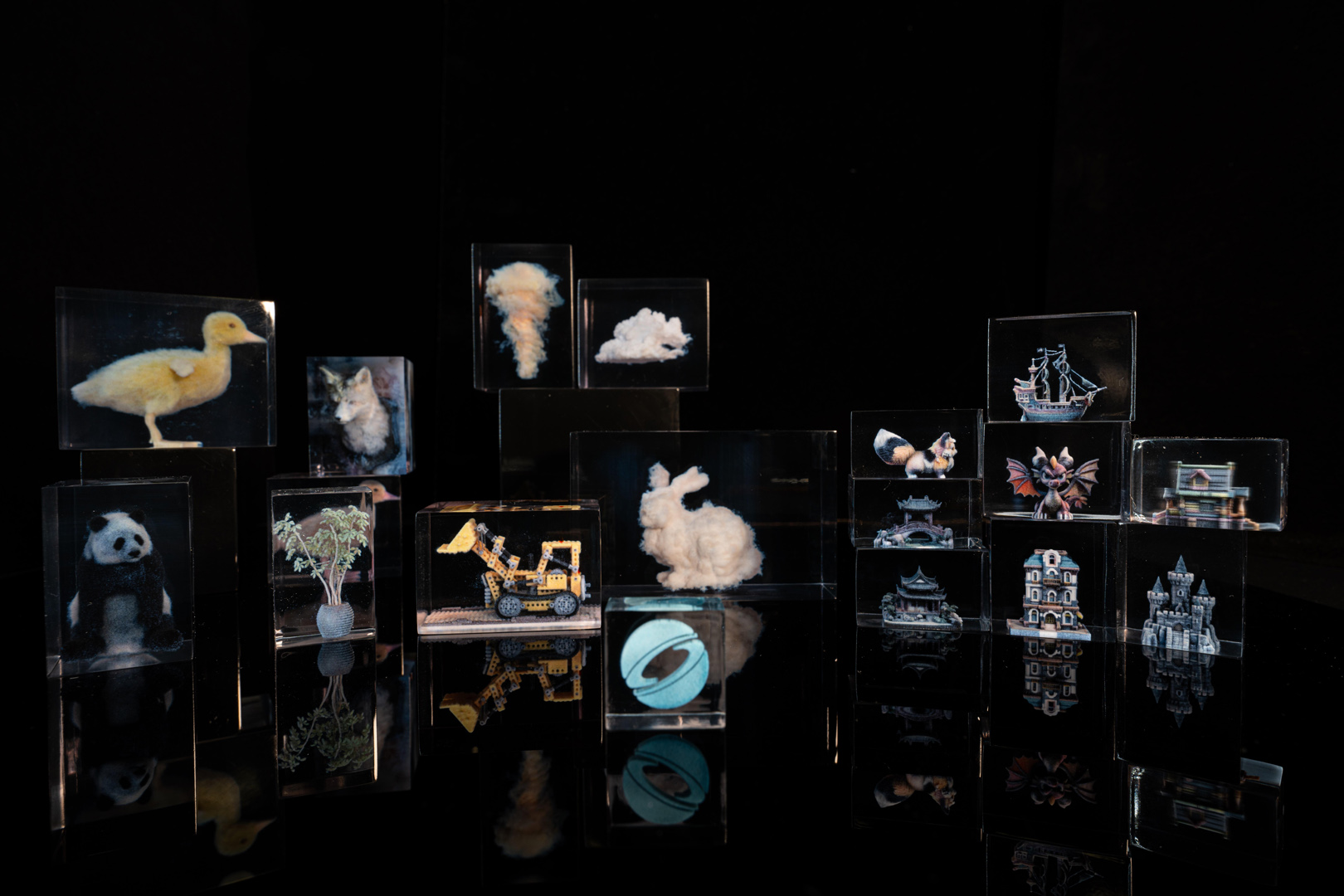
Translating the rich visual fidelity of volumetric rendering techniques into physically realizable 3D prints remains an open challenge. DreamPrinting tackles this by transforming radiance-based volumetric representations (such as NeRF) into explicit, material-centric Volumetric Printing Primitives (VPPs) suitable for real-world fabrication. While rendering primitives excel at capturing intricate geometry and appearance, they often lack the pigment and material-density constraints essential for 3D printing. DreamPrinting bridges this gap with an integrated Kubelka-Munk model and spectrophotometric calibration workflow that determines optimal pigment mixtures for reproducing vibrant color and translucency. A continuous-to-discrete mapping ensures each voxel accurately reflects both geometry and optical properties, while a 3D stochastic halftoning procedure refines these pigment concentrations into printable labels. During the Emerging Technologies demonstration, participants will see side-by-side comparisons of physical prints and their digital counterparts, revealing complex details like translucent fur, leaves, and clouds. They will also view a concise overview of DreamPrinting’s pipeline, from calibration to slicing, showcasing how color fidelity and internal consistency are achieved. Attendees are invited to handle physical prints, examining their internal opacity gradients and color transitions under diverse lighting. By surpassing traditional surface-based 3D printing in managing translucency and fine detail, DreamPrinting highlights new frontiers in computational fabrication for artists, researchers, and engineers. Seamlessly integrating with cutting-edge 3D generation techniques, it expands creative possibilities for complex, high-quality volumetric prints that closely mirror their digital origins, fueling novel applications in design, visualization, and interactive media.
References:
[1] Alfie Abdul-Rahman and Min Chen. 2005. Spectral volume rendering based on the kubelka-munk theory. In Computer Graphics Forum, Vol. 24. Citeseer, 413–422.
[2] Ruixiang Cao, Satoshi Yagi, Satoshi Yamamori, and Jun Morimoto. 2025. Poxel: Voxel Reconstruction for 3D Printing. arxiv:https://arXiv.org/abs/2501.10474 [cs.GR] https://arxiv.org/abs/2501.10474
[3] Šárka Sochorová and Ondřej Jamriška. 2021. Practical pigment mixing for digital painting. ACM Transactions on Graphics (TOG) 40, 6 (2021), 1–11.
[4] Stratasys. 2025. J850 Prime 3D Printer. https://www.stratasys.com/en/3d-printers/printer-catalog/polyjet/j8-series-printers/j850-prime-3d-printer/ Accessed: 2025-01-23.
[5] Jianfeng Xiang, Zelong Lv, Sicheng Xu, Yu Deng, Ruicheng Wang, Bowen Zhang, Dong Chen, Xin Tong, and Jiaolong Yang. 2024. Structured 3D Latents for Scalable and Versatile 3D Generation. arXiv preprint arXiv:https://arXiv.org/abs/2412.01506 (2024).