“Comix: Beyond: Evoking Multiple Emotions Using Pseudo Body Responses Depending on the Context” by Sakurai, Katsumura, Narumi, Tanikawa and Hirose
Conference:
Experience Type(s):
Title:
- Comix: Beyond: Evoking Multiple Emotions Using Pseudo Body Responses Depending on the Context
Organizer(s)/Presenter(s):
Description:
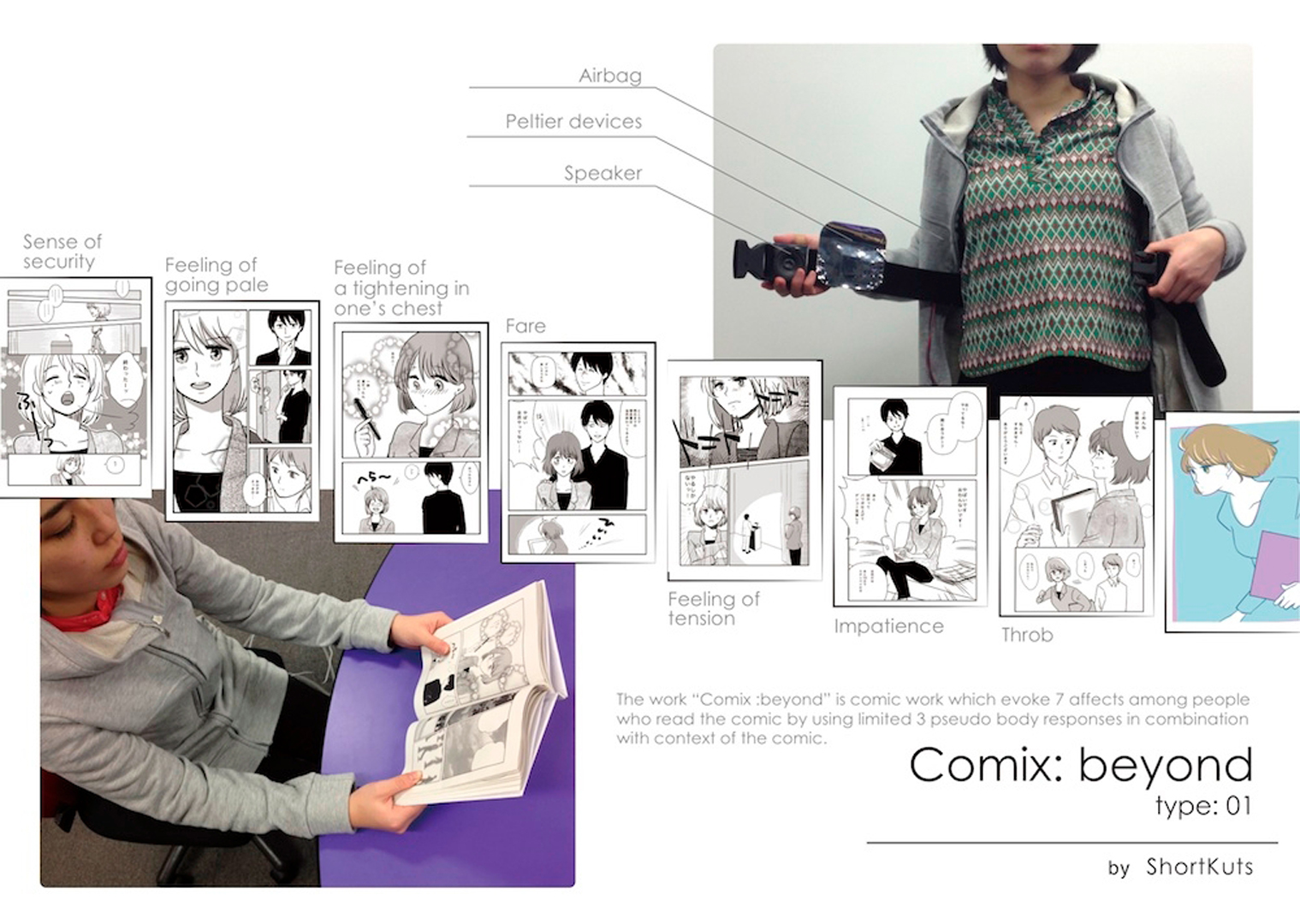
This study aims to evoke multiple emotions by presenting combinations of sensory stimulus based on the contexts in contents such as a comic as if the user feels those as their own real bodily responses.
The goal of this study is evoking multiple emotions by presenting combinations of sensory stimulus based on the contexts in contents such as a comic as if the user feels those as their own real bodily responses.
Recent psychology researchers have argued that physiological changes occur prior to an emotion, and some sort of emotion evokes through recognizing not only change in real body reactions but also feedback of stimuli that resemble the change in somebody reactions. On the other hand, different emotions may be evoked according to the way we interpret our own environments, even when similar circumstances and bodily responses arise.
Based on the knowledge, we hypothesize that providing a variety of pseudo-physiological responses with contexts can be evoked a greater number of emotions as intended than the number of pseudo-physiological responses used. We made a system named “Comix: beyond” to test our hypothesis. In this study, we focused on the relationship among heartbeat, vital warmth, chest pressure and seven emotions: throb, tense feeling, fear, feeling of a heartache, the feeling of going pale and sense of security. Since especially we speculate that contexts have an important role in evoking and enhancing the specific emotion with combinations of pseudo-bodily, we decided to use a comic whose story provides various contexts. The feedback of some people who used the work suggests a possibility that the work realizes our approach to evoke multiple emotions.
Our approach will be applied to not only comic but also other entertainment media, such as the movies and the games. It realizes novel media to provide more synchronized emotions with the one of the characters in the comic to a consumer, and lets people be more absorbed in the story. This also fertilizes interactive contents that work upon human emotion for entertainment.
References:
[1] James, S. The principles of psychology. New York, Dover Publications. Vol. 2. 1950.
[2] Valins, S. Cognitive Effects of False Heart-Rate Feedback. J. of Pers. Soc. Psychol., vol. 4, no. 4, pp. 400–408. 1966.
[3] Nishimura, S., Ishii, A., Sato, M., Fukushima, S. and Kajimoto, H. Facilitation of Affection by Tactile Feedback of False Heartbeat. In proc. of CHI EA’ 12. pp. 2321–2326. 2012.
[4] Fukushima, Sand Kajimoto. H. Chilly Chair: Facilitating an Emotional Feeling with Artificial Piloerection. In Proc. of SIGGRAPH’12, Article no. 5. 2012.
[5] Yoshida, S., Sakurai, S., Narumi, T., Tanikawa, T. and Hirose, M., Manipulation of an Emotional Experience by Real-time Deformed Facial Feedback. In Proceedings of Augmented Human. pp. 35–42. 2013.
[6] Tear machine: http://www.weststarland.com/wp/2011/04/tearmachine-tearful-reflection/(Last accessed in June 12, 2013)
[7] Dutton, D. et al. Some evidence for heightened sexual attraction under conditions of high anxiety. J. of Pers. Soc. Psychol., vol. 30, no. 4, pp. 510–517. 1974.
[8] Schachter, S. and Singer. J. Cognitive, social and physiological determinants of emotional state. Psychological. Review, Vol. 69, No. 5, pp. 379–399, 1962.
[9] Casioppo, J. T., Tassinary, L. G. and Berntson, G. G. (Eds.): Handbook of psychology. 2nd Ed. Cambridge University Press: New York, 2000.
[10] Narumi, T., Seong, Y. A., Akagawa, T. and Michitaka, H. An Entertainment System using Thermal Feedback for Increasing Communication and Social Skills, The 4th International Conference on E-Learning and Games, pp. 184–195, 2009.
[11] McCloud, S., 1990. Understanding Comics. The invisible Art. Harper. Paperbacks.