“Cathex” by D’hanens, Özbilge and Özbilge
Conference:
Experience Type(s):
Title:
- Cathex
Presenter(s):
Description:
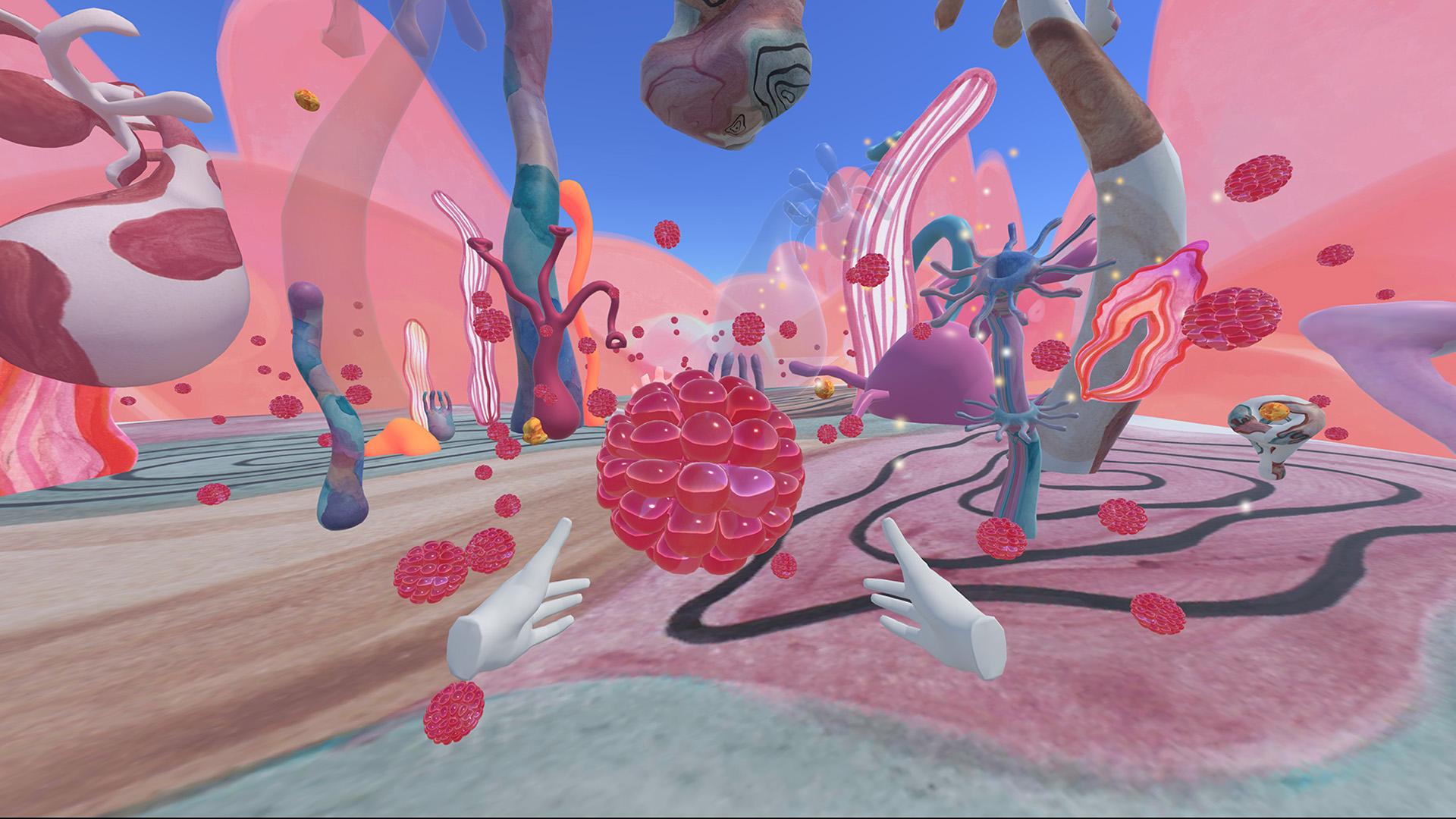
Cathex is an immersive VR experience that unfolds like a virtual poem. It guides players on a cathartic journey, blending art, philosophy, and science into a deeply introspective narrative. Inspired by the philosophies of Mary Whiton Calkins, particularly her concept of the Universe as the Absolute Self, along with Panpsychism, the experience explores the idea that every perception contributes to a singular, universal consciousness. Set in a womb-like subconscious space, players embark on a quest to rediscover a long-buried memory of origin. To unlock this memory, they engage in emotion-regulatory movements that release repressed feelings, dissolving emotional vessels known as cathexes. These actions, informed by scientific research, are designed to stimulate specific responses: upward movements create sensations of joy, while lowered or sharp motions provoke sadness or anger. With each cathartic release, the storyline evolves, bringing players closer to self-realization. In the climactic conclusion, the final cathex is drawn from within the player’s own body, revealing the profound truth that the memory they sought lies deep within themselves. It is the realization that we are all intrinsically connected to the universe, a shared oneness that transcends individuality. This experience is also a tribute to Calkins’ belief that the self is defined by perception, suggesting that the universe is composed of the perceptions of all beings. Drawing parallels to spiritual traditions like Sufism and Paganism, Cathex asks: if reality is what we perceive, does the virtual world also become part of our consciousness? And what does this imply about our connection to a universal consciousness beyond the physical world? As an homage to Calkins, who was denied her PhD title due to her gender, and to support diversity in the technological industry, Cathex has been created by a non-binary and female team of creatives.
References:
[1] Brett Adams and Margaret Stack. 2018. Cathexis. In Encyclopedia of Personality and Individual Differences, edited by V. Zeigler-Hill and T. Shackelford. Springer.
Crossref
[2] Konstantina Kilteni, Raphaela Groten, and Mel Slater. 2012. The sense of embodiment in virtual reality. Presence: Teleoperators and Virtual Environments 21, 4 (2012), 373–387.
[3] Dana Noelle McDonald. 2003. Achieving unity through uniqueness: Mary Whiton Calkins’s proof of immortality. Transactions of the Charles S. Peirce Society 39, 1 (2003), 113–125. http://www.jstor.org/stable/40321060
[4] Irene Messina and Marco Sambin. 2015. Berne’s theory of cathexis and its links to modern neuroscience. Transactional Analysis Journal 45, 1 (2015), 1–11.
[5] Michael P. Nichols and Jay S. Efran. 1985. Catharsis in psychotherapy: A new perspective. Psychotherapy: Theory, Research, Practice, Training 22, 1 (1985), 46–58.
[6] Tal Shafir, Rachelle P. Tsachor, and Kathleen B. Welch. 2016. Emotion regulation through movement: Unique sets of movement characteristics are associated with and enhance basic emotions. Frontiers in Psychology 7 (2016), Article 2030.
[7] Katie Salen and Eric Zimmerman. 2004. Rules of play: Game design fundamentals. MIT Press.
[8] Rong Fang. 2025. Exploring the role of virtual reality in transforming the environmental art experience. International Journal of e-Collaboration 21, 1 (2025), 1–15.