
“Bridging Physical and Virtual Realms in Mixed Reality: The Co-Presence Experience in LIAN: Re:Vision” by Carstensdottir, Cai and Xie
Conference:
Experience Type(s):
Title:
- Bridging Physical and Virtual Realms in Mixed Reality: The Co-Presence Experience in LIAN: Re:Vision
Presenter(s):
Description:
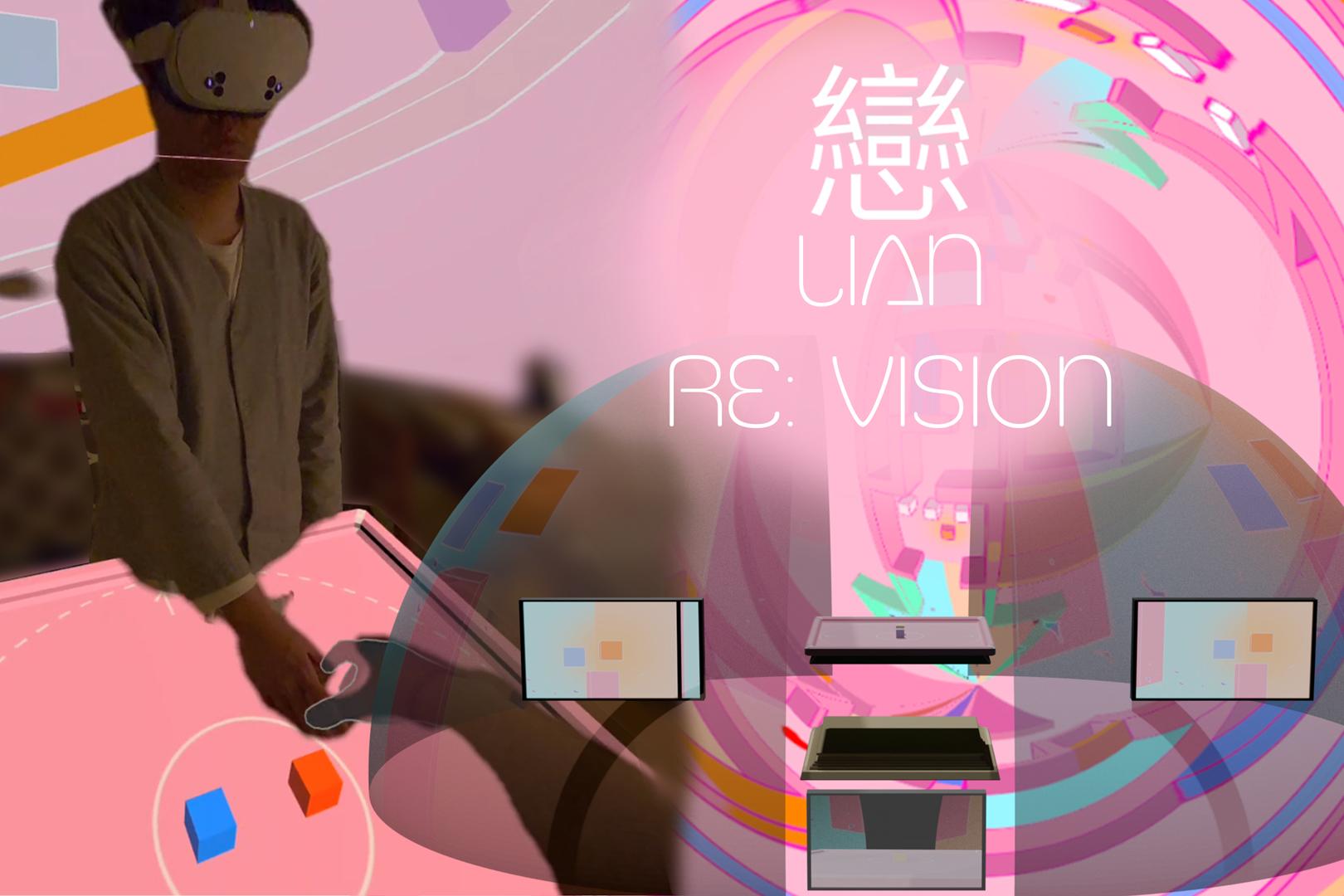
LIAN: Re:Vision is a Mixed Reality installation exploring love, longing, and distance through a co-located, two-player experience. Inspired by the Chinese character LIAN, symbolizing love and yearning, the installation immerses players in a narrative-driven journey where the essential rule is stay close to each other’s avatars as much as possible. Utilizing pass-through and occlusion features of the Meta Quest 3, LIAN: Re:Vision enhances co-presence and performance in shared virtual spaces. A network-synchronized virtual cube system, manipulated through hand gestures or Quest Touch controllers, offers an intuitive, collaborative gameplay experience while integrating performance art into the HMD control scheme. Dome screens with orbital lens distortion effects provide an alternative narrative-driven visual method without user discomfort. The installation also incorporates external displays that bridge the gap between participants in virtual and reality spaces, enriching audience engagement through a dramaturgical approach. By blending interactive performance, immersive storytelling, and co-located gameplay, LIAN: Re:Vision introduces new methodologies for designing social engagement in Mixed Reality.
References:
[1] Walter Benjamin. 2018. The work of art in the age of mechanical reproduction. In A museum studies approach to heritage. Routledge, 226–243.
[2] Ian Bogost. 2010. Persuasive games: The expressive power of videogames. mit Press.
[3] Christie Carson. 1997. Drama and theatre studies in the multimedia age:’Reviewing the situation’. Literary and linguistic computing 12, 4 (1997), 269–275.
[4] Steve Dixon. 2015. Digital performance: a history of new media in theater, dance, performance art, and installation. MIT press.
[5] Erving Goffman. 2008. Behavior in public places. Simon and Schuster.
[6] Katherine Isbister. 2016. How games move us: Emotion by design. Mit Press.
[7] Nadja Masura. 2020. Digital Theatre. Springer.
[8] Florian Floyd Mueller, Zhuying Li, Richard Byrne, Yash Dhanpal Mehta, Peter Arnold, and Tuomas Kari. 2019. A 2nd person social perspective on bodily play. In Proceedings of the 2019 CHI Conference on Human Factors in Computing Systems. 1–14.
[9] Rina R Wehbe, Terence Dickson, Anastasia Kuzminykh, Lennart E Nacke, and Edward Lank. 2020. Personal space in play: Physical and digital boundaries in large-display cooperative and competitive games. In Proceedings of the 2020 CHI Conference on Human Factors in Computing Systems. 1–14.
ACM Digital Library Publication:
- Bridging Physical and Virtual Realms in Mixed Reality: The Co-Presence Experience in LIAN: Re:Vision



