
“ARAtouch: Visuo-Haptic Interaction with Mobile Rear Touch Interface” by Kokubun, Ban, Narumi, Tanikawa and Hirose
Conference:
Experience Type(s):
Title:
- ARAtouch: Visuo-Haptic Interaction with Mobile Rear Touch Interface
Organizer(s)/Presenter(s):
Description:
“ARAtouch” is a visuo-haptic system that is able to evoke haptic sensations on a mobile device via only haptic illusions, without the use of a haptic interface.
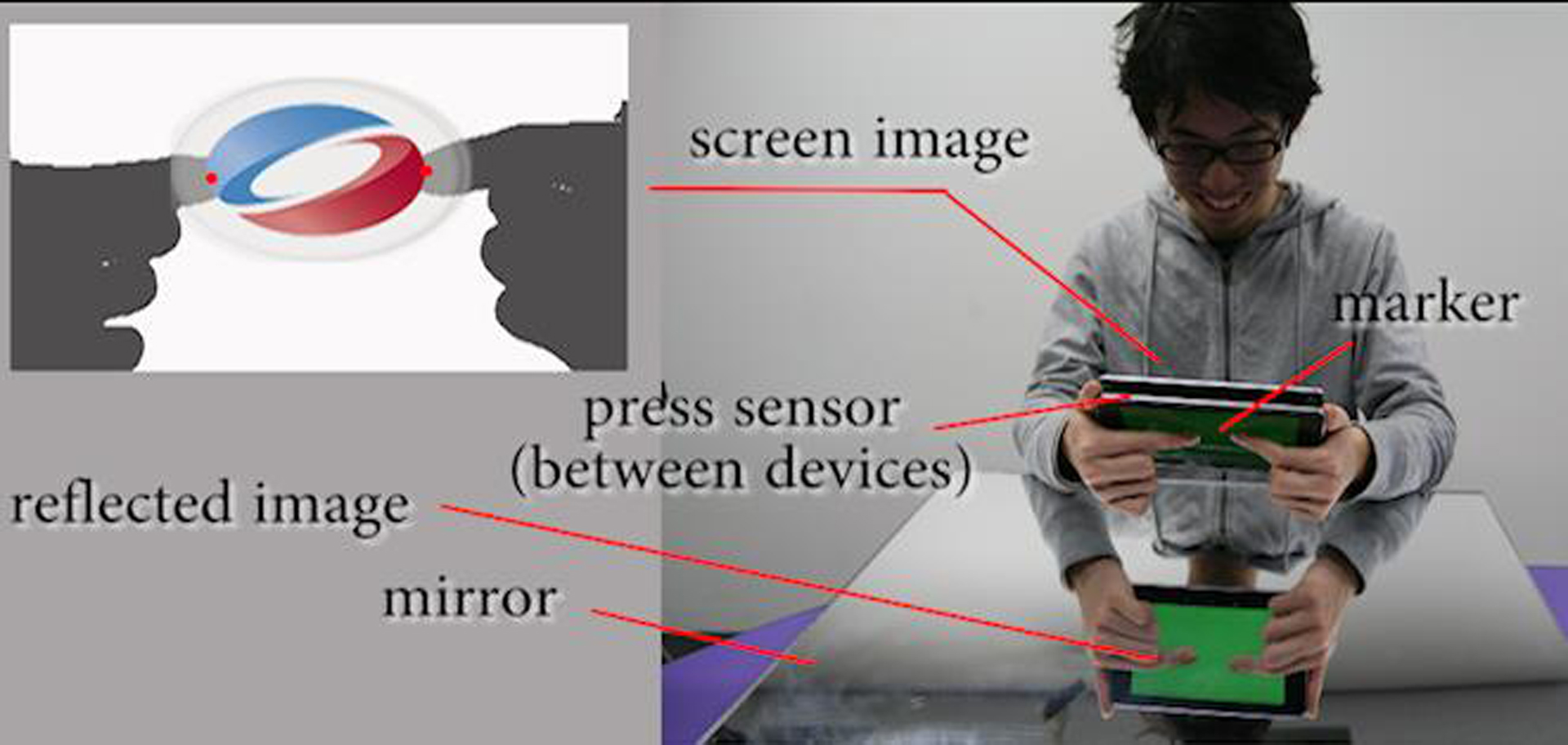
“ARAtouch” is a visuo-haptic system which is able to evoke the haptic sensation on the mobile device, without any haptic devices, only using haptic illusion. Touch panel is a compelling input modality for interactive devices. However, touch input is inaccurate due to occlusion by a user’s finger. To solve this problem, the rear touch interface is actively researched and commercialized. Meanwhile, there are increasing numbers of works which focus on passive haptics, which include pseudo-haptics. Pseudo-haptics is a kind of cross modal effect between our visual and haptic sense, which indicates an illusional perception in our haptic sensation evoked by vision. To provoke the pseudo haptic effect, it is need to hide a user’s hand or put it other place. So it is impossible to provoke pseudo-haptic effect, for the normal type of touch panel which we contact directly. Meanwhile, with the rear touch interface, we are able to evoke pseudo-haptic effects because users’ hand are hidden behind the screen. To realize a rear touch interface, we combine two mobile tablet back to back. As well, pressure sensors were attached between these two devices to measure the pressure users push. A mirror was set in front of users and a back side device capture a hand image reflected with it with its front camera. To evoke effective haptic illusion, deformed hand shadow composed from captured image is shown in the screen as an alternative to a computer mouse cursor, and the system deforms virtual objects and resize the marker which shows the touching point as to the pressure which was measured by a pressure sensor attached between devices. These methods are critically useful for inducing haptic feedback of the tangential and normal force on the small mobile device for the useful GUI or games.
References:
[1] P. Baudisch and G. Chu. Back-of-device interaction allows creating very small touch devices. In Proceedings of the 27th international conference on Human factors in computing systems, pp. 1923–1932. ACM, 2009.
[2] Wigdor, S et al.: Lucid touch: a see-through mobile device, the 20th ACM UIST, pp. 269–278, 2007
[3] A. Lecuyer: Simulating Haptic Feedback Using Vision: a Survey of Research and Applications of Pseudo-Haptic Feedback, Presence: Teleoperators and Virtual Environments, MIT Press, Volume 8, Issue l, pp. 39–53, 2009.
[4] L. Moody, A. et al. Beyond the visuals: tactile augmentation and sensory enhancement in an arthroscopy simulator. Virtual reality, Vol. 13, No. 1, pp. 59–68, 2009.
[5] Y. Ban et al.: Modifying an Identified Size of Objects Handled with Two Fingers Using Pseudo-Hapitc Effects, JVRC2012, pp. 1–8, 2012



