“Multi‑Layered Autonomy and AI Ecologies in Robotic Art Installations” by Chen, Xu and Qu
Conference:
Type(s):
Title:
- Multi‑Layered Autonomy and AI Ecologies in Robotic Art Installations
Session/Category Title:
- Agency and Performance
Presenter(s)/Author(s):
Moderator(s):
Abstract:
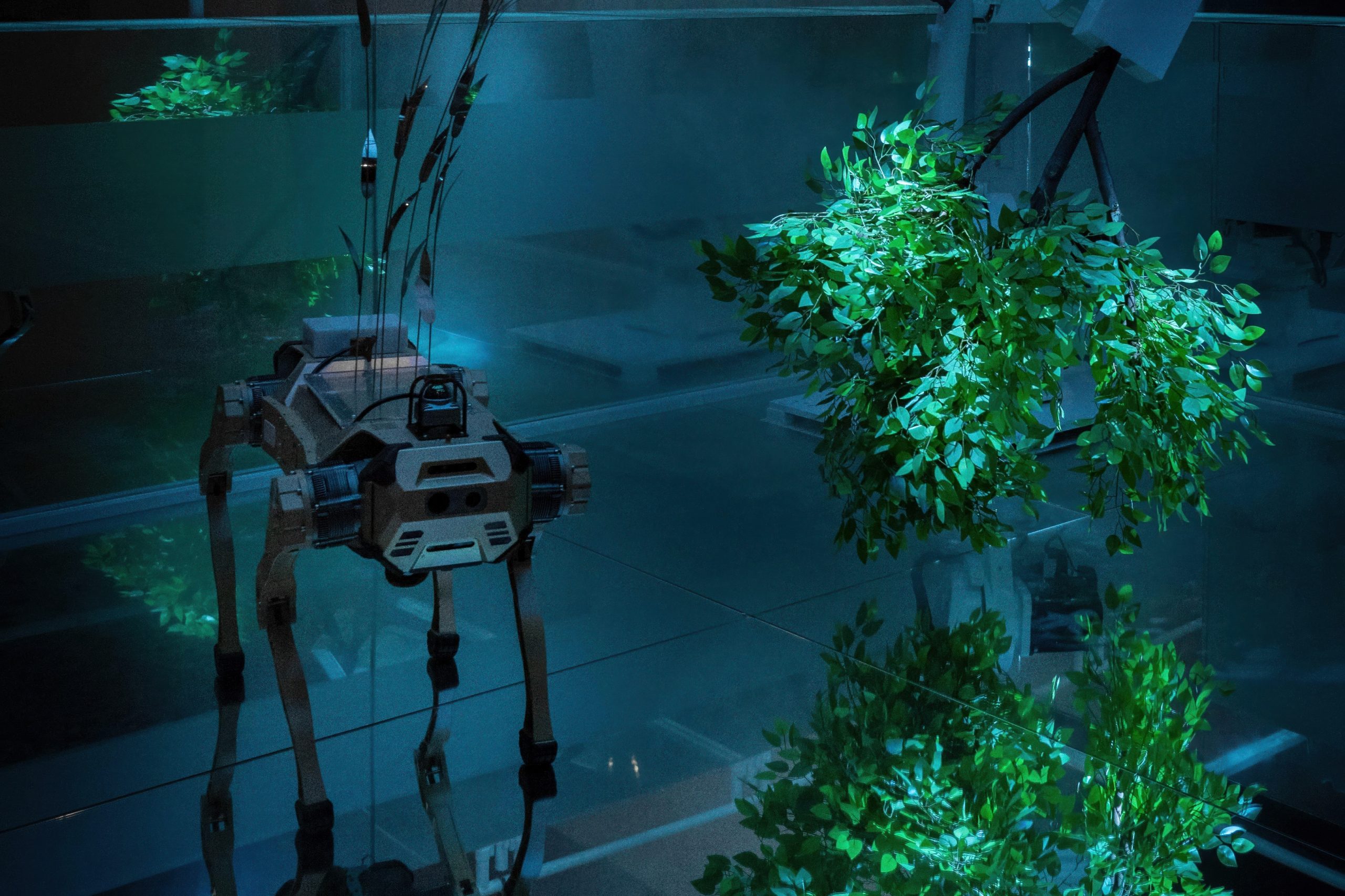
This paper presents Symbiosis of Agents is a large-scale installation integrating AI-driven robotic agents within an immersive, reflective environment, foregrounding the delicate balance between machine agency and artist authorship by harnessing emergent behaviors from self-organized AI robotic ecologies as a creative apparatus. This project draws upon the traditions of early cybernetics, rule-based conceptual art, and pioneering robotic art installations, featuring dynamic interactions among robotic arms, quadruped robots, their environment, and the audience. A sophisticated three-tiered “faith system” guides these agents, manifesting at the micro-level through adaptive strategies, at the mesoscopic level via narrative-driven “drives,” and at the macro level with an overarching directive. This architecture enables organic evolution of the robots’ behaviors in response to environmental cues and subtle audience presence, transforming passive spectators into active participants. This project situates itself within a speculative terraforming scenario, against the backdrop of historical and ethical analogies—particularly the exploitation of marginalized laborers—the installation raises critical questions about responsibility in AI-driven societies. Through carefully orchestrated robotic choreography, AI-generated conceptual scripts, and atmospheric effects like responsive lighting and fog, Symbiosis of Agents situates AI not merely as computational tool but as collaborator in a dynamic, evolving creative process. Exhibited internationally, it exemplifies how cybernetic principles, robotic art experimentation, and conceptual-art rule-making can converge, challenging prevailing notions of agency and authorship. By interrogating ethical considerations and exposing emergent storytelling, the work expands possibilities for human–machine collaboration in the ever-evolving domain of contemporary art.
References:
[1] Bidgoli, A., De Guevara, M. L., Hsiung, C., Oh, J., & Kang, E. (2020, Aug.). Artistic style in robotic painting: A machine‑learning approach to learning brushstroke from human artists. In 2020 29th IEEE International Conference on Robot and Human Interactive Communication (RO‑MAN) (pp. 412–418). IEEE.
[2] Benford, S., Garrett, R., Schneiders, R. E., Tennent, P., Chamberlain, A., Martinez, A., Brundell, P., & Castle‑Green, S. (2024). How artists improvise and provoke robotics. arXiv, 2410.22462.
[3] Goldberg, K., Santarromana, J., Bekey, G., et al. (1995). The Telegarden: A telerobotic garden on the Internet.
[4] Herath, D., & Kroos, C. (2016). Engineering the arts. In D. Herath, C. Kroos, & Stelarc (Eds.), Robots and Art (pp. 1–22). Springer.
[5] Jeon, M. (2017). Robotic arts: Current practices, potentials, and implications. Multimodal Technologies and Interaction, 1(2), 5.
[6] Kac, E. (2001). The origin and development of robotic art. Convergence, 7(1), 76–86.
[7] Kumaran, V., Rowe, J., & Lester, J. (2024). NarrativeGenie: Generating narrative beats and dynamic storytelling with large language models. In Proceedings of the AAAI Conference on Artificial Intelligence and Interactive Digital Entertainment, 20(1), 76–86.
[8] Méndez, G., Hervás, R., Gervás, P., Criado, A., Martín, M., & Julca, F. (2019). Dynamic emphatical narration for reduced authorial burden and increased user freedom in interactive storytelling. Connection Science, 31(1), 33–59.
[9] Petrović, D., Kićinbaći, L., Petric, F., & Kovačić, Z. (2019). Autonomous robots as actors in robotics theatre—Tribute to the centenary of R.U.R. In 2019 European Conference on Mobile Robots (ECMR) (pp. 1–7). IEEE.
[10] Pask, G. (1968). A comment, a case history, and a plan. In J. Reichardt (Ed.), Cybernetic Serendipity (pp. 76–99). Studio International.
[11] Penny, S. (2013). Art and robotics: Sixty years of situated machines. AI & Society, 28(2), 147–156.
[12] Qin, Y., Li, Y., & Cheon, E. (2025). Encountering robotic art: The social, material, and temporal processes of creation with machines. In Proceedings of the ACM CHI Conference on Human Factors in Computing Systems (CHI ’25).
[13] Sandoval, E. B., Sosa, R., Cappuccio, M., & Bednarz, T. (2022). Human–robot creative interactions: Exploring creativity in artificial agents using a storytelling game. Frontiers in Robotics and AI, 9.
[14] Simecek, K. (2024). Immersive theatre, affectivity and self‑understanding. In Philosophy, analytic aesthetics, and theater (1st ed., p. 13). Routledge.
[15] Tresset, P., & Leymarie, F. F. (2013). Portrait drawing by Paul the robot. Computers & Graphics, 37(5), 348–363.
[16] Vass, L., Cloutier, R., & Sylvia, N. (2021). Environments (out) of control: Notes on architecture’s cybernetic entanglements. Footprint, 15, 81–98.
[17] X‑Space Winke (Stocker, G., Hörtner, H., et al.). (1993). Winke Winke: Interactive robotic installation. Graz, Austria.