
“Learning to Move, Learning to Play, Learning to Animate: a Multimedia Exploration of the More-than-human Intelligence” by Cheng, Sun, Zhang and Gu
Conference:
Type(s):
Title:
- Learning to Move, Learning to Play, Learning to Animate: a Multimedia Exploration of the More-than-human Intelligence
Session/Category Title:
- The Nature of Reality
Presenter(s)/Author(s):
Moderator(s):
Abstract:
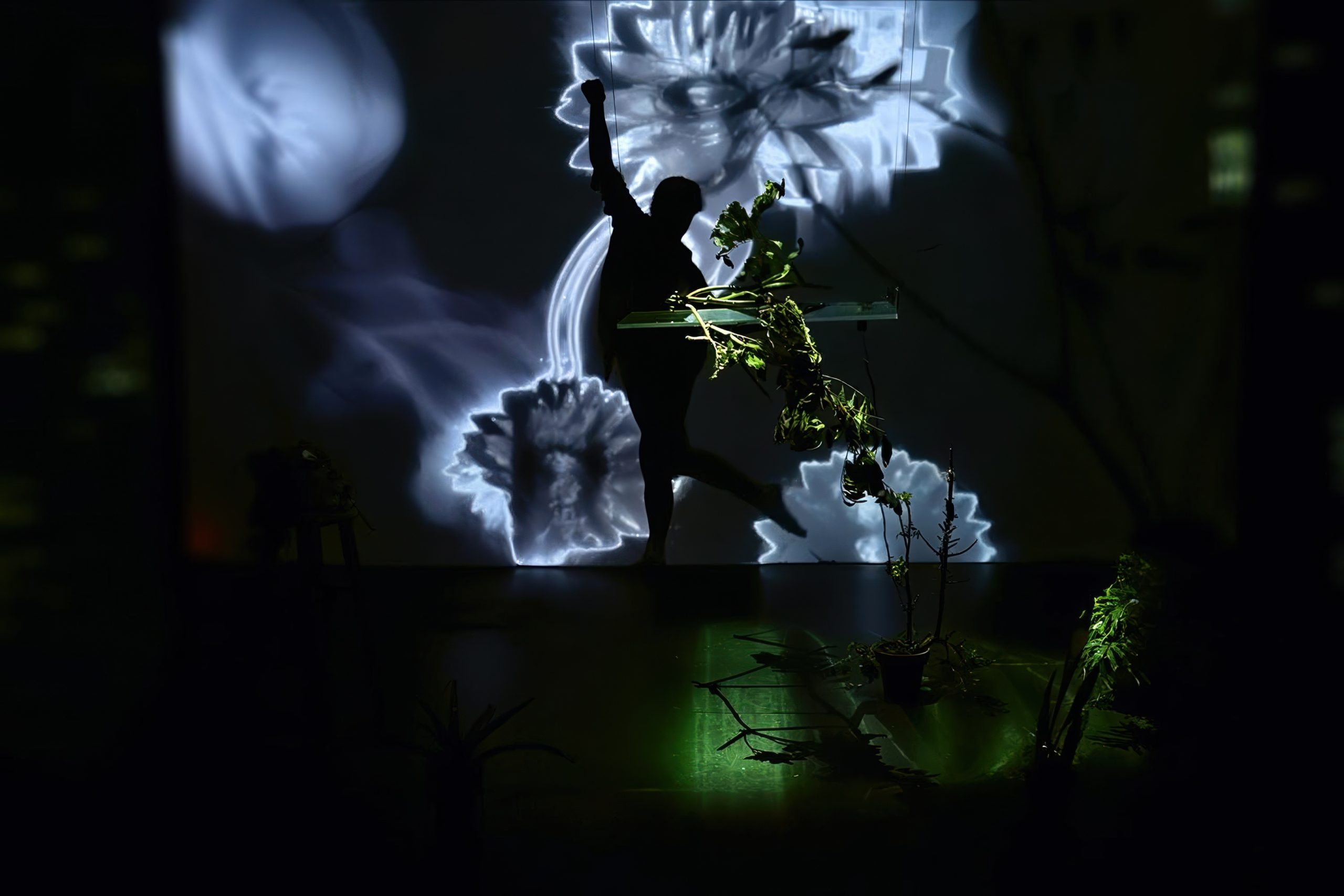
This paper presents Learning to Move, Learning to Play, Learning to Animate, a cross-disciplinary performance that explores the evolving relationships between human, technological, and natural intelligences through an integrated multimedia narrative. The work investigates how human performers, found-object robotics, organic entities, and AI-generated elements interact across layered realities, manifesting a critical response to traditional anthropocentric perspectives. Through a synthesis of electroacoustic soundscapes, bio-feedback mechanisms, and real-time visual generation, we develop a performative environment where shadows serve as liminal spaces between physical and digital presence, while organic robotics derived from natural forms challenge conventional human-machine dichotomies. The performance’s theoretical foundation draws from David Abram’s concept of the “more-than-human world,” reimagining it through contemporary technological mediation. By creating a space where performers, robots, plants, and their synthetic counterparts engage in mutual influence and response, the work offers an embodied exploration of collective intelligence and interspecies communication. This artistic investigation contributes to ongoing dialogues about agency and consciousness in our increasingly hybridized world, suggesting new possibilities for understanding the co-evolution of natural and synthetic entities.
References:
[1] David Abram. 2012. The spell of the sensuous: Perception and language in a more-than-human world. Vintage.
[2] Memo Akten. 2018. Deep Meditations: A brief history of almost everything (2018). https://www.memo.tv/works/deep-meditations/.
[3] James Bridle. 2022. Ways of being: Animals, plants, machines: The search for a planetary intelligence. Penguin UK.
[4] Devin Carroll and Mark Yim. 2020. Robots made from ice: an analysis of manufacturing techniques. In 2020 IEEE/RSJ International Conference on Intelligent Robots and Systems (IROS). IEEE, 1933–1938.
[5] Charles Darwin, Francis Darwin, et al. 1883. The power of movement in plants.D. Appleton and company.
[6] dotsimulate. 2023. Real-time diffusion in TouchDesigner – StreamdiffusionTD Setup + Install + Settings. https://www.youtube.com/watch?v=X4rlC6y1ahw.
[7] Theo Jansen. 2007. The great pretender. 010 Publishers.
[8] Akio Kodaira, Chenfeng Xu, Toshiki Hazama, Takanori Yoshimoto, Kohei Ohno, Shogo Mitsuhori, Soichi Sugano, Hanying Cho, Zhijian Liu, and Kurt Keutzer. 2023. StreamDiffusion: A Pipeline-level Solution for Real-time Interactive Generation. arxiv:https://arXiv.org/abs/2312.12491 [cs.CV] https://arxiv.org/abs/2312.12491
[9] Kosinkadink. 2024. ComfyUI-AnimateDiff-Evolved. https://github.com/Kosinkadink/ComfyUI-AnimateDiff-Evolved.
[10] Aristid Lindenmayer. 1968. Mathematical models for cellular interactions in development I. Filaments with one-sided inputs. Journal of Theoretical Biology 18 (1968), 280–299.
[11] Azumi Maekawa, Ayaka Kume, Hironori Yoshida, Jun Hatori, Jason Naradowsky, and Shunta Saito. 2018. Improvised robotic design with found objects. In Proc. 3rd Conf. NeurIPS Workshop Mach. Learn. Creativity Des. 1–5.
[12] Slobodan Marinković, Tatjana Stošić-Opinčal, and Oliver Tomić. 2012. Radiology and Fine Art. American Journal of Roentgenology 199, 1 (2012), W24–W26. PMID: 22733928.
[13] Nam June Paik and Charlotte Moorman. 1971. TV Cello.
[14] Man Ray. 1921. Rayograph. https://www.moma.org/collection/terms/rayograph.
[15] C. Sommerer and L. Mignonneau. 1992. Interactive Plant Growing. [Online]. Available: https://www.interface.ufg.ac.at/christa-laurent/InteractivePlantGrowing.html.
[16] Stelarc. 1980. Third Hand.
[17] Yusuke Tsunoda, Yuya Sato, and Koichi Osuka. 2024. GREEMA: Proposal and Experimental Verification of Growing Robot by Eating Environmental Material for Landslide Disaster. Journal of Robotics and Mechatronics 36, 2 (2024), 415–425.
[18] Nick Veasey. [n. d.]. Whistler Art – Nick Veasey. https://www.nickveasey.com/.
[19] Špela Petrič. 2020. PL’AI. https://www.spelapetric.org/plai
[20] Krista West. 2009. Biofeedback. Infobase Publishing.
[21] Matthew Wright, Adrian Freed, et al. 1997. Open SoundControl: A new protocol for communicating with sound synthesizers. In ICMC.
[22] Anicka Yi. 2021. In Love With The World. https://www.anickayistudio.biz/exhibitions/in-love-with-the-world.
[23] Pinar Yoldas. 2014. Ecosystem of Excess. https://pinaryoldas.info/Ecosystem-of-Excess-2014.



