
“Floating Strokes: A Spatial Interpretation and Modeling Method of Chinese Calligraphy” by Lin, Zheng, Lin, You, Zhang, et al. …
Conference:
Type(s):
Title:
- Floating Strokes: A Spatial Interpretation and Modeling Method of Chinese Calligraphy
Session/Category Title:
- Craft and Creativity
Presenter(s)/Author(s):
Moderator(s):
Abstract:
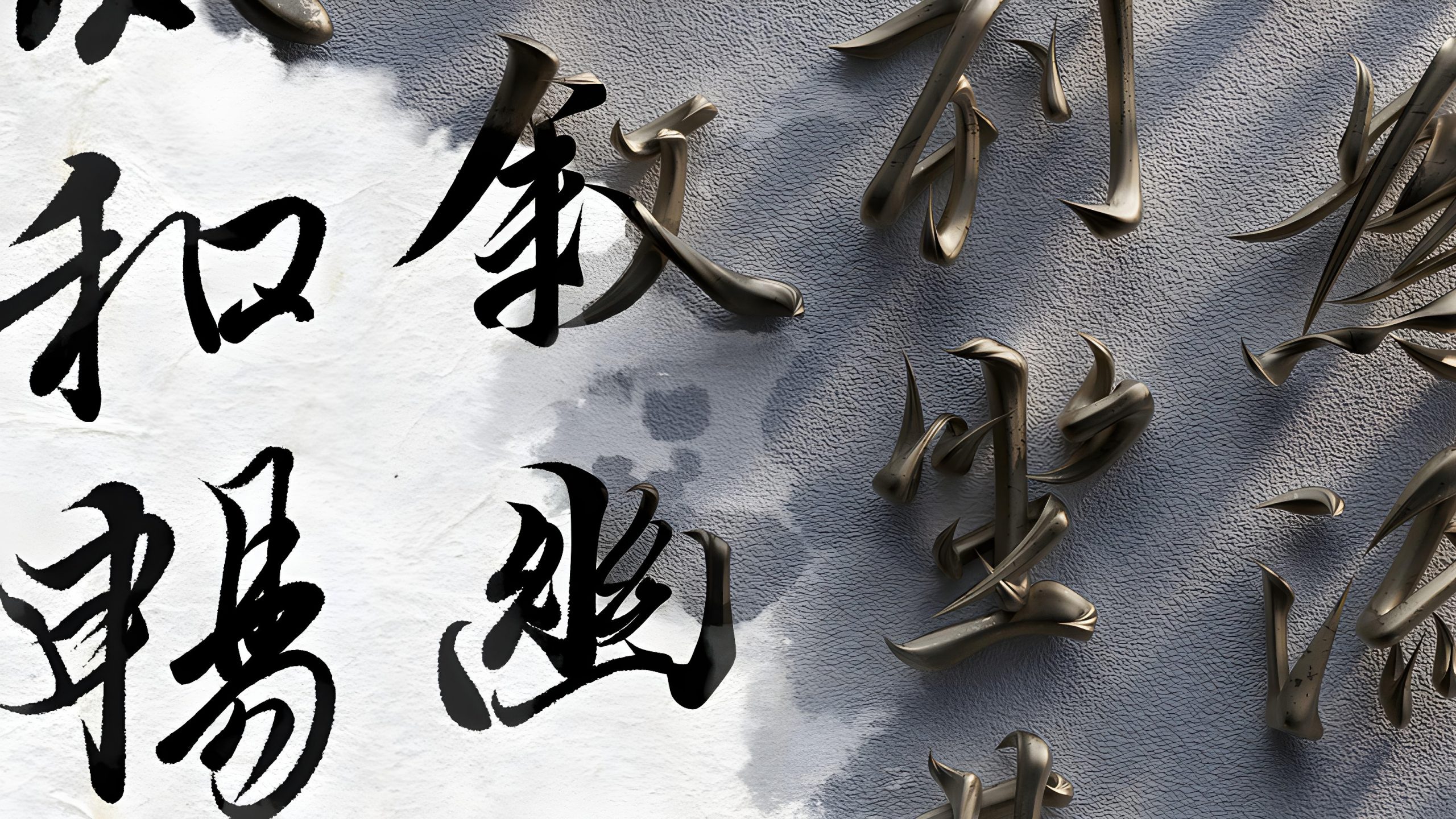
This paper presents a novel modeling method and a series of artworks that transform 2D Chinese calligraphy into 3D forms, offering a new perspective for understanding and appreciating traditional Chinese calligraphy beyond its conventional 2D representation. Drawing inspiration from the multidimensional nature of the calligraphic formation process and the philosophies of ancient calligraphers regarding the intrinsic depth of calligraphy, we propose a 3D modeling approach of Chinese calligraphy. This method analyzes stroke structures, incorporates volume modeling, and applies parametric optimization to a given 2D calligraphic script. The proposed technique seeks to preserve the original aesthetic essence by capturing the natural flow, spatial depth, structural dynamics, and layering of the calligraphy, while extending its expression into the 3D realm. A series of artworks created through this process have been exhibited, with feedback from both the public and experienced calligraphers indicating the unique value of appreciating traditional calligraphy beyond the original scripts.
References:
[1] Bassam Al Shiekh. 2016. ARABIC CALLIGRAPHY AND PARAMETRIC ARCHITECTURE. PARAMETRICISM VS. MATERIALISM (2016), 469.
[2] Ingar Brinck. 2018. Empathy, engagement, entrainment: The interaction dynamics of aesthetic experience. Cognitive processing 19, 2 (2018), 201–213.
[3] Wei Ting Chia. 2020. Calligraphic brushwork for 3D space. (2020).
[4] Yee Chiang. 1974. Chinese calligraphy: An introduction to its aesthetic and technique. Harvard University Press.
[5] Kwo Da-Wei. 2012. Chinese Brushwork in Calligraphy and Painting: its history, aesthetics, and techniques. Courier Corporation.
[6] Qin Gang, Pairoj Jamuni, Veerawat Sirvesmas, and Eakachat Joneurairatana. 2024. Transforming Chinese Calligraphy into Kinetic Sculptures: An Innovative Approach Using Rhino 3D Software. Kurdish Studies 12, 2 (2024), 755–770.
[7] Huizhi Ge. 2009. Preliminary Exploration of “Wushan Iron Characters”. News World 09 (2009), 168–169. doi:CNKI:SUN:PXWS.0.2009-09-107.
[8] Nor Azlin Hamidon and Zaneb Ali AbuAisha. 2022. The Use of Stainless Steel to Create Contemporary Artistic Arabic Calligraphy Sculptures. CONTEMPORARY ISSUES OF (2022), 1.
[9] Muwei Jian, Junyu Dong, Maoguo Gong, Hui Yu, Liqiang Nie, Yilong Yin, and Kin-Man Lam. 2019. Learning the traditional art of Chinese calligraphy via three-dimensional reconstruction and assessment. IEEE Transactions on Multimedia 22, 4 (2019), 970–979.
[10] Georgios Korakakis, Evangelia A Pavlatou, John A Palyvos, and Nicolas Spyrellis. 2009. 3D visualization types in multimedia applications for science learning: A case study for 8th grade students in Greece. Computers & Education 52, 2 (2009), 390–401.
[11] Chie Tsang Isaiah Lee. 2012. Chinese Calligraphic Thinking in my Compositional Work. Ph. D. Dissertation. University of Huddersfield.
[12] Rui Li, Xiaofei Jia, Changle Zhou, and Junsong Zhang. 2022. Reconfiguration of the brain during aesthetic experience on Chinese calligraphy—Using brain complex networks. Visual Informatics 6, 1 (2022), 35–46.
[13] Rem RunGu Lin, You Zhou, and Kang Zhang. 2024b. Cursive Calligraphy in 3d and bio-Ink. Leonardo (2024), 370–378.
[14] Troy TianYu Lin, James She, Yu-ao Wang, and Kang Zhang. 2024a. Future Ink: The Collision of AI and Chinese Calligraphy. ACM Journal on Computing and Cultural Heritage (2024).
[15] Rajkumar Pandey. 2024. Understanding of Visual Arts Theory and Practice.Blue Rose Publishers.
[16] Xiongbo Shi. 2019. Chinese calligraphy as “force-form”. Journal of Aesthetic Education 53, 3 (2019), 54–70.
[17] Xiongbo Shi. 2023. An Aesthetics of Chinese Calligraphy. Philosophy Compass 18, 5 (2023), e12912.
[18] Pierre Yat Siu Shum and Tobias Klein. 2024. VR Body Calligraphy-Whole-body Performance Writing for Chinese Calligraphy. In SIGGRAPH Asia 2024 Art Papers. 1–7.
[19] Peter Charles Sturman. 1997. Mi Fu: Style and the art of calligraphy in northern Song China. Yale University Press.
[20] Chen Wei. 2014. Volumetric cloud generation using a Chinese brush calligraphy style. (2014).
[21] Lia Wei. 2019. Epigraphy in the landscape: Intersections with contemporary ink painting and land art.
[22] Wu Wenhua. 2024. Mo Xiang Art: Brand Design and Creative Thinking. People’s Posts and Telecommunications Publishing House.
[23] Zhihao Yao, Qirui Sun, Beituo Liu, Yao Lu, Guanhong Liu, Xing-Dong Yang, and Haipeng Mi. 2024. InkBrush: A Sketching Tool for 3D Ink Painting. In Proceedings of the CHI Conference on Human Factors in Computing Systems. 1–15.
[24] Yu-Wei Zhang, Yanzhao Chen, Hui Liu, Zhongping Ji, and Caiming Zhang. 2018. Modeling Chinese calligraphy reliefs from one image. Computers & Graphics 70 (2018), 300–306.



