“Motion In-Betweening via Two-Stage Transformers” by Qin, Zheng and Zhou
Conference:
Type(s):
Title:
- Motion In-Betweening via Two-Stage Transformers
Session/Category Title:
- Character Animation
Presenter(s)/Author(s):
Abstract:
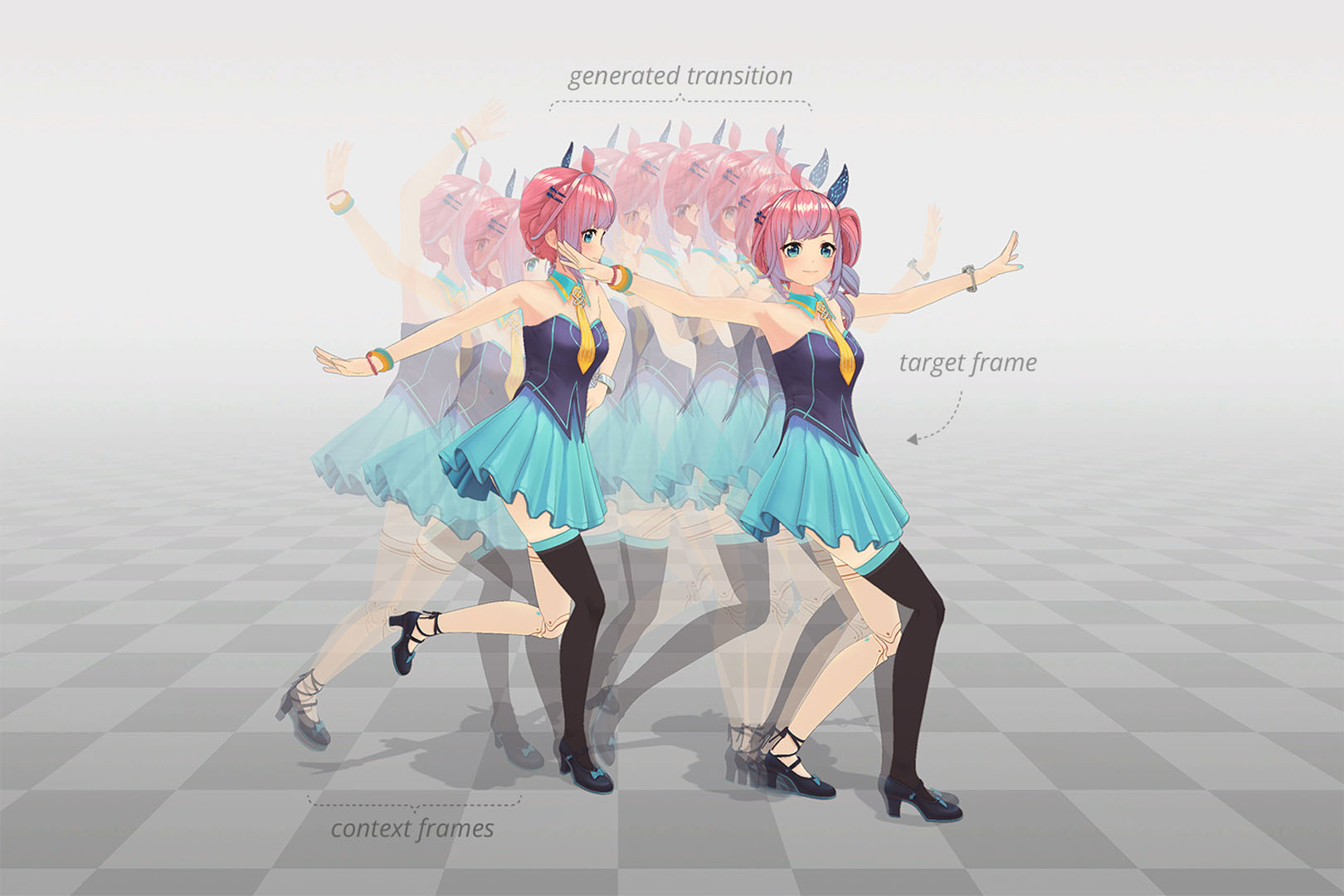
We present a deep learning-based framework to synthesize motion in-betweening in a two-stage manner. Given some context frames and a target frame, the system can generate plausible transitions with variable lengths in a non-autoregressive fashion. The framework consists of two Transformer Encoder-based networks operating in two stages: in the first stage a Context Transformer is designed to generate rough transitions based on the context and in the second stage a Detail Transformer is employed to refine motion details. Compared to existing Transformer-based methods which either use a complete Transformer Encoder-Decoder architecture or additional 1D convolutions to generate motion transitions, our framework achieves superior performance with less trainable parameters by only leveraging the Transformer Encoder and masked self-attention mechanism. To enhance the generalization of our transformer-based framework, we further introduce Keyframe Positional Encoding and Learned Relative Positional Encoding to make our method robust in synthesizing longer transitions exceeding the maximum transition length during training. Our framework is also artist-friendly by supporting full and partial pose constraints within the transition, giving artists fine control over the synthesized results. We benchmark our framework on the LAFAN1 dataset, and experiments show that our method outperforms the current state-of-the-art methods at a large margin (an average of 16% for normal-length sequences and 55% for excessive-length sequences). Our method trains faster than the RNN-based method and achieves a four-time speedup during inference. We implement our framework into a production-ready tool inside an animation authoring software and conduct a pilot study to validate the practical value of our method.
References:
1. Emre Aksan, Manuel Kaufmann, Peng Cao, and Otmar Hilliges. 2021. A spatio-temporal transformer for 3D human motion prediction. In 2021 International Conference on 3D Vision (3DV). IEEE, 565–574.
2. Okan Arikan and David A Forsyth. 2002. Interactive motion generation from examples. ACM Transactions on Graphics (TOG) 21, 3 (2002), 483–490.
3. Autodesk. 2022. Maya. https://www.autodesk.com/products/maya/overview
4. Jimmy Lei Ba, Jamie Ryan Kiros, and Geoffrey E Hinton. 2016. Layer normalization. arXiv preprint arXiv:1607.06450 (2016).
5. Emad Barsoum, John Kender, and Zicheng Liu. 2018. HP-GAN: Probabilistic 3D Human Motion Prediction via GAN. In Proceedings of the IEEE Conference on Computer Vision and Pattern Recognition Workshops. 1418–1427.
6. Philippe Beaudoin, Stelian Coros, Michiel van de Panne, and Pierre Poulin. 2008. Motionmotif graphs. In Proceedings of the 2008 ACM SIGGRAPH/Eurographics Symposium on Computer Animation. 117–126.
7. Blender Foundation. 2022. Blender. http://www.blender.org
8. Michael Büttner and Simon Clavet. 2015. Motion Matching. https://www.youtube.com/watch?v=z_wpgHFSWss&t=658s.
9. Yujun Cai, Lin Huang, Yiwei Wang, Tat-Jen Cham, Jianfei Cai, Junsong Yuan, Jun Liu, Xu Yang, Yiheng Zhu, Xiaohui Shen, et al. 2020. Learning progressive joint propagation for human motion prediction. In Proceedings of the European Conference on Computer Vision (ECCV). Springer, 226–242.
10. Yujun Cai, Yiwei Wang, Yiheng Zhu, Tat-Jen Cham, Jianfei Cai, Junsong Yuan, Jun Liu, Chuanxia Zheng, Sijie Yan, Henghui Ding, et al. 2021. A Unified 3D Human Motion Synthesis Model via Conditional Variational Auto-Encoder. In Proceedings of the IEEE/CVF International Conference on Computer Vision. 11645–11655.
11. Jinxiang Chai and Jessica K Hodgins. 2005. Performance animation from low-dimensional control signals. ACM Transactions on Graphics (TOG) 24, 3 (2005), 686–696.
12. Jinxiang Chai and Jessica K Hodgins. 2007. Constraint-based motion optimization using a statistical dynamic model. ACM Transactions on Graphics (TOG) 26, 3 (2007), 8–es.
13. Mia Xu Chen, Orhan Firat, Ankur Bapna, Melvin Johnson, Wolfgang Macherey, George Foster, Llion Jones, Mike Schuster, Noam Shazeer, Niki Parmar, et al. 2018. The Best of Both Worlds: Combining Recent Advances in Neural Machine Translation. In Proceedings of the 56th Annual Meeting of the Association for Computational Linguistics (Volume 1: Long Papers). 76–86.
14. Hsu-kuang Chiu, Ehsan Adeli, Borui Wang, De-An Huang, and Juan Carlos Niebles. 2019. Action-agnostic human pose forecasting. In 2019 IEEE Winter Conference on Applications of Computer Vision (WACV). IEEE, 1423–1432.
15. Loïc Ciccone, Cengiz Öztireli, and Robert W Sumner. 2019. Tangent-space optimization for interactive animation control. ACM Transactions on Graphics (TOG) 38, 4 (2019), 1–10.
16. Zihang Dai, Zhilin Yang, Yiming Yang, Jaime G Carbonell, Quoc Le, and Ruslan Salakhutdinov. 2019. Transformer-XL: Attentive Language Models beyond a Fixed-Length Context. In Proceedings of the 57th Annual Meeting of the Association for Computational Linguistics. 2978–2988.
17. Lingwei Dang, Yongwei Nie, Chengjiang Long, Qing Zhang, and Guiqing Li. 2021. MSR-GCN: Multi-Scale Residual Graph Convolution Networks for Human Motion Prediction. In Proceedings of the IEEE/CVF International Conference on Computer Vision. 11467–11476.
18. Jacob Devlin, Ming-Wei Chang, Kenton Lee, and Kristina Toutanova. 2018. Bert: Pre-training of deep bidirectional transformers for language understanding. arXiv preprint arXiv:1810.04805 (2018).
19. Yinglin Duan, Tianyang Shi, Zhengxia Zou, Yenan Lin, Zhehui Qian, Bohan Zhang, and Yi Yuan. 2021. Single-Shot Motion Completion with Transformer. arXiv preprint arXiv:2103.00776 (2021).
20. Petros Faloutsos, Michiel Van de Panne, and Demetri Terzopoulos. 2001. Composable controllers for physics-based character animation. In Proceedings of the 28th annual conference on Computer graphics and interactive techniques. 251–260.
21. Anthony C Fang and Nancy S Pollard. 2003. Efficient synthesis of physically valid human motion. ACM Transactions on Graphics (TOG) 22, 3 (2003), 417–426.
22. Katerina Fragkiadaki, Sergey Levine, Panna Felsen, and Jitendra Malik. 2015. Recurrent network models for human dynamics. In Proceedings of the IEEE/CVF International Conference on Computer Vision. 4346–4354.
23. Jonas Gehring, Michael Auli, David Grangier, Denis Yarats, and Yann N Dauphin. 2017. Convolutional sequence to sequence learning. In International Conference on Machine Learning. PMLR, 1243–1252.
24. Romi Geleijn, Adrian Radziszewski, Julia Beryl van Straaten, and Henrique Galvan Debarba. 2021. Lightweight Quaternion Transition Generation with Neural Networks. In 2021 IEEE Conference on Virtual Reality and 3D User Interfaces Abstracts and Workshops (VRW). IEEE, 579–580.
25. Anand Gopalakrishnan, Ankur Mali, Dan Kifer, Lee Giles, and Alexander G Ororbia. 2019. A neural temporal model for human motion prediction. In Proceedings of the IEEE/CVF Conference on Computer Vision and Pattern Recognition. 12116–12125.
26. Keith Grochow, Steven L Martin, Aaron Hertzmann, and Zoran Popović. 2004. Style-based inverse kinematics. ACM Transactions on Graphics (TOG) 23, 3 (2004), 522–531.
27. Liang-Yan Gui, Yu-Xiong Wang, Xiaodan Liang, and José MF Moura. 2018. Adversarial geometry-aware human motion prediction. In Proceedings of the European Conference on Computer Vision (ECCV). 786–803.
28. Félix G Harvey and Christopher Pal. 2018. Recurrent transition networks for character locomotion. In SIGGRAPH Asia 2018 Technical Briefs. 1–4.
29. Félix G Harvey, Mike Yurick, Derek Nowrouzezahrai, and Christopher Pal. 2020. Robust motion in-betweening. ACM Transactions on Graphics (TOG) 39, 4 (2020), 60–1.
30. Kaiming He, Xiangyu Zhang, Shaoqing Ren, and Jian Sun. 2015. Delving deep into rectifiers: Surpassing human-level performance on imagenet classification. In Proceedings of the IEEE/CVF International Conference on Computer Vision. 1026–1034.
31. Kaiming He, Xiangyu Zhang, Shaoqing Ren, and Jian Sun. 2016. Deep residual learning for image recognition. In Proceedings of the IEEE/CVF Conference on Computer Vision and Pattern Recognition. 770–778.
32. Alejandro Hernandez, Jurgen Gall, and Francesc Moreno-Noguer. 2019. Human motion prediction via spatio-temporal inpainting. In Proceedings of the IEEE/CVF International Conference on Computer Vision. 7134–7143.
33. Jessica K Hodgins, Wayne L Wooten, David C Brogan, and James F O’Brien. 1995. Animating human athletics. In Proceedings of the 22nd annual conference on Computer graphics and interactive techniques. 71–78.
34. Daniel Holden, Oussama Kanoun, Maksym Perepichka, and Tiberiu Popa. 2020. Learned motion matching. ACM Transactions on Graphics (TOG) 39, 4 (2020), 53–1.
35. Daniel Holden, Taku Komura, and Jun Saito. 2017. Phase-functioned neural networks for character control. ACM Transactions on Graphics (TOG) 36, 4 (2017), 1–13.
36. Daniel Holden, Jun Saito, and Taku Komura. 2016. A deep learning framework for character motion synthesis and editing. ACM Transactions on Graphics (TOG) 35, 4 (2016), 1–11.
37. Daniel Holden, Jun Saito, Taku Komura, and Thomas Joyce. 2015. Learning motion manifolds with convolutional autoencoders. In SIGGRAPH Asia 2015 technical briefs. 1–4.
38. Cheng-Zhi Anna Huang, Ashish Vaswani, Jakob Uszkoreit, Noam Shazeer, Ian Simon, Curtis Hawthorne, Andrew M Dai, Matthew D Hoffman, Monica Dinculescu, and Douglas Eck. 2018. Music transformer. arXiv preprint arXiv:1809.04281 (2018).
39. Ashesh Jain, Amir R Zamir, Silvio Savarese, and Ashutosh Saxena. 2016. Structural-rnn: Deep learning on spatio-temporal graphs. In Proceedings of the IEEE/CVF Conference on Computer Vision and Pattern Recognition. 5308–5317.
40. Manuel Kaufmann, Emre Aksan, Jie Song, Fabrizio Pece, Remo Ziegler, and Otmar Hilliges. 2020. Convolutional autoencoders for human motion infilling. In 2020 International Conference on 3D Vision (3DV). IEEE, 918–927.
41. Jihoon Kim, Taehyun Byun, Seungyoun Shin, Jungdam Won, and Sungjoon Choi. 2022. Conditional Motion In-betweening. arXiv preprint arXiv:2202.04307 (2022).
42. Diederik P Kingma and Jimmy Ba. 2014. Adam: A method for stochastic optimization. arXiv preprint arXiv:1412.6980 (2014).
43. Lucas Kovar and Michael Gleicher. 2004. Automated extraction and parameterization of motions in large data sets. ACM Transactions on Graphics (TOG) 23, 3 (2004), 559–568.
44. Lucas Kovar, Michael Gleicher, and Frédéric Pighin. 2002. Motion Graphs. ACM Transactions on Graphics (TOG) 21, 3 (July 2002), 473–482.
45. Jehee Lee, Jinxiang Chai, Paul SA Reitsma, Jessica K Hodgins, and Nancy S Pollard. 2002. Interactive control of avatars animated with human motion data. In Proceedings of the 29th annual conference on Computer graphics and interactive techniques. 491–500.
46. Yongjoon Lee, Kevin Wampler, Gilbert Bernstein, Jovan Popović, and Zoran Popović. 2010. Motion fields for interactive character locomotion. In ACM SIGGRAPH Asia 2010 papers. 1–8.
47. Andreas M Lehrmann, Peter V Gehler, and Sebastian Nowozin. 2014. Efficient nonlinear markov models for human motion. In Proceedings of the IEEE/CVF Conference on Computer Vision and Pattern Recognition. 1314–1321.
48. Jiaman Li, Ruben Villegas, Duygu Ceylan, Jimei Yang, Zhengfei Kuang, Hao Li, and Yajie Zhao. 2021. Task-generic hierarchical human motion prior using vaes. In 2021 International Conference on 3D Vision (3DV). IEEE, 771–781.
49. Hung Yu Ling, Fabio Zinno, George Cheng, and Michiel Van De Panne. 2020. Character controllers using motion vaes. ACM Transactions on Graphics (TOG) 39, 4 (2020), 40–1.
50. Xiaoli Liu, Jianqin Yin, Jin Liu, Pengxiang Ding, Jun Liu, and Huaping Liu. 2020. Trajectorycnn: a new spatio-temporal feature learning network for human motion prediction. IEEE Transactions on Circuits and Systems for Video Technology 31, 6 (2020), 2133–2146.
51. Julieta Martinez, Michael J Black, and Javier Romero. 2017. On human motion prediction using recurrent neural networks. In Proceedings of the IEEE/CVF Conference on Computer Vision and Pattern Recognition. 2891–2900.
52. Jianyuan Min and Jinxiang Chai. 2012. Motion graphs++ a compact generative model for semantic motion analysis and synthesis. ACM Transactions on Graphics (TOG) 31, 6 (2012), 1–12.
53. Jianyuan Min, Yen-Lin Chen, and Jinxiang Chai. 2009. Interactive generation of human animation with deformable motion models. ACM Transactions on Graphics (TOG) 29, 1 (2009), 1–12.
54. Tomohiko Mukai and Shigeru Kuriyama. 2005. Geostatistical motion interpolation. ACM Transactions on Graphics (TOG) 24, 3 (2005), 1062–1070.
55. J Thomas Ngo and Joe Marks. 1993. Spacetime constraints revisited. In Proceedings of the 20th annual conference on Computer graphics and interactive techniques. 343–350.
56. Boris N Oreshkin, Antonios Valkanas, Félix G Harvey, Louis-Simon Ménard, Florent Bocquelet, and Mark J Coates. 2022. Motion Inbetweening via Deep Δ-Interpolator. arXiv preprint arXiv:2201.06701 (2022).
57. Sang Il Park, Hyun Joon Shin, and Sung Yong Shin. 2002. On-line locomotion generation based on motion blending. In Proceedings of the 2002 ACM SIGGRAPH/Eurographics Symposium on Computer animation. 105–111.
58. Dario Pavllo, Christoph Feichtenhofer, Michael Auli, and David Grangier. 2020. Modeling human motion with quaternion-based neural networks. International Journal of Computer Vision 128, 4 (2020), 855–872.
59. Dario Pavllo, David Grangier, and Michael Auli. 2018. Quaternet: A quaternion-based recurrent model for human motion. arXiv preprint arXiv:1805.06485 (2018).
60. Mathis Petrovich, Michael J Black, and Gül Varol. 2021. Action-conditioned 3d human motion synthesis with transformer vae. In Proceedings of the IEEE/CVF International Conference on Computer Vision. 10985–10995.
61. Charles Rose, Michael F Cohen, and Bobby Bodenheimer. 1998. Verbs and adverbs: Multidimensional motion interpolation. IEEE Computer Graphics and Applications 18, 5 (1998), 32–40.
62. Charles Rose, Brian Guenter, Bobby Bodenheimer, and Michael F Cohen. 1996. Efficient generation of motion transitions using spacetime constraints. In Proceedings of the 23rd annual conference on Computer graphics and interactive techniques. 147–154.
63. Alla Safonova and Jessica K. Hodgins. 2007. Construction and Optimal Search of Interpolated Motion Graphs. ACM Transactions on Graphics (TOG) 26, 3 (July 2007), 106–es.
64. Peter Shaw, Jakob Uszkoreit, and Ashish Vaswani. 2018. Self-Attention with Relative Position Representations. In Proceedings of the 2018 Conference of the North American Chapter of the Association for Computational Linguistics: Human Language Technologies, Volume 2 (Short Papers). 464–468.
65. Sebastian Starke, He Zhang, Taku Komura, and Jun Saito. 2019. Neural state machine for character-scene interactions. ACM Transactions on Graphics (TOG) 38, 6 (2019), 209–1.
66. Sebastian Starke, Yiwei Zhao, Taku Komura, and Kazi Zaman. 2020. Local motion phases for learning multi-contact character movements. ACM Transactions on Graphics (TOG) 39, 4 (2020), 54–1.
67. Sebastian Starke, Yiwei Zhao, Fabio Zinno, and Taku Komura. 2021. Neural animation layering for synthesizing martial arts movements. ACM Transactions on Graphics (TOG) 40, 4 (2021), 1–16.
68. Xiangjun Tang, He Wang, Bo Hu, Xu Gong, Ruifan Yi, Qilong Kou, and Xiaogang Jin. 2022. Real-time Controllable Motion Transition for Characters. arXiv preprint arXiv:2205.02540 (2022).
69. Jochen Tautges, Arno Zinke, Björn Krüger, Jan Baumann, Andreas Weber, Thomas Helten, Meinard Müller, Hans-Peter Seidel, and Bernd Eberhardt. 2011. Motion reconstruction using sparse accelerometer data. ACM Transactions on Graphics (TOG) 30, 3 (2011), 1–12.
70. Graham W Taylor, Geoffrey E Hinton, and Sam Roweis. 2006. Modeling human motion using binary latent variables. Advances in neural information processing systems 19 (2006).
71. Ashish Vaswani, Noam Shazeer, Niki Parmar, Jakob Uszkoreit, Llion Jones, Aidan N Gomez, Łukasz Kaiser, and Illia Polosukhin. 2017. Attention is all you need. In Advances in neural information processing systems. 5998–6008.
72. Ruben Villegas, Jimei Yang, Duygu Ceylan, and Honglak Lee. 2018. Neural kinematic networks for unsupervised motion retargetting. In Proceedings of the IEEE/CVF Conference on Computer Vision and Pattern Recognition. 8639–8648.
73. Jack M Wang, David J Fleet, and Aaron Hertzmann. 2007. Gaussian process dynamical models for human motion. IEEE transactions on pattern analysis and machine intelligence 30, 2 (2007), 283–298.
74. Qiang Wang, Bei Li, Tong Xiao, Jingbo Zhu, Changliang Li, Derek F Wong, and Lidia S Chao. 2019. Learning deep transformer models for machine translation. arXiv preprint arXiv:1906.01787 (2019).
75. Tingwu Wang, Yunrong Guo, Maria Shugrina, and Sanja Fidler. 2020. Unicon: Universal neural controller for physics-based character motion. arXiv preprint arXiv:2011.15119 (2020).
76. Andrew Witkin and Michael Kass. 1988. Spacetime constraints. In Proceedings of the 15th annual conference on Computer graphics and interactive techniques. 159–168.
77. He Zhang, Sebastian Starke, Taku Komura, and Jun Saito. 2018. Mode-adaptive neural networks for quadruped motion control. ACM Transactions on Graphics (TOG) 37, 4 (2018), 1–11.
78. Xinyi Zhang and Michiel van de Panne. 2018. Data-driven autocompletion for keyframe animation. In Proceedings of the 11th Annual International Conference on Motion, Interaction, and Games. 1–11.
79. Yi Zhou, Connelly Barnes, Jingwan Lu, Jimei Yang, and Hao Li. 2019. On the continuity of rotation representations in neural networks. In Proceedings of the IEEE/CVF Conference on Computer Vision and Pattern Recognition. 5745–5753.
80. Yi Zhou, Jingwan Lu, Connelly Barnes, Jimei Yang, Sitao Xiang, et al. 2020. Generative tweening: Long-term inbetweening of 3d human motions. arXiv preprint arXiv:2005.08891 (2020).