“Computational Design of Wiring Layout on Tight Suits with Minimal Motion Resistance” by Wang, Xu, Zheng, Zhou, Guo, et al. …
Conference:
Type(s):
Title:
- Computational Design of Wiring Layout on Tight Suits with Minimal Motion Resistance
Session/Category Title:
- Technical Papers Fast-Forward
Presenter(s)/Author(s):
Abstract:
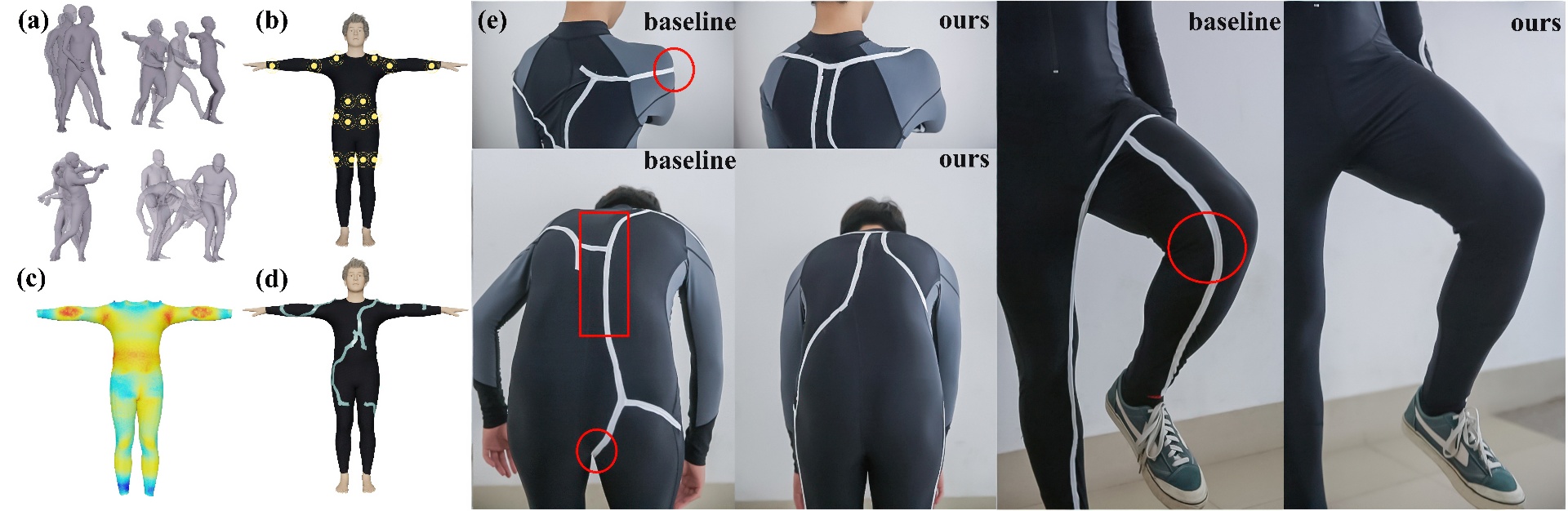
An increasing number of electronics are directly embedded on the clothing to monitor human status (skeletal motion or electromyogram activity) or provide haptic feedback. A specific challenge to prototype and fabricate such a clothing is to design the wiring layout, to minimize the intervention to human motion and maximize the physical robustness. We address this challenge by formulating the topological optimization problem on the clothing surface as a deformation-weighted Steiner tree problem on a 3D clothing mesh. Our method proposed an energy function for minimizing Green strain energy in the wiring area under different motions, regularized by its total length. We built the physical prototype to verify the effectiveness of our method and conducted user study with participants of both layout design experts and smart cloth users. On three types of commercial products of smart clothing, the optimized layout design reduced stretching by an average of 77% among 245 actions compared to baseline design.
References:
[1]
Talha Agcayazi, Kony Chatterjee, Alper Bozkurt, and Tushar K Ghosh. 2018. Flexible interconnects for electronic textiles. Advanced Materials Technologies 3, 10 (2018), 1700277.
[2]
Ahmed Al Maimani and Anne Roudaut. 2017. Frozen suit: designing a changeable stiffness suit and its application to haptic games. In Proceedings of the 2017 CHI Conference on Human Factors in Computing Systems. 2440–2448.
[3]
Lea Albaugh, Scott Hudson, and Lining Yao. 2019. Digital fabrication of soft actuated objects by machine knitting. In Proceedings of the 2019 CHI Conference on Human Factors in Computing Systems. 1–13.
[4]
Armands Ancans, Modris Greitans, Ricards Cacurs, Beate Banga, and Artis Rozentals. 2021. Wearable sensor clothing for body movement measurement during physical activities in healthcare. Sensors 21, 6 (2021), 2068.
[5]
Alessandra Angelucci, Matteo Cavicchioli, Ilaria A Cintorrino, Giuseppe Lauricella, Chiara Rossi, Sara Strati, and Andrea Aliverti. 2021. Smart textiles and sensorized garments for physiological monitoring: A review of available solutions and techniques. Sensors 21, 3 (2021), 814.
[6]
Hans L Bodlaender, Marek Cygan, Stefan Kratsch, and Jesper Nederlof. 2015. Deterministic single exponential time algorithms for connectivity problems parameterized by treewidth. Information and Computation 243 (2015), 86–111.
[7]
Elena A Caffarelli, Denise M Halverson, and Ryan J Jensen. 2014. The Steiner problem on surfaces of revolution. Graphs and Combinatorics 30 (2014), 315–342.
[8]
Shaoyu Cai, Pingchuan Ke, Shanshan Jiang, Takuji Narumi, and Kening Zhu. 2019. Demonstration of thermairglove: A pneumatic glove for material perception in virtual reality through thermal and force feedback. In SIGGRAPH Asia 2019 Emerging Technologies. 11–12.
[9]
Xiaowei Chen, Xiao Jiang, Jiawei Fang, Shihui Guo, Juncong Lin, Minghong Liao, Guoliang Luo, and Hongbo Fu. 2023. DisPad: Flexible On-Body Displacement of Fabric Sensors for Robust Joint-Motion Tracking. Proc. ACM Interact. Mob. Wearable Ubiquitous Technol. 7, 1, Article 5 (2023), 27 pages.
[10]
Xiaowei Chen, Xiao Jiang, Lishuang Zhan, Shihui Guo, Qunsheng Ruan, Guoliang Luo, Minghong Liao, and Yipeng Qin. 2022. Full-body human motion reconstruction with sparse joint tracking using flexible sensors. ACM Transactions on Multimedia Computing, Communications, and Applications (2022).
[11]
Zhiyong Chen, Ronghui Wu, Shihui Guo, Xiangyang Liu, Hongbo Fu, Xiaogang Jin, and Minghong Liao. 2021. 3D upper body reconstruction with sparse soft sensors. Soft Robotics 8, 2 (2021), 226–239.
[12]
Markus Chimani, Petra Mutzel, and Bernd Zey. 2012. Improved Steiner tree algorithms for bounded treewidth. Journal of Discrete Algorithms 16 (2012), 67–78.
[13]
Alexandra Delazio, Ken Nakagaki, Roberta L Klatzky, Scott E Hudson, Jill Fain Lehman, and Alanson P Sample. 2018. Force jacket: Pneumatically-actuated jacket for embodied haptic experiences. In Proceedings of the 2018 CHI conference on human factors in computing systems. 1–12.
[14]
Yiwen Deng, Tianlu Mao, Min Shi, and Zhaoqi Wang. 2016. Cloth deformation prediction based on human motion. In 2016 International Conference on Virtual Reality and Visualization (ICVRV). IEEE, 258–263.
[15]
Mavelous Designer. 2022. Homepage. https://marvelousdesigner.com/ [accessed: 01.05.2023].
[16]
Stuart E Dreyfus and Robert A Wagner. 1971. The Steiner problem in graphs. Networks 1, 3 (1971), 195–207.
[17]
Bernhard Fuchs, Walter Kern, D Molle, Stefan Richter, Peter Rossmanith, and Xinhui Wang. 2007. Dynamic programming for minimum Steiner trees. Theory of Computing Systems 41 (2007), 493–500.
[18]
Mohsen Gholami, Ahmad Rezaei, Tyler J Cuthbert, Christopher Napier, and Carlo Menon. 2019. Lower body kinematics monitoring in running using fabric-based wearable sensors and deep convolutional neural networks. Sensors 19, 23 (2019), 5325.
[19]
Sean Gillies 2007. Shapely: manipulation and analysis of geometric objects. https://github.com/Toblerity/Shapely
[20]
Oliver Glauser, Shihao Wu, Daniele Panozzo, Otmar Hilliges, and Olga Sorkine-Hornung. 2019. Interactive hand pose estimation using a stretch-sensing soft glove. ACM Transactions on Graphics (ToG) 38, 4 (2019), 1–15.
[21]
Clemens Gröpl, Stefan Hougardy, Till Nierhoff, and Hans Jürgen Prömel. 2001. Approximation algorithms for the Steiner tree problem in graphs. Steiner trees in industry (2001), 235–279.
[22]
Sebastian Günther, Mohit Makhija, Florian Müller, Dominik Schön, Max Mühlhäuser, and Markus Funk. 2019. PneumAct: Pneumatic kinesthetic actuation of body joints in virtual reality environments. In Proceedings of the 2019 on Designing Interactive Systems Conference. 227–240.
[23]
Stefan Hougardy, Jannik Silvanus, and Jens Vygen. 2017. Dijkstra meets Steiner: a fast exact goal-oriented Steiner tree algorithm. Mathematical Programming Computation 9 (2017), 135–202.
[24]
Xinrong Hu, Ziyi Zhang, Ruiqi Luo, Junjie Huang, Jinxing Liang, Jin Huang, Tao Peng, and Hao Cai. 2022. MMTrans: MultiModal Transformer for realistic video virtual try-on. In The 18th ACM SIGGRAPH International Conference on Virtual-Reality Continuum and its Applications in Industry. 1–8.
[25]
Yoichi Iwata and Takuto Shigemura. 2019. Separator-based pruned dynamic programming for steiner tree. In Proceedings of the AAAI Conference on Artificial Intelligence, Vol. 33. 1520–1527.
[26]
Alexandre Kaspar, Liane Makatura, and Wojciech Matusik. 2019. Knitting skeletons: A computer-aided design tool for shaping and patterning of knitted garments. In proceedings of the 32nd annual ACM symposium on user interface software and technology. 53–65.
[27]
Jinsoo Kim, Giuk Lee, Roman Heimgartner, Dheepak Arumukhom Revi, Nikos Karavas, Danielle Nathanson, Ignacio Galiana, Asa Eckert-Erdheim, Patrick Murphy, David Perry, 2019. Reducing the metabolic rate of walking and running with a versatile, portable exosuit. Science 365, 6454 (2019), 668–672.
[28]
Tsz-Ho Kwok, Yan-Qiu Zhang, Charlie CL Wang, Yong-Jin Liu, and Kai Tang. 2015. Styling evolution for tight-fitting garments. IEEE transactions on visualization and computer graphics 22, 5 (2015), 1580–1591.
[29]
Jaehong Lee, Hyukho Kwon, Jungmok Seo, Sera Shin, Ja Hoon Koo, Changhyun Pang, Seungbae Son, Jae Hyung Kim, Yong Hoon Jang, Dae Eun Kim, 2015. Conductive fiber-based ultrasensitive textile pressure sensor for wearable electronics. Advanced materials 27, 15 (2015), 2433–2439.
[30]
Sangjun Lee, Nikos Karavas, Brenna T Quinlivan, Danielle LouiseRyan, David Perry, Asa Eckert-Erdheim, Patrick Murphy, Taylor Greenberg Goldy, Nicolas Menard, Maria Athanassiu, 2018. Autonomous multi-joint soft exosuit for assistance with walking overground. In 2018 IEEE International Conference on Robotics and Automation (ICRA). IEEE, 2812–2819.
[31]
Anatoly Yur’evich Levin. 1971. Algorithm for the shortest connection of a group of graph vertices. In Doklady Akademii Nauk, Vol. 200. Russian Academy of Sciences, 773–776.
[32]
Jituo Li and Guodong Lu. 2011. Customizing 3D garments based on volumetric deformation. Computers in Industry 62, 7 (2011), 693–707.
[33]
Ruibo Liu, Qijia Shao, Siqi Wang, Christina Ru, Devin Balkcom, and Xia Zhou. 2019. Reconstructing human joint motion with computational fabrics. Proceedings of the ACM on Interactive, Mobile, Wearable and Ubiquitous Technologies 3, 1 (2019), 1–26.
[34]
Tiantian Liu. 2018. Towards real-time simulation of hyperelastic materials. PhD dissertation. University of Pennsylvania.
[35]
Yiwei Liu, Jincai Li, and Kepeng Wu. 2022. The invention relates to a capacitive elastic strain sensor with high safety and high detection range and a preparation method, Patented on 2022-09-20, CN113670187A, Invention Patent (China).
[36]
Zishun Liu, Xingjian Han, Yuchen Zhang, Xiangjia Chen, Yu-Kun Lai, Eugeni L Doubrovski, Emily Whiting, and Charlie CL Wang. 2021. Knitting 4D garments with elasticity controlled for body motion. ACM Transactions on Graphics (TOG) 40, 4 (2021), 1–16.
[37]
Ivana Ljubić. 2021. Solving Steiner trees: Recent advances, challenges, and perspectives. Networks 77, 2 (2021), 177–204.
[38]
James McCann, Lea Albaugh, Vidya Narayanan, April Grow, Wojciech Matusik, Jennifer Mankoff, and Jessica Hodgins. 2016. A compiler for 3D machine knitting. ACM Transactions on Graphics (TOG) 35, 4 (2016), 1–11.
[39]
Juan Montes, Bernhard Thomaszewski, Sudhir Mudur, and Tiberiu Popa. 2020. Computational design of skintight clothing. ACM Transactions on Graphics (TOG) 39, 4 (2020), 105–1.
[40]
Sachith Muthukumarana, Moritz Alexander Messerschmidt, Denys JC Matthies, Jürgen Steimle, Philipp M Scholl, and Suranga Nanayakkara. 2021. Clothtiles: A prototyping platform to fabricate customized actuators on clothing using 3d printing and shape-memory alloys. In Proceedings of the 2021 CHI Conference on Human Factors in Computing Systems. 1–12.
[41]
Vidya Narayanan, Lea Albaugh, Jessica Hodgins, Stelian Coros, and James Mccann. 2018. Automatic machine knitting of 3D meshes. ACM Transactions on Graphics (TOG) 37, 3 (2018), 1–15.
[42]
Vidya Narayanan, Kui Wu, Cem Yuksel, and James McCann. 2019. Visual knitting machine programming. ACM Transactions on Graphics (TOG) 38, 4 (2019), 1–13.
[43]
Jesper Nederlof. 2009. Fast polynomial-space algorithms using möbius inversion: Improving on steiner tree and related problems. In Automata, Languages and Programming: 36th International Colloquium, ICALP 2009, Rhodes, Greece, July 5-12, 2009, Proceedings, Part I 36. Springer, 713–725.
[44]
Xiaoyu Pan, Jiaming Mai, Xinwei Jiang, Dongxue Tang, Jingxiang Li, Tianjia Shao, Kun Zhou, Xiaogang Jin, and Dinesh Manocha. 2022. Predicting loose-fitting garment deformations using bone-driven motion networks. In ACM SIGGRAPH 2022 Conference Proceedings. 1–10.
[45]
Georgios Pavlakos, Vasileios Choutas, Nima Ghorbani, Timo Bolkart, Ahmed AA Osman, Dimitrios Tzionas, and Michael J Black. 2019. Expressive body capture: 3d hands, face, and body from a single image. In Proceedings of the IEEE/CVF conference on computer vision and pattern recognition. 10975–10985.
[46]
Nico Pietroni, Corentin Dumery, Raphael Falque, Mark Liu, Teresa Vidal-Calleja, and Olga Sorkine-Hornung. 2022. Computational pattern making from 3D garment models. ACM Transactions on Graphics (TOG) 41, 4 (2022), 1–14.
[47]
Andreas Pointner, Thomas Preindl, Sara Mlakar, Roland Aigner, and Michael Haller. 2020. Knitted resi: A highly flexible, force-sensitive knitted textile based on resistive yarns. In ACM SIGGRAPH 2020 Emerging Technologies. 1–2.
[48]
Vivek Ramachandran, Fabian Schilling, Amy R Wu, and Dario Floreano. 2021. Smart Textiles that Teach: Fabric-Based Haptic Device Improves the Rate of Motor Learning. Advanced Intelligent Systems 3, 11 (2021), 2100043.
[49]
Gabriel Robins and Alexander Zelikovsky. 2005. Tighter bounds for graph Steiner tree approximation. SIAM Journal on Discrete Mathematics 19, 1 (2005), 122–134.
[50]
Carine Rognon, Stefano Mintchev, Fabio Dell’Agnola, Alexandre Cherpillod, David Atienza, and Dario Floreano. 2018. Flyjacket: An upper body soft exoskeleton for immersive drone control. IEEE Robotics and Automation Letters 3, 3 (2018), 2362–2369.
[51]
Rebecca R Ruckdashel, Ninad Khadse, and Jay Hoon Park. 2022. Smart E-Textiles: Overview of Components and Outlook. Sensors 22, 16 (2022), 6055.
[52]
Abhinit Sati, Ioannis Karamouzas, and Victor Zordan. 2021. DIGISEW: Anisotropic Stitching for Variable Stretch in Textiles. In Proceedings of the 6th Annual ACM Symposium on Computational Fabrication. 1–10.
[53]
Guangyuan Shi, Chengying Gao, Dong Wang, and Zhuo Su. 2021. Automatic 3D virtual fitting system based on skeleton driving. The Visual Computer 37 (2021), 1075–1088.
[54]
Jessica Stanley, John A Hunt, Phil Kunovski, and Yang Wei. 2022. A review of connectors and joining technologies for electronic textiles. Engineering Reports 4, 6 (2022), e12491.
[55]
VR Electronics Ltd Teslasuit. 2022. Tesla Suit 4. https://teslasuit.io/products/teslasuit-4/ [accessed: 01.05.2023].
[56]
Velko Vechev, Ronan Hinchet, Stelian Coros, Bernhard Thomaszewski, and Otmar Hilliges. 2022. Computational Design of Active Kinesthetic Garments. In Proceedings of the 35th Annual ACM Symposium on User Interface Software and Technology. 1–11.
[57]
Thomas Vervust, Guy Buyle, Frederick Bossuyt, and Jan Vanfleteren. 2012. Integration of stretchable and washable electronic modules for smart textile applications. Journal of The Textile Institute 103, 10 (2012), 1127–1138.
[58]
Jens Vygen. 2011. Faster algorithm for optimum Steiner trees. Inform. Process. Lett. 111, 21-22 (2011), 1075–1079.
[59]
Q. Wang, W. Chen, A.A.A. Timmermans, C. Karachristos, J.B. Martens, and P. Markopoulos. 2015. Smart Rehabilitation Garment for posture monitoring. In 2015 37th Annual International Conference of the IEEE Engineering in Medicine and Biology Society (EMBC). 5736–5739.
[60]
Katja Wolff, Philipp Herholz, Verena Ziegler, Frauke Link, Nico Brügel, and Olga Sorkine-Hornung. 2022. Designing Personalized Garments with Body Movement. In Computer Graphics Forum. Wiley Online Library.
[61]
Botao Wu, Zhendong Wang, and Huamin Wang. 2022. A GPU-based multilevel additive schwarz preconditioner for cloth and deformable body simulation. ACM Transactions on Graphics (TOG) 41, 4 (2022), 1–14.
[62]
Kui Wu, Hannah Swan, and Cem Yuksel. 2019. Knittable stitch meshes. ACM Transactions on Graphics (TOG) 38, 1 (2019), 1–13.
[63]
Murat A Yokus, Rachel Foote, and Jesse S Jur. 2016. Printed stretchable interconnects for smart garments: design, fabrication, and characterization. IEEE Sensors Journal 16, 22 (2016), 7967–7976.
[64]
Hechuan Zhang, Zhiyong Chen, Shihui Guo, Juncong Lin, Yating Shi, Xiangyang Liu, and Yong Ma. 2020. Sensock: 3D foot reconstruction with flexible sensors. In Proceedings of the 2020 CHI Conference on Human Factors in Computing Systems. 1–13.
[65]
Xiaoting Zhang, Guoxin Fang, Mélina Skouras, Gwenda Gieseler, Charlie CL Wang, and Emily Whiting. 2019. Computational design of fabric formwork. ACM Transactions on Graphics 38, 4 (2019), 1–13.