“DeepVecFont: synthesizing high-quality vector fonts via dual-modality learning” by Wang and Lian
Conference:
Type(s):
Title:
- DeepVecFont: synthesizing high-quality vector fonts via dual-modality learning
Session/Category Title:
- Curves and Surfaces
Presenter(s)/Author(s):
Abstract:
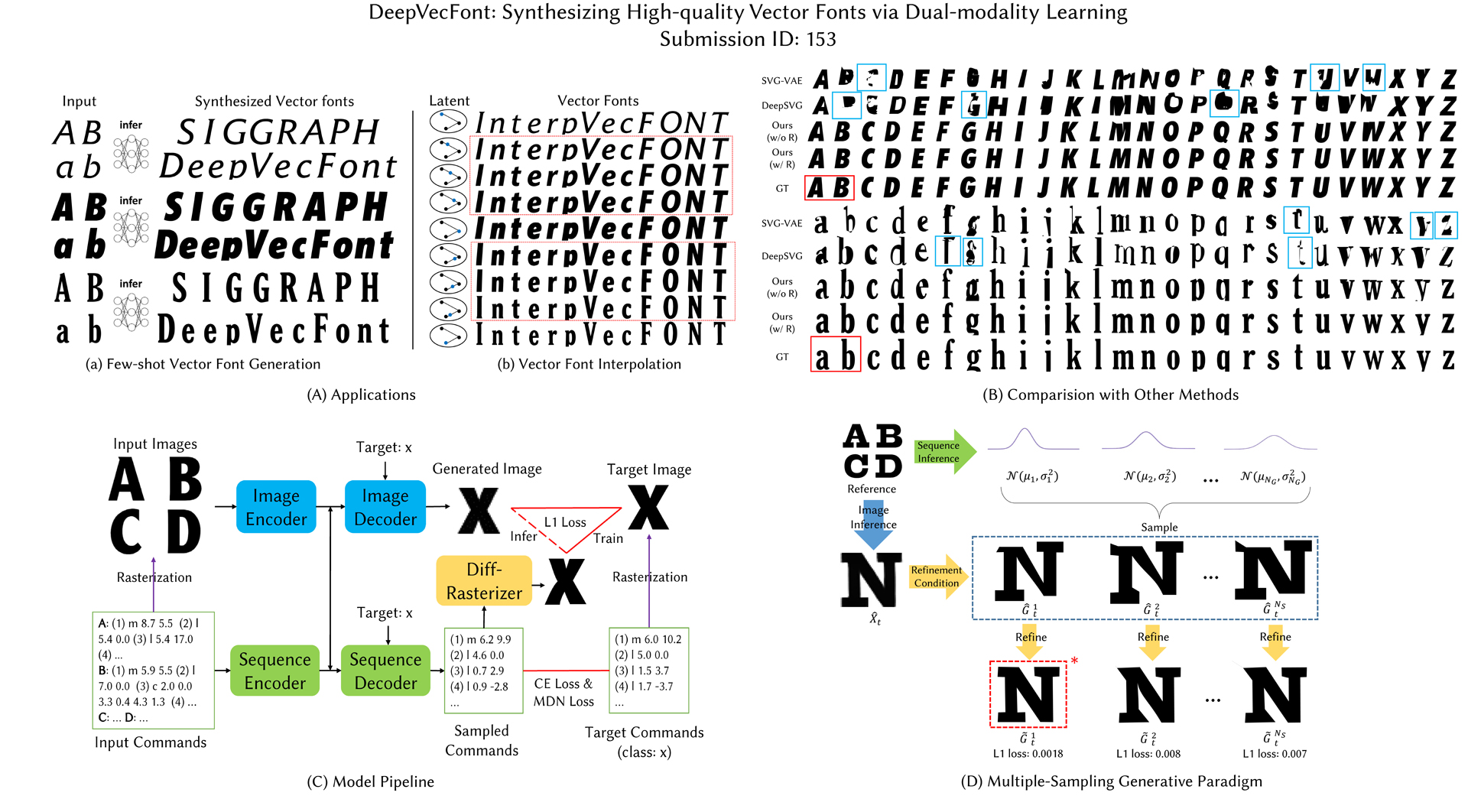
Automatic font generation based on deep learning has aroused a lot of interest in the last decade. However, only a few recently-reported approaches are capable of directly generating vector glyphs and their results are still far from satisfactory. In this paper, we propose a novel method, DeepVecFont, to effectively resolve this problem. Using our method, for the first time, visually-pleasing vector glyphs whose quality and compactness are both comparable to human-designed ones can be automatically generated. The key idea of our DeepVecFont is to adopt the techniques of image synthesis, sequence modeling and differentiable rasterization to exhaustively exploit the dual-modality information (i.e., raster images and vector outlines) of vector fonts. The highlights of this paper are threefold. First, we design a dual-modality learning strategy which utilizes both image-aspect and sequence-aspect features of fonts to synthesize vector glyphs. Second, we provide a new generative paradigm to handle unstructured data (e.g., vector glyphs) by randomly sampling plausible synthesis results to get the optimal one which is further refined under the guidance of generated structured data (e.g., glyph images). Finally, qualitative and quantitative experiments conducted on a publicly-available dataset demonstrate that our method obtains high-quality synthesis results in the applications of vector font generation and interpolation, significantly outperforming the state of the art.
References:
1. Samaneh Azadi, Matthew Fisher, Vladimir G Kim, Zhaowen Wang, Eli Shechtman, and Trevor Darrell. 2018. Multi-content gan for few-shot font style transfer. In Proceedings of the IEEE conference on computer vision and pattern recognition. 7564–7573.
2. Tadas Baltrušaitis, Chaitanya Ahuja, and Louis-Philippe Morency. 2018. Multimodal machine learning: A survey and taxonomy. IEEE transactions on pattern analysis and machine intelligence 41, 2 (2018), 423–443.
3. Christopher M Bishop. 1994. Mixture density networks. (1994).
4. Neill DF Campbell and Jan Kautz. 2014. Learning a manifold of fonts. ACM Transactions on Graphics (TOG) 33, 4 (2014), 91.
5. Alexandre Carlier, Martin Danelljan, Alexandre Alahi, and Radu Timofte. 2020. DeepSVG: A Hierarchical Generative Network for Vector Graphics Animation. In NeurIPS.
6. Kyunghyun Cho, Bart Van Merriënboer, Caglar Gulcehre, Dzmitry Bahdanau, Fethi Bougares, Holger Schwenk, and Yoshua Bengio. 2014. Learning phrase representations using RNN encoder-decoder for statistical machine translation. arXiv preprint arXiv:1406.1078 (2014).
7. Akira Fukui, Dong Huk Park, Daylen Yang, Anna Rohrbach, Trevor Darrell, and Marcus Rohrbach. 2016. Multimodal compact bilinear pooling for visual question answering and visual grounding. arXiv preprint arXiv:1606.01847 (2016).
8. Yue Gao, Yuan Guo, Zhouhui Lian, Yingmin Tang, and Jianguo Xiao. 2019. Artistic glyph image synthesis via one-stage few-shot learning. ACM Transactions on Graphics (TOG) 38, 6 (2019), 185.
9. Ian Goodfellow, Jean Pouget-Abadie, Mehdi Mirza, Bing Xu, David Warde-Farley, Sherjil Ozair, Aaron Courville, and Yoshua Bengio. 2014. Generative adversarial nets. In Advances in neural information processing systems. 2672–2680.
10. Alex Graves. 2013. Generating sequences with recurrent neural networks. arXiv preprint arXiv:1308.0850 (2013).
11. Yuan Guo, Zhouhui Lian, Yingmin Tang, and Jianguo Xiao. 2018. Creating New Chinese Fonts based on Manifold Learning and Adversarial Networks.. In Eurographics (Short Papers). 61–64.
12. David Ha and Douglas Eck. 2017. A neural representation of sketch drawings. arXiv preprint arXiv:1704.03477 (2017).
13. Sepp Hochreiter and Jürgen Schmidhuber. 1997. Long short-term memory. Neural computation 9, 8 (1997), 1735–1780.
14. Zhewei Huang, Wen Heng, and Shuchang Zhou. 2019. Learning to paint with model-based deep reinforcement learning. In Proceedings of the IEEE International Conference on Computer Vision. 8709–8718.
15. Phillip Isola, Jun-Yan Zhu, Tinghui Zhou, and Alexei A Efros. 2017. Image-to-image translation with conditional adversarial networks. In Proceedings of the IEEE conference on computer vision and pattern recognition. 1125–1134.
16. Yue Jiang, Zhouhui Lian, Yingmin Tang, and Jianguo Xiao. 2017. DCFont: an end-to-end deep Chinese font generation system. In SIGGRAPH Asia 2017 Technical Briefs. ACM, 22.
17. Justin Johnson, Alexandre Alahi, and Li Fei-Fei. 2016. Perceptual losses for real-time style transfer and super-resolution. In European conference on computer vision. Springer, 694–711.
18. Jin-Hwa Kim, Kyoung-Woon On, Woosang Lim, Jeonghee Kim, Jung-Woo Ha, and Byoung-Tak Zhang. 2016. Hadamard product for low-rank bilinear pooling. arXiv preprint arXiv:1610.04325 (2016).
19. Diederik P. Kingma and Jimmy Lei Ba. 2015. Adam: A Method for Stochastic Optimization. ICLR (2015).
20. Diederik P Kingma and Max Welling. 2013. Auto-encoding variational bayes. arXiv preprint arXiv:1312.6114 (2013).
21. Tzu-Mao Li, Michal Lukáč, Michaël Gharbi, and Jonathan Ragan-Kelley. 2020. Differentiable vector graphics rasterization for editing and learning. ACM Transactions on Graphics (TOG) 39, 6 (2020), 1–15.
22. Zhouhui Lian, Bo Zhao, Xudong Chen, and Jianguo Xiao. 2018. EasyFont: A Style Learning-Based System to Easily Build Your Large-Scale Handwriting Fonts. ACM Transactions on Graphics (TOG) 38, 1 (2018), 6.
23. Raphael Gontijo Lopes, David Ha, Douglas Eck, and Jonathon Shlens. 2019. A learned representation for scalable vector graphics. In Proceedings of the IEEE/CVF International Conference on Computer Vision. 7930–7939.
24. Pradyumna Reddy, Michael Gharbi, Michal Lukac, and Niloy J Mitra. 2021. Im2vec: Synthesizing vector graphics without vector supervision. In Proceedings of the IEEE/CVF Conference on Computer Vision and Pattern Recognition. 7342–7351.
25. Olaf Ronneberger, Philipp Fischer, and Thomas Brox. 2015. U-net: Convolutional networks for biomedical image segmentation. In International Conference on Medical image computing and computer-assisted intervention. Springer, 234–241.
26. Karen Simonyan and Andrew Zisserman. 2014. Very deep convolutional networks for large-scale image recognition. arXiv preprint arXiv:1409.1556 (2014).
27. Dmitriy Smirnov, Matthew Fisher, Vladimir G Kim, Richard Zhang, and Justin Solomon. 2020. Deep parametric shape predictions using distance fields. In Proceedings of the IEEE/CVF Conference on Computer Vision and Pattern Recognition. 561–570.
28. Rapee Suveeranont and Takeo Igarashi. 2010. Example-based automatic font generation. In International Symposium on Smart Graphics. Springer, 127–138.
29. Shusen Tang, Zeqing Xia, Zhouhui Lian, Yingmin Tang, and Jianguo Xiao. 2019. FontRNN: Generating Large-scale Chinese Fonts via Recurrent Neural Network. In Computer Graphics Forum, Vol. 38. Wiley Online Library, 567–577.
30. Yuchen Tian. 2017. Rewrite. (2017). Retrieved from https://github.com/kaonashityc/zi2zi/.
31. Laurens Van der Maaten and Geoffrey Hinton. 2008. Visualizing data using t-SNE. Journal of machine learning research 9, 11 (2008).
32. Ashish Vaswani, Noam Shazeer, Niki Parmar, Jakob Uszkoreit, Llion Jones, Aidan N Gomez, Łukasz Kaiser, and Illia Polosukhin. 2017. Attention is all you need. In Advances in neural information processing systems. 5998–6008.
33. Yizhi Wang, Yue Gao, and Zhouhui Lian. 2020. Attribute2Font: creating fonts you want from attributes. ACM Transactions on Graphics (TOG) 39, 4 (2020), 69–1.
34. Zhou Yu, Jun Yu, Jianping Fan, and Dacheng Tao. 2017. Multi-modal factorized bilinear pooling with co-attention learning for visual question answering. In Proceedings of the IEEE international conference on computer vision. 1821–1830.
35. Xu-Yao Zhang, Fei Yin, Yan-Ming Zhang, Cheng-Lin Liu, and Yoshua Bengio. 2017. Drawing and recognizing chinese characters with recurrent neural network. IEEE transactions on pattern analysis and machine intelligence 40, 4 (2017), 849–862.