
“Synthesizing scene-aware virtual reality teleport graphs” by Li, Huang, Lien and Yu
Conference:
Type(s):
Title:
- Synthesizing scene-aware virtual reality teleport graphs
Session/Category Title:
- Scene Synthesis and Navigation
Presenter(s)/Author(s):
Abstract:
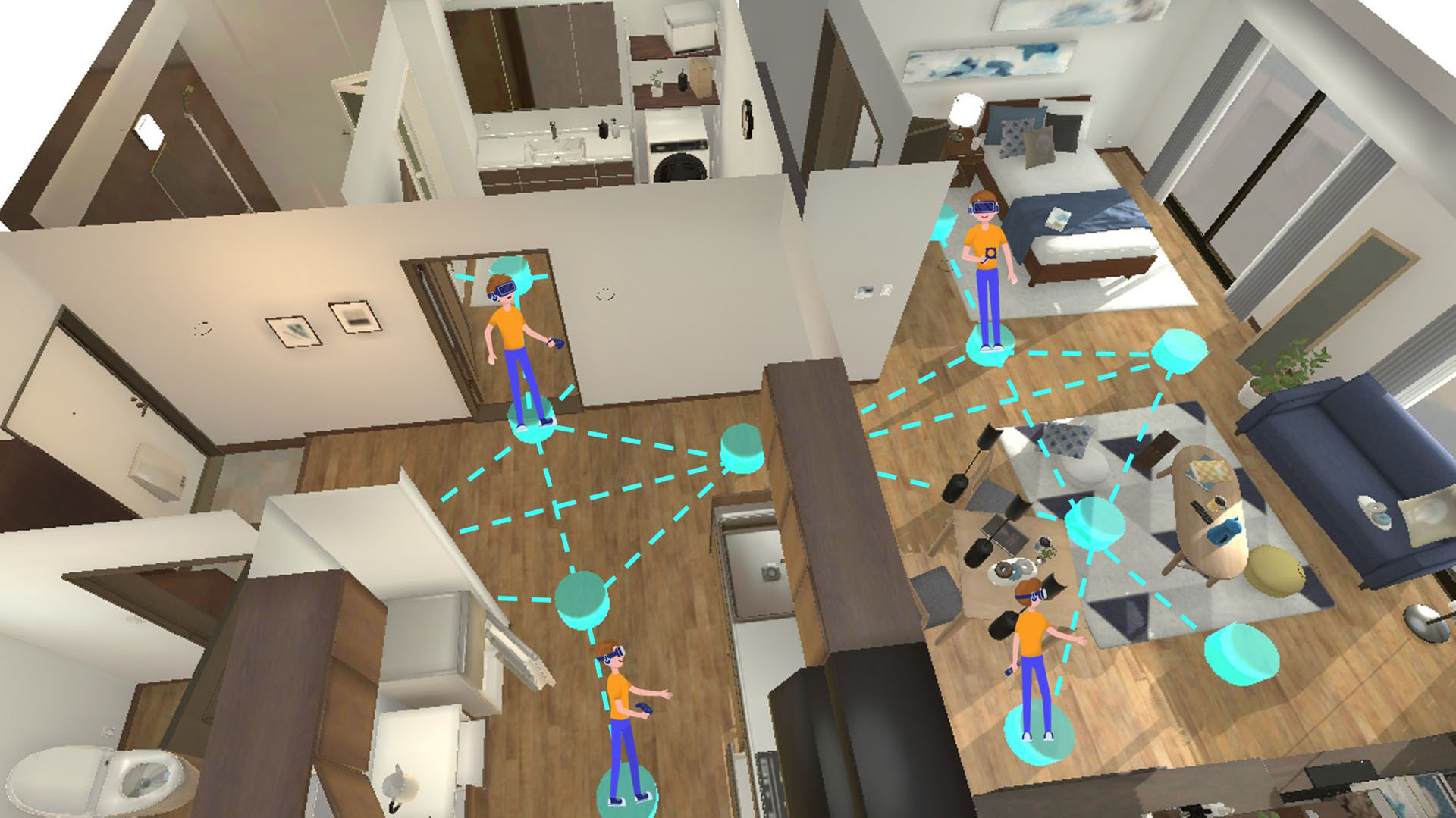
We present a novel approach for synthesizing scene-aware virtual reality teleport graphs, which facilitate navigation in indoor virtual environments by suggesting desirable teleport positions. Our approach analyzes panoramic views at candidate teleport positions by extracting scene perception graphs, which encode scene perception relationships between the observer and the surrounding objects, and predict how desirable the views at these positions are. We train a graph convolutional model to predict the scene perception scores of different teleport positions. Based on such predictions, we apply an optimization approach to sample a set of desirable teleport positions while considering other navigation properties such as coverage and connectivity to synthesize a teleport graph. Using teleport graphs, users can navigate virtual environments efficaciously. We demonstrate our approach for synthesizing teleport graphs for common indoor scenes. By conducting a user study, we validate the efficacy and desirability of navigating virtual environments via the synthesized teleport graphs. We also extend our approach to cope with different constraints, user preferences, and practical scenarios.
References:
1. Majed Al Zayer, Paul MacNeilage, and Eelke Folmer. 2018. Virtual locomotion: a survey. IEEE transactions on visualization and computer graphics (2018).
2. Dzmitry Bahdanau, Kyunghyun Cho, and Yoshua Bengio. 2014. Neural machine translation by jointly learning to align and translate. arXiv preprint arXiv:1409.0473 (2014).
3. Jiwan Bhandari, Paul R MacNeilage, and Eelke Folmer. 2018. Teleportation without Spatial Disorientation Using Optical Flow Cues.. In Graphics interface. 162–167.
4. Costas Boletsis. 2017. The new era of virtual reality locomotion: A systematic literature review of techniques and a proposed typology. Multimodal Technologies and Interaction 1, 4 (2017), 24.
5. Evren Bozgeyikli, Andrew Raij, Srinivas Katkoori, and Rajiv Dubey. 2016. Point & teleport locomotion technique for virtual reality. In Proceedings of the 2016 Annual Symposium on Computer-Human Interaction in Play. ACM, 205–216.
6. Fabio Buttussi and Luca Chittaro. 2019. Locomotion in Place in Virtual Reality: A Comparative Evaluation of Joystick, Teleport, and Leaning. IEEE transactions on visualization and computer graphics (2019).
7. Angel Chang, Angela Dai, Thomas Funkhouser, Maciej Halber, Matthias Niessner, Manolis Savva, Shuran Song, Andy Zeng, and Yinda Zhang. 2017. Matterport3D: Learning from RGB-D Data in Indoor Environments. International Conference on 3D Vision (3DV) (2017).
8. Shih-Han Chou, Cheng Sun, Wen-Yen Chang, Wan-Ting Hsu, Min Sun, and Jianlong Fu. 2020. 360-Indoor: Towards Learning Real-World Objects in 360deg Indoor Equirectangular Images. In The IEEE Winter Conference on Applications of Computer Vision. 845–853.
9. Benjamin Coors, Alexandru Paul Condurache, and Andreas Geiger. 2018. Spherenet: Learning spherical representations for detection and classificationin omnidirectional images. In Proceedings of the European Conference on Computer Vision. 518–533.
10. Zhi-Chao Dong, Xiao-Ming Fu, Zeshi Yang, and Ligang Liu. 2019. Redirected smooth mappings for multiuser real walking in virtual reality. ACM Transactions on Graphics (TOG) 38, 5 (2019), 1–17.
11. Li Fei-Fei. 2007. Recognizing and learning object categories. CVPR Short Course, 2007 (2007).
12. Tian Feng, Lap-Fai Yu, Sai-Kit Yeung, KangKang Yin, and Kun Zhou. 2016. Crowd-driven mid-scale layout design. ACM Trans. Graph. 35, 4 (2016), 132–1.
13. Sebastian Freitag, Benjamin Weyers, and Torsten W Kuhlen. 2016. Automatic speed adjustment for travel through immersive virtual environments based on viewpoint quality. In 2016 IEEE Symposium on 3D User Interfaces (3DUI). IEEE, 67–70.
14. Sebastian Freitag, Benjamin Weyers, and Torsten W Kuhlen. 2017. Efficient approximate computation of scene visibility based on navigation meshes and applications for navigation and scene analysis. In 2017 IEEE Symposium on 3D User Interfaces (3DUI). IEEE, 134–143.
15. Sebastian Freitag, Benjamin Weyers, and Torsten W Kuhlen. 2018. Interactive exploration assistance for immersive virtual environments based on object visibility and viewpoint quality. In 2018 IEEE Conference on Virtual Reality and 3D User Interfaces (VR). IEEE, 355–362.
16. Markus Funk, Florian Müller, Marco Fendrich, Megan Shene, Moritz Kolvenbach, Niclas Dobbertin, Sebastian Günther, and Max Mühlhäuser. 2019. Assessing the Accuracy of Point & Teleport Locomotion with Orientation Indication for Virtual Reality using Curved Trajectories. In Proceedings of the 2019 CHI Conference on Human Factors in Computing Systems. 1–12.
17. Thomas Gärtner, Peter Flach, and Stefan Wrobel. 2003. On graph kernels: Hardness results and efficient alternatives. In Learning theory and kernel machines. Springer, 129–143.
18. Wilson S Geisler. 2008. Visual perception and the statistical properties of natural scenes. Annu. Rev. Psychol. 59 (2008), 167–192.
19. Peter J Green. 1995. Reversible jump Markov chain Monte Carlo computation and Bayesian model determination. Biometrika 82, 4 (1995), 711–732.
20. MP Jacob Habgood, David Moore, David Wilson, and Sergio Alapont. 2018. Rapid, continuous movement between nodes as an accessible virtual reality locomotion technique. In 2018 IEEE Conference on Virtual Reality and 3D User Interfaces (VR). IEEE, 371–378.
21. Kaiming He, Xiangyu Zhang, Shaoqing Ren, and Jian Sun. 2016. Deep residual learning for image recognition. In Proceedings of the IEEE conference on computer vision and pattern recognition. 770–778.
22. Peter Hedström and Charlotta Stern. 2008. Rational choice and sociology. The new Palgrave dictionary of economics 2 (2008).
23. Dichao Hu. 2019. An introductory survey on attention mechanisms in NLP problems. In Proceedings of SAI Intelligent Systems Conference. Springer, 432–448.
24. Laurent Itti, Christof Koch, and Ernst Niebur. 1998. A model of saliency-based visual attention for rapid scene analysis. IEEE Transactions on pattern analysis and machine intelligence 20, 11 (1998), 1254–1259.
25. Scott Kirkpatrick, C Daniel Gelatt, and Mario P Vecchi. 1983. Optimization by simulated annealing. science 220, 4598 (1983), 671–680.
26. Eike Langbehn, Paul Lubos, and Frank Steinicke. 2018. Evaluation of locomotion techniques for room-scale vr: Joystick, teleportation, and redirected walking. In Proceedings of the Virtual Reality International Conference-Laval Virtual. 1–9.
27. Yujia Li, Oriol Vinyals, Chris Dyer, Razvan Pascanu, and Peter Battaglia. 2018. Learning deep generative models of graphs. arXiv preprint arXiv:1803.03324 (2018).
28. Yong-Lu Li, Siyuan Zhou, Xijie Huang, Liang Xu, Ze Ma, Hao-Shu Fang, Yanfeng Wang, and Cewu Lu. 2019. Transferable interactiveness knowledge for human-object interaction detection. In Proceedings of the IEEE Conference on Computer Vision and Pattern Recognition. 3585–3594.
29. Tsung-Yi Lin, Piotr Dollár, Ross Girshick, Kaiming He, Bharath Hariharan, and Serge Belongie. 2017. Feature pyramid networks for object detection. In Proceedings of the IEEE conference on computer vision and pattern recognition. 2117–2125.
30. Imran Mahalil, Azmi Mohd Yusof, Nazrita Ibrahim, Eze Manzura Mohd Mahidin, and Mohd Ezanee Rusli. 2019. Virtual Reality Mini Map Presentation Techniques: Lessons and experience learned. In 2019 IEEE Conference on Graphics and Media (GAME). IEEE, 26–31.
31. Siyuan Qi, Wenguan Wang, Baoxiong Jia, Jianbing Shen, and Song-Chun Zhu. 2018a. Learning human-object interactions by graph parsing neural networks. In Proceedings of the European Conference on Computer Vision (ECCV). 401–417.
32. Siyuan Qi, Yixin Zhu, Siyuan Huang, Chenfanfu Jiang, and Song-Chun Zhu. 2018b. Human-centric indoor scene synthesis using stochastic grammar. In Proceedings of the IEEE Conference on Computer Vision and Pattern Recognition. 5899–5908.
33. Sharif Razzaque, Zachariah Kohn, and Mary C. Whitton. 2001. Redirected Walking. In Eurographics 2001 – Short Presentations. Eurographics Association.
34. Shaoqing Ren, Kaiming He, Ross Girshick, and Jian Sun. 2015. Faster r-cnn: Towards real-time object detection with region proposal networks. In Advances in neural information processing systems. 91–99.
35. Ronald A Rensink. 2000. Scene perception. Encyclopedia of psychology 7 (2000), 151–155.
36. Jeffrey N Rouder, Paul L Speckman, Dongchu Sun, Richard D Morey, and Geoffrey Iverson. 2009. Bayesian t tests for accepting and rejecting the null hypothesis. Psychonomic bulletin & review 16, 2 (2009), 225–237.
37. Shlomo S Sawilowsky. 2009. New effect size rules of thumb. Journal of modern applied statistical methods 8, 2 (2009), 26.
38. Ehsan Sayyad, Misha Sra, and Tobias Höllerer. 2020. Walking and Teleportation in Wide-area Virtual Reality Experiences. In 2020 IEEE International Symposium on Mixed and Augmented Reality (ISMAR). IEEE, 608–617.
39. Nino Shervashidze, Pascal Schweitzer, Erik Jan Van Leeuwen, Kurt Mehlhorn, and Karsten M Borgwardt. 2011. Weisfeiler-lehman graph kernels. Journal of Machine Learning Research 12, 9 (2011).
40. Mel Slater, Martin Usoh, and Anthony Steed. 1995. Taking steps: the influence of a walking technique on presence in virtual reality. ACM Transactions on Computer-Human Interaction (TOCHI) 2, 3 (1995), 201–219.
41. Richard Stoakley, Matthew J Conway, and Randy Pausch. 1995. Virtual reality on a WIM: interactive worlds in miniature. In Proceedings of the SIGCHI conference on Human factors in computing systems. 265–272.
42. Qi Sun, Anjul Patney, Li-Yi Wei, Omer Shapira, Jingwan Lu, Paul Asente, Suwen Zhu, Morgan Mcguire, David Luebke, and Arie Kaufman. 2018. Towards virtual reality infinite walking: dynamic saccadic redirection. ACM Transactions on Graphics (TOG) 37, 4 (2018), 67.
43. Oytun Ulutan, ASM Iftekhar, and Bangalore S Manjunath. 2020. VSGNet: Spatial Attention Network for Detecting Human Object Interactions Using Graph Convolutions. In Proceedings of the IEEE/CVF Conference on Computer Vision and Pattern Recognition. 13617–13626.
44. Martin Usoh, Kevin Arthur, Mary C Whitton, Rui Bastos, Anthony Steed, Mel Slater, and Frederick P Brooks Jr. 1999. Walking> walking-in-place> flying, in virtual environments. In Proceedings of the 26th annual conference on Computer graphics and interactive techniques. ACM Press/Addison-Wesley Publishing Co., 359–364.
45. Petar Veličković, Guillem Cucurull, Arantxa Casanova, Adriana Romero, Pietro Lio, and Yoshua Bengio. 2017. Graph attention networks. arXiv preprint arXiv:1710.10903 (2017).
46. S Vichy N Vishwanathan, Nicol N Schraudolph, Risi Kondor, and Karsten M Borgwardt. 2010. Graph kernels. The Journal of Machine Learning Research 11 (2010), 1201–1242.
47. Kai Wang, Yu-An Lin, Ben Weissmann, Manolis Savva, Angel X Chang, and Daniel Ritchie. 2019. Planit: Planning and instantiating indoor scenes with relation graph and spatial prior networks. ACM Transactions on Graphics (TOG) 38, 4 (2019), 1–15.
48. Fei Xia, Amir R. Zamir, Zhi-Yang He, Alexander Sax, Jitendra Malik, and Silvio Savarese. 2018. Gibson env: real-world perception for embodied agents. In Proceedings of the IEEE conference on computer vision and pattern recognition.
49. Si Zhang, Hanghang Tong, Jiejun Xu, and Ross Maciejewski. 2019. Graph convolutional networks: a comprehensive review. Computational Social Networks 6, 1 (2019), 11.
50. Yin Zhang, Rong Jin, and Zhi-Hua Zhou. 2010. Understanding bag-of-words model: a statistical framework. International Journal of Machine Learning and Cybernetics 1, 1-4 (2010), 43–52.
51. Yixin Zhu, Chenfanfu Jiang, Yibiao Zhao, Demetri Terzopoulos, and Song-Chun Zhu. 2016. Inferring forces and learning human utilities from videos. In Proceedings of the IEEE Conference on Computer Vision and Pattern Recognition. 3823–3833.



