
“Light stage super-resolution: continuous high-frequency relighting” by Sun, Xu, Zhang, Fanello, Rhemann, et al. …
Conference:
Type(s):
Title:
- Light stage super-resolution: continuous high-frequency relighting
Session/Category Title:
- Neural Rendering
Presenter(s)/Author(s):
Abstract:
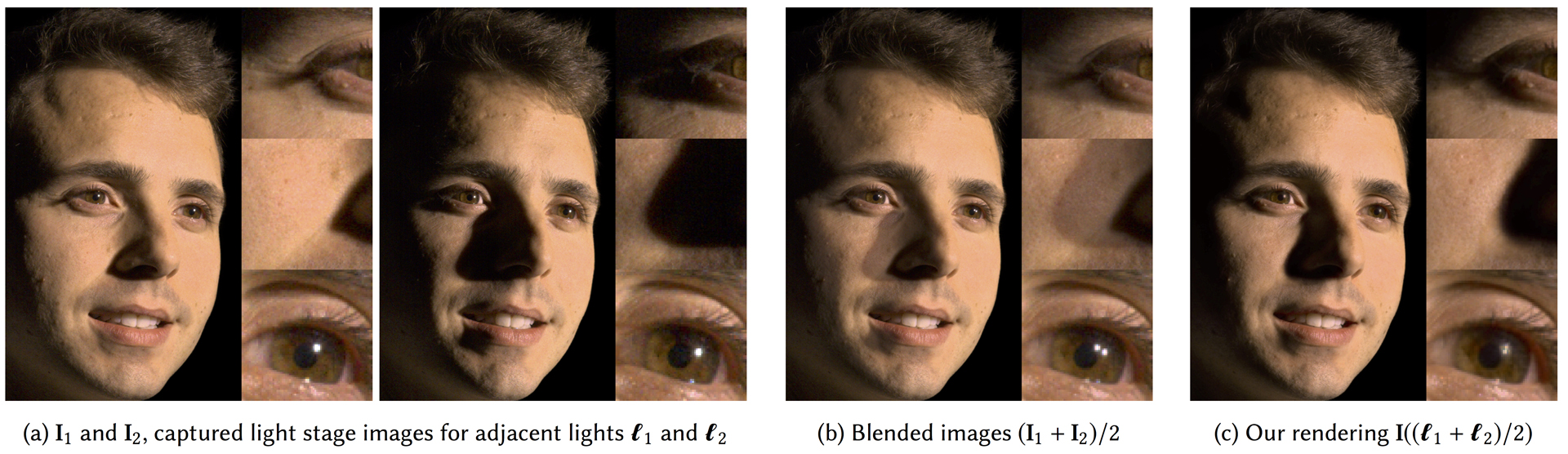
The light stage has been widely used in computer graphics for the past two decades, primarily to enable the relighting of human faces. By capturing the appearance of the human subject under different light sources, one obtains the light transport matrix of that subject, which enables image-based relighting in novel environments. However, due to the finite number of lights in the stage, the light transport matrix only represents a sparse sampling on the entire sphere. As a consequence, relighting the subject with a point light or a directional source that does not coincide exactly with one of the lights in the stage requires interpolation and resampling the images corresponding to nearby lights, and this leads to ghosting shadows, aliased specularities, and other artifacts. To ameliorate these artifacts and produce better results under arbitrary high-frequency lighting, this paper proposes a learning-based solution for the “super-resolution” of scans of human faces taken from a light stage. Given an arbitrary “query” light direction, our method aggregates the captured images corresponding to neighboring lights in the stage, and uses a neural network to synthesize a rendering of the face that appears to be illuminated by a “virtual” light source at the query location. This neural network must circumvent the inherent aliasing and regularity of the light stage data that was used for training, which we accomplish through the use of regularized traditional interpolation methods within our network. Our learned model is able to produce renderings for arbitrary light directions that exhibit realistic shadows and specular highlights, and is able to generalize across a wide variety of subjects. Our super-resolution approach enables more accurate renderings of human subjects under detailed environment maps, or the construction of simpler light stages that contain fewer light sources while still yielding comparable quality renderings as light stages with more densely sampled lights.
References:
1. Martin Abadi, Paul Barham, Jianmin Chen, Zhifeng Chen, Andy Davis, Jeffrey Dean, et al. 2016. TensorFlow: A system for large-scale machine learning. OSDI (2016).Google Scholar
2. Apple. 2017. Use Portrait mode on your iPhone. https://support.apple.com/en-us/HT208118.Google Scholar
3. Jin-Xiang Chai, Xin Tong, Shing-Chow Chan, and Heung-Yeung Shum. 2000. Plenoptic Sampling. In SIGGRAPH.Google Scholar
4. Zhen Cheng, Zhiwei Xiong, Chang Chen, and Dong Liu. 2019. Light Field Super-Resolution: A Benchmark. In CVPR Workshops.Google Scholar
5. Paul Debevec. 2012. The Light Stages and Their Applications to Photoreal Digital Actors. In SIGGRAPH Asia.Google Scholar
6. Paul Debevec, Tim Hawkins, Chris Tchou, Haarm-Pieter Duiker, Westley Sarokin, and Mark Sagar. 2000. Acquiring the reflectance field of a human face. In SIGGRAPH.Google Scholar
7. Frédo Durand, Nicolas Holzschuch, Cyril Soler, Eric Chan, and François X. Sillion. 2005. A Frequency Analysis of Light Transport. In SIGGRAPH.Google Scholar
8. Martin Fuchs, Hendrik PA Lensch, Volker Blanz, and Hans-Peter Seidel. 2007. Superresolution reflectance fields: Synthesizing images for intermediate light directions. In Computer Graphics Forum, Vol. 26. Wiley Online Library, 447–456.Google Scholar
9. Kaiwen Guo, Jason Dourgarian, Danhang Tang, Anastasia tkach, Adarsh Kowdle, Emily Cooper, Mingsong Dou, Sean Fanello, Graham Fyffe, Christoph Rhemann, Jonathan Taylor, Peter Lincoln, Paul Debevec, Shahram Izad, Philip Davidson, Jay Busch, Xueming Yu, Matt Whalen, Geoff Harvey, Sergio Orts-Escolano, and Rohit Pandey. 2019. The Relightables: Volumetric Performance Capture of Humans with Realistic Relighting. In SIGGRAPH Asia.Google Scholar
10. Kaiming He, Xiangyu Zhang, Shaoqing Ren, and Jian Sun. 2015. Delving deep into rectifiers: Surpassing human-level performance on imagenet classification. CVPR (2015).Google Scholar
11. Nima Khademi Kalantari, Ting-Chun Wang, and Ravi Ramamoorthi. 2016. Learning-based view synthesis for light field cameras. SIGGRAPH (2016).Google Scholar
12. Kaizhang Kang, Zimin Chen, Jiaping Wang, Kun Zhou, and Hongzhi Wu. 2018. Efficient reflectance capture using an autoencoder. SIGGRAPH (2018).Google Scholar
13. Tero Karras, Timo Aila, Samuli Laine, and Jaakko Lehtinen. 2018. Progressive Growing of GANs for Improved Quality, Stability, and Variation. In ICLR.Google Scholar
14. Markus Kettunen, Erik Härkönen, and Jaakko Lehtinen. 2019. E-LPIPS: Robust Perceptual Image Similarity via Random Transformation Ensembles. CoRR abs/1906.03973 (2019). http://arxiv.org/abs/1906.03973Google Scholar
15. Diederik P. Kingma and Jimmy Ba. 2015. Adam: A Method for Stochastic Optimization. ICLR (2015).Google Scholar
16. Stephen Lombardi, Jason Saragih, Tomas Simon, and Yaser Sheikh. 2018. Deep appearance models for face rendering. SIGGRAPH (2018).Google Scholar
17. Jonathan Long, Evan Shelhamer, and Trevor Darrell. 2015. Fully convolutional networks for semantic segmentation. In CVPR.Google Scholar
18. Vincent Masselus, Pieter Peers, Philip Dutré, and Yves D Willemsy. 2004. Smooth reconstruction and compact representation of reflectance functions for image-based relighting. In Proceedings of the fifteenth eurographics conference on rendering techniques.Google ScholarDigital Library
19. Abhimitra Meka, Christian Haene, Rohit Pandey, Michael Zollhöfer, Sean Fanello, Graham Fyffe, Adarsh Kowdle, Xueming Yu, Jay Busch, Jason Dourgarian, et al. 2019. Deep Reflectance Fields: High-Quality Facial Reflectance Field Inference from Color Gradient Illumination.Google Scholar
20. Peyman Milanfar. 2010. Super-resolution imaging. CRC Press.Google Scholar
21. Ben Mildenhall, Pratul P. Srinivasan, Rodrigo Ortiz-Cayon, Nima Khademi Kalantari, Ravi Ramamoorthi, Ren Ng, and Abhishek Kar. 2019. Local Light Field Fusion: Practical View Synthesis with Prescriptive Sampling Guidelines. In SIGGRAPH.Google Scholar
22. Thomas Nestmeyer, Iain Matthews, Jean-François Lalonde, and Andreas M Lehrmann. 2019. Structural Decompositions for End-to-End Relighting. arXiv preprint arXiv:1906.03355 (2019).Google Scholar
23. Ren Ng, Ravi Ramamoorthi, and Pat Hanrahan. 2003. All-Frequency Shadows using Non-Linear Wavelet Lighting Approximation. In SIGGRAPH.Google Scholar
24. Matthew O’Toole and Kiriakos N. Kutulakos. 2010. Optical Computing for Fast Light Transport. In SIGGRAPH.Google Scholar
25. Pieter Peers, Dhruv K Mahajan, Bruce Lamond, Abhijeet Ghosh, Wojciech Matusik, Ravi Ramamoorthi, and Paul Debevec. 2009. Compressive Light Transport Sensing. ACM TOG (2009).Google Scholar
26. Gilles Rainer, Wenzel Jakob, Abhijeet Ghosh, and Tim Weyrich. 2019. Neural btf compression and interpolation. In Computer Graphics Forum.Google Scholar
27. Ravi Ramamoorthi and Pat Hanrahan. 2001. A Signal-Processing Framework for Inverse Rendering. In SIGGRAPH.Google Scholar
28. Peiran Ren, Yue Dong, Stephen Lin, Xin Tong, and Baining Guo. 2015. Image Based Relighting Using Neural Networks. ACM TOG (2015).Google Scholar
29. Peiran Ren, Jiaping Wang, Minmin Gong, Stephen Lin, Xin Tong, and Baining Guo. 2013. Global illumination with radiance regression functions. SIGGRAPH (2013).Google Scholar
30. Olaf Ronneberger, Philipp Fischer, and Thomas Brox. 2015. U-Net: Convolutional Networks for Biomedical Image Segmentation. In MICCAI.Google Scholar
31. I Sato, T Okabe, Y Sato, and K Ikeuchi. 2003. Appearance Sampling for Obtaining a set of basis images for variable illumination. In ICCV.Google Scholar
32. P. Sen and S. Darabi. 2009. Compressive Dual Photography. Computer Graphics Forum (2009).Google Scholar
33. Soumyadip Sengupta, Angjoo Kanazawa, Carlos D. Castillo, and David W. Jacobs. 2018. SfSNet: Learning Shape, Reflectance and Illuminance of Faces in the Wild. In CVPR.Google Scholar
34. Nitish Srivastava, Geoffrey Hinton, Alex Krizhevsky, Ilya Sutskever, and Ruslan Salakhutdinov. 2014. Dropout: a Simple Way to Prevent Neural Networks from Overfitting. JMLR (2014).Google Scholar
35. Tiancheng Sun, Jonathan T. Barron, Yun-Ta Tsai, Zexiang Xu, Xueming Yu, Graham Fyffe, Christoph Rhemann, Jay Busch, Paul E. Debevec, and Ravi Ramamoorthi. 2019. Single Image Portrait Relighting. SIGGRAPH (2019).Google Scholar
36. Ayush Tewari, Ohad Fried, Justus Thies, Vincent Sitzmann, Stephen Lombardi, Kalyan Sunkavalli, Ricardo Martin-Brualla, Tomas Simon, Jason Saragih, Matthias Nießner, et al. 2020. State of the Art on Neural Rendering. (2020).Google Scholar
37. Borom Tunwattanapong, Graham Fyffe, Paul Graham, Jay Busch, Xueming Yu, Abhijeet Ghosh, and Paul Debevec. 2013. Acquiring reflectance and shape from continuous spherical harmonic illumination. SIGGRAPH (2013).Google Scholar
38. Borom Tunwattanapong, Abhijeet Ghosh, and Paul Debevec. 2011. Practical image-based relighting and editing with spherical-harmonics and local lights. In 2011 Conference for Visual Media Production. IEEE.Google ScholarDigital Library
39. Dmitry Ulyanov, Andrea Vedaldi, and Victor Lempitsky. 2016. Instance normalization: The missing ingredient for fast stylization. arXiv preprint arXiv:1607.08022 (2016).Google Scholar
40. J Wang, Y Dong, X Tong, Z Lin, and B Guo. 2009. Kernel Nystrom method for light transport. ACM Transactions on Graphics (2009).Google Scholar
41. Zhou Wang, Alan C. Bovik, Hamid R. Sheikh, and Eero P. Simoncelli. 2004. Image quality assessment: from error visibility to structural similarity. TIP (2004).Google Scholar
42. Andreas Wenger, Andrew Gardner, Chris Tchou, Jonas Unger, Tim Hawkins, and Paul Debevec. 2005. Performance Relighting and Reflectance Transformation with Time-multiplexed Illumination. SIGGRAPH (2005).Google Scholar
43. Robert J. Woodham. 1980. Photometric Method For Determining Surface Orientation From Multiple Images. Optical Engineering (1980).Google Scholar
44. Yuxin Wu and Kaiming He. 2018. Group Normalization. In ECCV.Google Scholar
45. Zexiang Xu, Kalyan Sunkavalli, Sunil Hadap, and Ravi Ramamoorthi. 2018. Deep image-based relighting from optimal sparse samples. In SIGGRAPH.Google Scholar



