
“Glossy probe reprojection for interactive global illumination” by Rodriguez, Leimkühler, Prakash, Wyman, Shirley, et al. …
Conference:
Type(s):
Title:
- Glossy probe reprojection for interactive global illumination
Session/Category Title:
- Light Transport: Methods
Presenter(s)/Author(s):
Abstract:
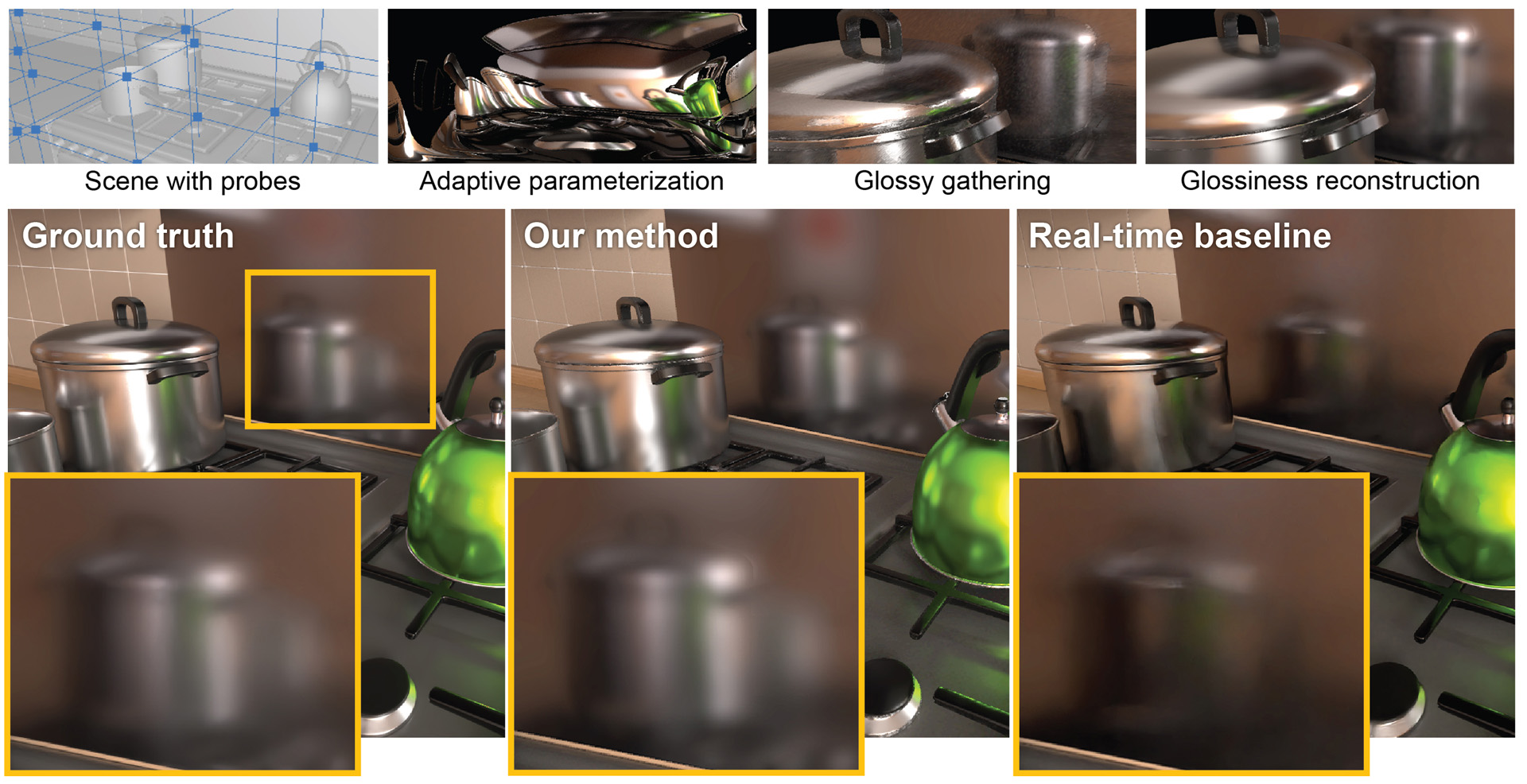
Recent rendering advances dramatically reduce the cost of global illumination. But even with hardware acceleration, complex light paths with multiple glossy interactions are still expensive; our new algorithm stores these paths in precomputed light probes and reprojects them at runtime to provide interactivity. Combined with traditional light maps for diffuse lighting our approach interactively renders all light paths in static scenes with opaque objects. Naively reprojecting probes with glossy lighting is memory-intensive, requires efficient access to the correctly reflected radiance, and exhibits problems at occlusion boundaries in glossy reflections. Our solution addresses all these issues. To minimize memory, we introduce an adaptive light probe parameterization that allocates increased resolution for shinier surfaces and regions of higher geometric complexity. To efficiently sample glossy paths, our novel gathering algorithm reprojects probe texels in a view-dependent manner using efficient reflection estimation and a fast rasterization-based search. Naive probe reprojection often sharpens glossy reflections at occlusion boundaries, due to changes in parallax. To avoid this, we split the convolution induced by the BRDF into two steps: we precompute probes using a lower material roughness and apply an adaptive bilateral filter at runtime to reproduce the original surface roughness. Combining these elements, our algorithm interactively renders complex scenes while fitting in the memory, bandwidth, and computation constraints of current hardware.
References:
1. Nasir Ahmed, T Raj Natarajan, and Kamisetty R Rao. 1974. Discrete cosine transform. IEEE Trans. Comput. 100, 1 (1974), 90–93.Google ScholarDigital Library
2. Nir Benty, Kai-Hwa Yao, Petrik Clarberg, Lucy Chen, Simon Kallweit, Tim Foley, Matthew Oakes, Conor Lavelle, and Chris Wyman. 2020. The Falcor rendering framework. https://github.com/NVIDIAGameWorks/FalcorGoogle Scholar
3. Benedikt Bitterli. 2016. Rendering resources. https://benedikt-bitterli.me/resources/.Google Scholar
4. Chris Buehler, Michael Bosse, Leonard McMillan, Steven Gortler, and Michael Cohen. 2001. Unstructured lumigraph rendering. In Proceedings of the 28th annual conference on Computer Graphics and Interactive Techniques. ACM, 425–432.Google ScholarDigital Library
5. John Burgess. 2020. RTX on the NVIDIA Turing GPU. IEEE Micro 40, 2 (2020), 36–44.Google ScholarCross Ref
6. Min Chen and James Arvo. 2000a. Perturbation methods for interactive specular reflections. IEEE Transactions on Visualization and Computer Graphics 6, 3 (2000), 253–264.Google ScholarDigital Library
7. Min Chen and James Arvo. 2000b. Theory and application of specular path perturbation. ACM Transactions on Graphics (TOG) 19, 4 (2000), 246–278.Google ScholarDigital Library
8. Shenchang Eric Chen, Holly E Rushmeier, Gavin Miller, and Douglass Turner. 1991. A progressive multi-pass method for global illumination. In ACM SIGGRAPH Computer Graphics, Vol. 25. ACM, 165–174.Google ScholarDigital Library
9. Abhinav Dayal, Cliff Woolley, Benjamin Watson, and David Luebke. 2005. Adaptive frameless rendering. In ACM SIGGRAPH Courses. ACM, 24.Google Scholar
10. Pau Estalella, Ignacio Martin, George Drettakis, Dani Tost, Olivier Devillers, and Frédéric Cazals. 2005. Accurate Interactive Specular Reflections on Curved Objects. In Proceedings of Vision Modeling and Visualization. Eurographics Association. http://www-sop.inria.fr/reves/Basilic/2005/EMDTDC05Google Scholar
11. Sebastian Friston, Tobias Ritschel, and Anthony Steed. 2019. Perceptual Rasterization for Head-mounted Display Image Synthesis. ACM Transactions on Graphics (TOG) 38, 4 (2019).Google ScholarDigital Library
12. Eduardo SL Gastal and Manuel M Oliveira. 2011. Domain transform for edge-aware image and video processing. ACM Transactions on Graphics (TOG) (2011), 1–12.Google Scholar
13. Jan-Mark Geusebroek, Arnold WM Smeulders, and Joost Van De Weijer. 2003. Fast anisotropic gauss filtering. IEEE Transactions on Image Processing 12, 8 (2003), 938–943.Google ScholarDigital Library
14. Gene Greger, Peter Shirley, Philip M Hubbard, and Donald P Greenberg. 1998. The irradiance volume. IEEE Computer Graphics and Applications 18, 2 (1998), 32–43.Google ScholarDigital Library
15. Ziyad S Hakura and John M Snyder. 2001. Realistic reflections and refractions on graphics hardware with hybrid rendering and layered environment maps. In Rendering Techniques 2001. Springer, 289–300.Google ScholarCross Ref
16. Ziyad S Hakura, John M Snyder, and Jerome E Lengyel. 2001. Parameterized environment maps. In Proceedings of the Symposium on Interactive 3D Graphics. ACM, 203–208.Google ScholarDigital Library
17. Paul S Heckbert. 1990. Adaptive radiosity textures for bidirectional ray tracing. ACM SIGGRAPH Computer Graphics 24, 4 (1990), 145–154.Google ScholarDigital Library
18. Antti Hirvonen, Atte Seppälä, Maksim Aizenshtein, and Niklas Smal. 2019. Accurate Real-Time Specular Reflections with Radiance Caching. In Ray Tracing Gems. Springer, 571–607.Google Scholar
19. Jozef Hladky, Hans-Peter Seidel, and Markus Steinberger. 2019. Tessellated Shading Streaming. In Computer Graphics Forum, Vol. 38. Wiley Online Library, 171–182.Google Scholar
20. Wenzel Jakob. 2010. Mitsuba renderer. http://www.mitsuba-renderer.org/index_old.html.Google Scholar
21. Wenzel Jakob. 2013. Light transport on path-space manifolds.Google Scholar
22. Anton S Kaplanyan, Stephan Hill, Anjul Patney, and Aaron E Lefohn. 2016. Filtering distributions of normals for shading antialiasing.. In Proceedings of High Performance Graphics. ACM, 151–162.Google ScholarDigital Library
23. Brian Karis. 2014. High-quality temporal supersampling. Advances in Real-Time Rendering in Games, ACM SIGGRAPH Courses 1 (2014), 1–55.Google Scholar
24. Hans Knutsson and C-F Westin. 1993. Normalized and differential convolution. In Proceedings of the IEEE Conference on Computer Vision and Pattern Recognition. IEEE, 515–523.Google ScholarCross Ref
25. Sébastien Lagarde and Antoine Zanuttini. 2012. Local image-based lighting with parallax-corrected cubemaps. In ACM SIGGRAPH 2012 Talks. ACM, 36.Google Scholar
26. Jaakko Lehtinen, Timo Aila, Samuli Laine, and Frédo Durand. 2012. Reconstructing the indirect light field for global illumination. ACM Transactions on Graphics (TOG) 31, 4 (2012), 1–10.Google ScholarDigital Library
27. Dani Lischinski and Ari Rappoport. 1998. Image-based rendering for non-diffuse synthetic scenes. In Rendering Techniques’ 98. Springer, 301–314.Google Scholar
28. Gerrit Lochmann, Bernhard Reinert, Tobias Ritschel, Stefan Müller, and Hans-Peter Seidel. 2014. Real-time Reflective and Refractive Novel-view Synthesis. In Proceedings of Vision Modeling and Visualization. Eurographics Association, 9–16.Google Scholar
29. Artur Loza, Lyudmila Mihaylova, Nishan Canagarajah, and David Bull. 2006. Structural similarity-based object tracking in video sequences. In 9th International Conference on Information Fusion. IEEE, 1–6.Google ScholarCross Ref
30. Christian Luksch, Robert F Tobler, Ralf Habel, Michael Schwärzler, and Michael Wimmer. 2013. Fast light-map computation with virtual polygon lights. In Proceedings of the Symposium on Interactive 3D Graphics and Games. ACM, 87–94.Google ScholarDigital Library
31. Christan Luksch, Michael Wimmer, and Michael Schwärzler. 2019. Incrementally baked global illumination. In Proceedings of the Symposium on Interactive 3D Graphics and Games. ACM, 4.Google ScholarDigital Library
32. Zander Majercik, Jean-Philippe Guertin, Derek Nowrouzezahrai, and Morgan McGuire. 2019. Dynamic diffuse global illumination with ray-traced irradiance fields. Journal of Computer Graphics Techniques 8, 2 (2019).Google Scholar
33. Morgan McGuire, Michael Mara, and Zander Majercik. 2017a. The G3D Innovation Engine. https://casual-effects.com/g3d https://casual-effects.com/g3d.Google Scholar
34. Morgan McGuire, Mike Mara, Derek Nowrouzezahrai, and David Luebke. 2017b. Real-time global illumination using precomputed light field probes. In Proceedings of the Symposium on Interactive 3D Graphics and Games. ACM, 2.Google ScholarDigital Library
35. Mark Meyer, Mathieu Desbrun, Peter Schröder, and Alan H Barr. 2003. Discrete differential-geometry operators for triangulated 2-manifolds. In Visualization and Mathematics III. Springer, 35–57.Google Scholar
36. Ben Mildenhall, Pratul P Srinivasan, Matthew Tancik, Jonathan T Barron, Ravi Ramamoorthi, and Ren Ng. 2020. Nerf: Representing scenes as neural radiance fields for view synthesis. arXiv preprint arXiv:2003.08934 (2020).Google Scholar
37. Joerg H Mueller, Philip Voglreiter, Mark Dokter, Thomas Neff, Mina Makar, Markus Steinberger, and Dieter Schmalstieg. 2018. Shading atlas streaming. ACM Transactions on Graphics (TOG) 37, 6 (2018), 1–16.Google ScholarDigital Library
38. Diego Nehab, Pedro V Sander, Jason Lawrence, Natalya Tatarchuk, and John R Isidoro. 2007. Accelerating real-time shading with reverse reprojection caching. In Graphics Hardware, Vol. 41. ACM, 61–62.Google Scholar
39. NVIDIA. 2018. NVIDIA Turing GPU architecture: Graphics reinvented. https://www.nvidia.com/content/dam/en-zz/Solutions/design-visualization/technologies/turing-architecture/NVIDIA-Turing-Architecture-Whitepaper.pdfGoogle Scholar
40. Eyal Ofek and Ari Rappoport. 1998. Interactive reflections on curved objects. In Proceedings of the 25th annual conference on Computer Graphics and Interactive Techniques. ACM, 333–342.Google ScholarDigital Library
41. Steven G Parker, James Bigler, Andreas Dietrich, Heiko Friedrich, Jared Hoberock, David Luebke, David McAllister, Morgan McGuire, Keith Morley, Austin Robison, and Martin Stich. 2010. OptiX: a general purpose ray tracing engine. ACM Transactions on Graphics (TOG) 29, 4 (2010), 1–13.Google ScholarDigital Library
42. Tuan Q Pham and Lucas J Van Vliet. 2005. Separable bilateral filtering for fast video preprocessing. In IEEE International Conference on Multimedia and Expo. IEEE, 4–7.Google ScholarCross Ref
43. Peiran Ren, Jiaping Wang, Minmin Gong, Stephen Lin, Xin Tong, and Baining Guo. 2013. Global illumination with radiance regression functions. ACM Transactions on Graphics (TOG) 32, 4 (2013), 1–12.Google ScholarDigital Library
44. Tobias Ritschel, Carsten Dachsbacher, Thorsten Grosch, and Jan Kautz. 2012. The state of the art in interactive global illumination. In Computer Graphics Forum, Vol. 31. Wiley Online Library, 160–188.Google Scholar
45. Austin Robison and Peter Shirley. 2009. Image space gathering. In Proceedings of High Performance Graphics. ACM, 91–98.Google ScholarDigital Library
46. Takafumi Saito and Tokiichiro Takahashi. 1991. NC machining with G-buffer method. In ACM SIGGRAPH Computer Graphics, Vol. 25. ACM, 207–216.Google ScholarDigital Library
47. Pedro V Sander, Steven Gortler, John Snyder, and Hugues Hoppe. 2002. Signal-specialized parameterization. Eurographics Workshop on Rendering (2002).Google Scholar
48. Christoph Schied, Anton Kaplanyan, Chris Wyman, Anjul Patney, Chakravarty R Alla Chaitanya, John Burgess, Shiqiu Liu, Carsten Dachsbacher, Aaron Lefohn, and Marco Salvi. 2017. Spatiotemporal variance-guided filtering: real-time reconstruction for path-traced global illumination. In Proceedings of High Performance Graphics. ACM, 1–12.Google ScholarDigital Library
49. Harry Shum and Sing Bing Kang. 2000. Review of image-based rendering techniques. In Visual Communications and Image Processing, Vol. 4067. International Society for Optics and Photonics, 2–13.Google Scholar
50. Ari Silvennoinen and Jaakko Lehtinen. 2017. Real-time global illumination by pre-computed local reconstruction from sparse radiance probes. ACM Transactions on Graphics (TOG) 36, 6 (2017), 1–13.Google ScholarDigital Library
51. Peter-Pike J Sloan, David M Weinstein, and J Brederson. 1998. Importance driven texture coordinate optimization. In Computer Graphics Forum, Vol. 17. Wiley Online Library, 97–104.Google Scholar
52. Philipp Slusallek, Marc Stamminger, Wolfgang Heidrich, J-C Popp, and H-P Seidel. 1998. Composite lighting simulations with lighting networks. IEEE Computer Graphics and Applications 18, 2 (1998), 22–31.Google ScholarDigital Library
53. László Szirmay-Kalos, Barnabás Aszódi, István Lazányi, and Mátyás Premecz. 2005. Approximate ray-tracing on the GPU with distance impostors. In Computer Graphics Forum, Vol. 24. Wiley Online Library, 695–704.Google Scholar
54. László Szirmay-Kalos, Tamás Umenhoffer, Gustavo Patow, László Szécsi, and Mateu Sbert. 2009. Specular effects on the GPU: State of the art. In Computer Graphics Forum, Vol. 28. Wiley Online Library, 1586–1617.Google Scholar
55. Ayush. Tewari, Ohad Fried, Justus Thies, Vincent Sitzmann, Stephen Lombardi, Kalyan Sunkavalli, Ricardo Martin-Brualla, Tomas Simon, Jason Saragih, Matthias Nießner, Rohit Pandey, Sean Fanello, Gordon Wetzstein, Jun-Yan Zhu, Christian Theobalt, Maneesh Agrawala, Eli Shechtman, Dan B Goldman, and Michael Zollhöfer. 2020. State of the Art on Neural Rendering. Computer Graphics Forum (EG STAR) (2020).Google Scholar
56. Yusuke Tokuyoshi and Anton S Kaplanyan. 2019. Improved geometric specular antialiasing. In Proceedings of the Symposium on Interactive 3D Graphics and Games. ACM, 1–8.Google ScholarDigital Library
57. Carlo Tomasi and Roberto Manduchi. 1998. Bilateral filtering for gray and color images. In Proceedings of the IEEE International Conference on Computer Vision. IEEE, 839–846.Google ScholarCross Ref
58. John R Wallace, Michael F Cohen, and Donald P Greenberg. 1987. A two-pass solution to the rendering equation: A synthesis of ray tracing and radiosity methods. Vol. 21. ACM. 311–320 pages.Google Scholar
59. Bruce Walter, George Drettakis, and Steven Parker. 1999. Interactive rendering using the render cache. In Rendering techniques’ 99. Springer, 19–30.Google Scholar
60. Bruce Walter, Stephen R Marschner, Hongsong Li, and Kenneth E Torrance. 2007. Microfacet Models for Refraction through Rough Surfaces. Rendering Techniques 2007 2007, 18th.Google Scholar
61. Yue Wang, Soufiane Khiat, Paul G Kry, and Derek Nowrouzezahrai. 2019. Fast nonuniform radiance probe placement and tracing. In Proceedings of the Symposium on Interactive 3D Graphics and Games. ACM, 5.Google ScholarDigital Library
62. Gregory Ward and Maryann Simmons. 1999. The holodeck ray cache: an interactive rendering system for global illumination in nondiffuse environments. ACM Transactions on Graphics (TOG) 18, 4 (1999), 361–368.Google ScholarDigital Library
63. Chris Wyman and Adam Marrs. 2019. Introduction to DirectX raytracing. In Ray Tracing Gems. Springer, 21–47.Google Scholar
64. Kun Xu, Yan-Pei Cao, Li-Qian Ma, Zhao Dong, Rui Wang, and Shi-Min Hu. 2014. A practical algorithm for rendering interreflections with all-frequency BRDFs. ACM Transactions on Graphics (TOG) 33, 1 (2014), 1–16.Google ScholarDigital Library
65. Jingyi Yu, Jason Yang, and Leonard McMillan. 2005. Real-time reflection mapping with parallax. In Proceedings of the Symposium on Interactive 3D Graphics and Games. ACM, 133–138.Google ScholarDigital Library
66. Rhaleb Zayer, Christian Rossl, and H-P Seidel. 2005. Discrete tensorial quasi-harmonic maps. In International Conference on Shape Modeling and Applications. IEEE, 276–285.Google ScholarDigital Library
67. Henning Zimmer, Fabrice Rousselle, Wenzel Jakob, Oliver Wang, David Adler, Wojciech Jarosz, Olga Sorkine-Hornung, and Alexander Sorkine-Hornung. 2015. Path-space motion estimation and decomposition for robust animation filtering. In Computer Graphics Forum, Vol. 34. Wiley Online Library, 131–142.Google Scholar



