
“A novel discretization and numerical solver for non-fourier diffusion” by Xue, Su, Han, Jiang and Aanjaneya
Conference:
Type(s):
Title:
- A novel discretization and numerical solver for non-fourier diffusion
Session/Category Title:
- Animation: Fluids - Phenomenon
Presenter(s)/Author(s):
Abstract:
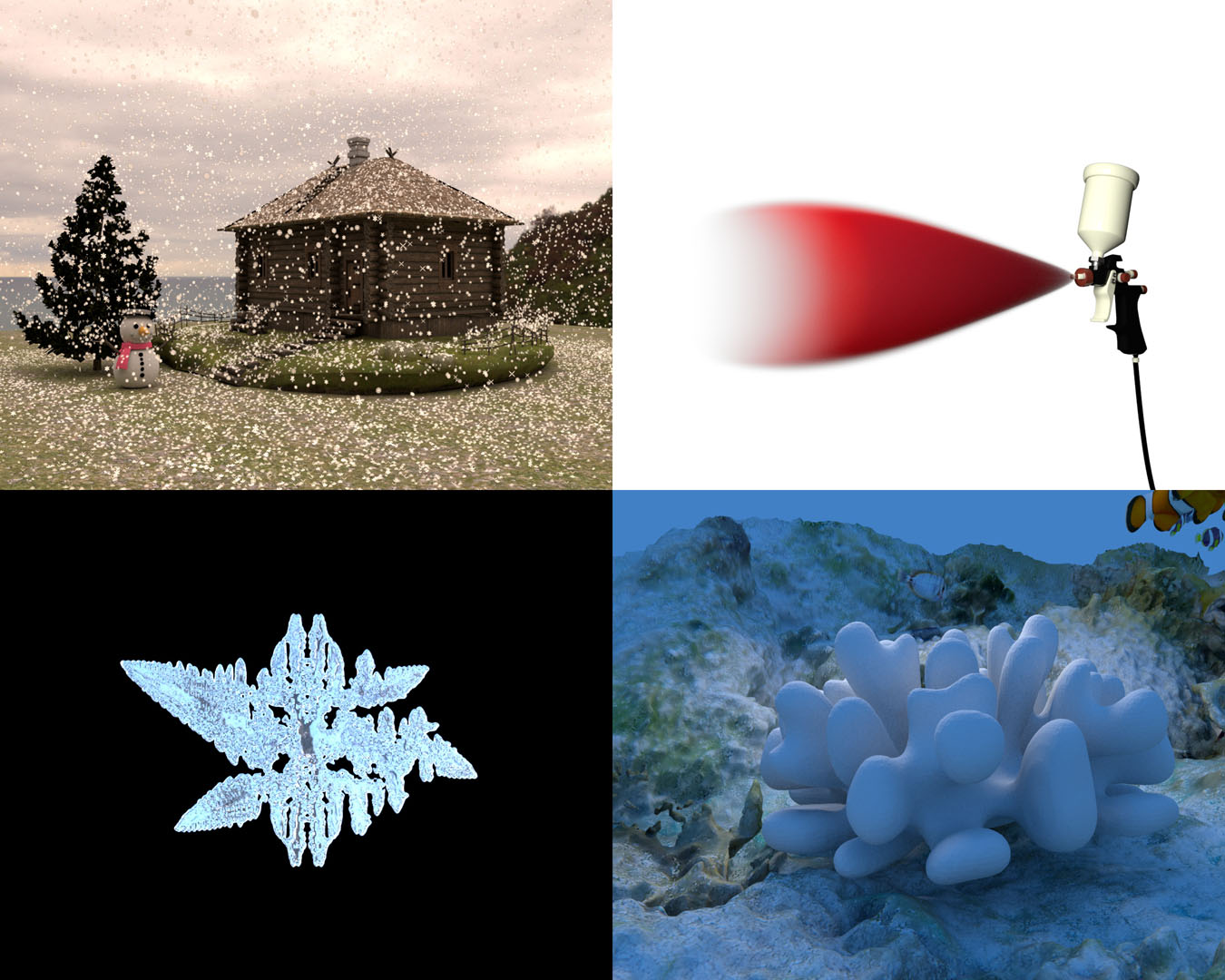
We introduce the C-F diffusion model [Anderson and Tamma 2006; Xue et al. 2018] to computer graphics for diffusion-driven problems that has several attractive properties: (a) it fundamentally explains diffusion from the perspective of the non-equilibrium statistical mechanical Boltzmann Transport Equation, (b) it allows for a finite propagation speed for diffusion, in contrast to the widely employed Fick’s/Fourier’s law, and (c) it can capture some of the most characteristic visual aspects of diffusion-driven physics, such as hydrogel swelling, limited diffusive domain for smoke flow, snowflake and dendrite formation, that span from Fourier-type to non-Fourier-type diffusive phenomena. We propose a unified convection-diffusion formulation using this model that treats both the diffusive quantity and its associated flux as the primary unknowns, and that recovers the traditional Fourier-type diffusion as a limiting case. We design a novel semi-implicit discretization for this formulation on staggered MAC grids and a geometric Multigrid-preconditioned Conjugate Gradients solver for efficient numerical solution. To highlight the efficacy of our method, we demonstrate end-to-end examples of elastic porous media simulated with the Material Point Method (MPM), and diffusion-driven Eulerian incompressible fluids.
References:
1. Christianne VDR Anderson and Kumar K Tamma. 2006. Novel heat conduction model for bridging different space and time scales. Physical review letters 96, 18 (2006), 184301.Google Scholar
2. John Anderson. 2002. Modern Compressible Flow: With Historical Perspective. McGraw-Hill Education; 3 edition.Google Scholar
3. KJ Baumeister and TD Hamill. 1969. Hyperbolic heat-conduction equation—a solution for the semi-infinite body problem. (1969).Google Scholar
4. Javier Bonet and Richard D Wood. 1997. Nonlinear continuum mechanics for finite element analysis. Cambridge university press.Google Scholar
5. Jose A. Canabal, Miguel A. Otaduy, Byungmoon Kim, and Jose Echevarria. 2020. Simulation of Dendritic Painting. Computer Graphics Forum 39, 2 (2020).Google Scholar
6. A. Cangialosi, C. Yoon, J. Liu, Q. Huang, J. Guo, T. D Nguyen, D. H Gracias, and R. Schulman. 2017. DNA sequence-directed shape change of photopatterned hydrogels via high-degree swelling. Science 357, 6356 (2017), 1126–1130.Google Scholar
7. Mark Carlson, Peter J Mucha, R Brooks Van Horn III, and Greg Turk. 2002. Melting and flowing. In Symposium on Computer Animation. 167–174.Google ScholarDigital Library
8. Carlo Cattaneo. 1948. Sulla conduzione del calore. Atti Sem. Mat. Fis. Univ. Modena 3 (1948), 83–101.Google Scholar
9. DS Chandrasekharaiah. 1986. Thermoelasticity with second sound: a review. (1986).Google Scholar
10. Gang Chen. 2001. Ballistic-diffusive heat-conduction equations. Physical Review Letters 86, 11 (2001), 2297.Google ScholarCross Ref
11. Hsiao-Yu Chen, Arnav Sastry, Wim M van Rees, and Etienne Vouga. 2018. Physical simulation of environmentally induced thin shell deformation. ACM Transactions on Graphics (TOG) 37, 4 (2018), 1–13.Google ScholarDigital Library
12. Nelson S-H Chu and Chiew-Lan Tai. 2005. MoXi: real-time ink dispersion in absorbent paper. ACM Transactions on Graphics (TOG) 24, 3 (2005), 504–511.Google ScholarDigital Library
13. Pascal Clausen, Martin Wicke, Jonathan R Shewchuk, and James F O’brien. 2013. Simulating liquids and solid-liquid interactions with lagrangian meshes. ACM Transactions on Graphics (TOG) 32, 2 (2013), 1–15.Google ScholarDigital Library
14. Cassidy J Curtis, Sean E Anderson, Joshua E Seims, Kurt W Fleischer, and David H Salesin. 1997. Computer-generated watercolor. In Proceedings of the 24th annual conference on Computer graphics and interactive techniques. 421–430.Google ScholarDigital Library
15. G. Demange, H. Zapolsky, R. Patte, and M. Brunel. 2017. A phase field model for snow crystal growth in three dimensions. Computational Materials 3, 1 (2017), 1–7.Google Scholar
16. Mengyuan Ding, Xuchen Han, Stephanie Wang, Theodore F Gast, and Joseph M Teran. 2019. A thermomechanical material point method for baking and cooking. ACM Transactions on Graphics (TOG) 38, 6 (2019), 192.Google ScholarDigital Library
17. Y. Fei, C. Batty, E. Grinspun, and C. Zheng. 2018. A multi-scale model for simulating liquid-fabric interactions. ACM Transactions on Graphics 37, 4 (2018), 1–16.Google ScholarDigital Library
18. Adolph Fick. 1855. V. On liquid diffusion. The London, Edinburgh, and Dublin Philosophical Magazine and Journal of Science 10, 63 (1855), 30–39.Google ScholarCross Ref
19. Jean-Baptiste Joseph Fourier. 1878. Théorie analytique de la chaleur. Paris 1822. Engl. Übersetzung:”Theory o: Heat Transfer”, Cambridge (1878).Google Scholar
20. Ming Gao, Andre Pradhana, Xuchen Han, Qi Guo, Grant Kot, Eftychios Sifakis, and Chenfanfu Jiang. 2018a. Animating fluid sediment mixture in particle-laden flows. ACM Transactions on Graphics (TOG) 37, 4 (2018), 1–11.Google ScholarDigital Library
21. Ming Gao, Xinlei Wang, Kui Wu, Andre Pradhana, Eftychios Sifakis, Cem Yuksel, and Chenfanfu Jiang. 2018b. GPU optimization of material point methods. ACM Transactions on Graphics (TOG) 37, 6 (2018), 1–12.Google ScholarDigital Library
22. Christoph Gissler, Andreas Henne, Stefan Band, Andreas Peer, and Matthias Teschner. 2020. An Implicit Compressible SPH Solver for Snow Simulation. ACM Trans. Graph. 39, 4, Article 36 (2020), 16 pages.Google ScholarDigital Library
23. Francis H. Harlow and J. Eddie Welch. 1965. Numerical Calculation of Time-Dependent Viscous Incompressible Flow of Fluid with Free Surface. Physics of Fluids 8, 12 (1965), 2182–2189.Google ScholarCross Ref
24. Xiaowei He, Huamin Wang, Fengjun Zhang, Hongan Wang, Guoping Wang, Kun Zhou, and Enhua Wu. 2015. Simulation of fluid mixing with interface control. In Symposium on Computer Animation. 129–135.Google ScholarDigital Library
25. Markus Huber, Simon Pabst, and Wolfgang Straßer. 2011. Wet cloth simulation. In ACM SIGGRAPH 2011 Posters. 1–1.Google ScholarDigital Library
26. K. Iwasaki, H. Uchida, Y. Dobashi, and T. Nishita. 2010. Fast particle-based visual simulation of ice melting. In Computer graphics forum, Vol. 29. 2215–2223.Google Scholar
27. Chenfanfu Jiang, Craig Schroeder, Joseph Teran, Alexey Stomakhin, and Andrew Selle. 2016. The material point method for simulating continuum materials. In ACM SIGGRAPH 2016 Courses. 1–52.Google ScholarDigital Library
28. Guang-Shan Jiang and Chi-Wang Shu. 1996. Efficient Implementation of Weighted ENO Schemes. J. Comput. Phys. 126, 1 (1996), 202 — 228.Google ScholarDigital Library
29. Daniel D Joseph and Luigi Preziosi. 1989. Heat waves. Reviews of Modern Physics 61, 1 (1989), 41.Google ScholarCross Ref
30. N. Kang, J. Park, J. Noh, and S. Y Shin. 2010. A hybrid approach to multiple fluid simulation using volume fractions. In Computer Graphics Forum, Vol. 29. 685–694.Google ScholarCross Ref
31. Theodore Kim, David Adalsteinsson, and Ming C Lin. 2006. Modeling ice dynamics as a thin-film stefan problem. In Symposium on Computer animation. 167–176.Google Scholar
32. Theodore Kim, Michael Henson, and Ming C Lin. 2004. A hybrid algorithm for modeling ice formation. In Symposium on Computer Animation. 305–314.Google ScholarDigital Library
33. Theodore Kim and Ming Lin. 2007. Stable advection-reaction-diffusion with arbitrary anisotropy. Computer Animation and Virtual Worlds 18, 4–5 (2007), 329–338.Google ScholarCross Ref
34. Theodore Kim and Ming C Lin. 2003. Visual simulation of ice crystal growth. In Symposium on Computer Animation. Eurographics Association, 86–97.Google Scholar
35. Ryo Kobayashi. 1994. A numerical approach to three-dimensional dendritic solidification. Experimental mathematics 3, 1 (1994), 59–81.Google Scholar
36. Toon Lenaerts, Bart Adams, and Philip Dutré. 2008. Porous flow in particle-based fluid simulations. ACM Transactions on Graphics (TOG) 27, 3 (2008), 1–8.Google ScholarDigital Library
37. Kenneth G Libbrecht. 2005a. The physics of snow crystals. Reports on progress in physics 68, 4 (2005), 855.Google Scholar
38. Kenneth G Libbrecht. 2005b. The physics of snow crystals. Reports on progress in physics 68, 4 (2005), 855.Google Scholar
39. Kenneth G Libbrecht. 2019. Snow crystals. arXiv preprint arXiv:1910.06389 (2019).Google Scholar
40. W-C Lin. 2014. Coupling hair with smoothed particle hydrodynamics fluids. (2014).Google Scholar
41. Wei-Chin Lin. 2015. Boundary handling and porous flow for fluid-hair interactions. Computers & Graphics 52 (2015), 33–42.Google ScholarDigital Library
42. A. McAdams, E. Sifakis, and J. Teran. 2010. A Parallel Multigrid Poisson Solver for Fluids Simulation on Large Grids. In Symposium on Computer Animation. 65–74.Google Scholar
43. Michael B Nielsen and Ole Østerby. 2013. A two-continua approach to Eulerian simulation of water spray. ACM Transactions on Graphics (TOG) 32, 4 (2013), 1–10.Google ScholarDigital Library
44. Stanley Osher, Ronald Fedkiw, and K Piechor. 2004. Level set methods and dynamic implicit surfaces. Appl. Mech. Rev. 57, 3 (2004), B15–B15.Google ScholarCross Ref
45. Saket Patkar and Parag Chaudhuri. 2013. Wetting of porous solids. IEEE transactions on visualization and computer graphics 19, 9 (2013), 1592–1604.Google ScholarDigital Library
46. B. Ren, J. Huang, M. C Lin, and S-M Hu. 2018. Controllable Dendritic Crystal Simulation Using Orientation Field. In Computer Graphics Forum, Vol. 37. 485–495.Google ScholarCross Ref
47. Bo Ren, Chenfeng Li, Xiao Yan, Ming C Lin, Javier Bonet, and Shi-Min Hu. 2014. Multiple-fluid SPH simulation using a mixture model. ACM TOG 33, 5 (2014), 1–11.Google ScholarDigital Library
48. Witawat Rungjiratananon, Yoshihiro Kanamori, and Tomoyuki Nishita. 2012. Wetting effects in hair simulation. In Computer Graphics Forum, Vol. 31. 1993–2002.Google ScholarDigital Library
49. W. Rungjiratananon, Z. Szego, Y. Kanamori, and T. Nishita. 2008. Real-time animation of sand-water interaction. In Computer Graphics Forum, Vol. 27. 1887–1893.Google ScholarCross Ref
50. A Sellitto, VA Cimmelli, and D Jou. 2020. Nonlinear propagation of coupled first-and second-sound waves in thermoelastic solids. Journal of Elasticity 138, 1 (2020), 93–109.Google ScholarCross Ref
51. Rajsekhar Setaluri, Mridul Aanjaneya, Sean Bauer, and Eftychios Sifakis. 2014. SPGrid: A sparse paged grid structure applied to adaptive smoke simulation. ACM Transactions on Graphics (TOG) 33, 6 (2014), 1–12.Google ScholarDigital Library
52. Jos Stam. 1999. Stable Fluids. In Proc. of ACM SIGGRAPH (SIGGRAPH ’99). 121–128.Google Scholar
53. Johan Stefan. 1891. Über die Theorie der Eisbildung, insbesondere über die Eisbildung im Polarmeere. Annalen der Physik 278, 2 (1891), 269–286.Google ScholarCross Ref
54. A. Stomakhin, C. Schroeder, L. Chai, J. Teran, and A. Selle. 2013. A material point method for snow simulation. ACM Transactions on Graphics 32, 4 (2013), 1–10.Google ScholarDigital Library
55. A. Stomakhin, C. Schroeder, C. Jiang, L. Chai, J. Teran, and A. Selle. 2014. Augmented MPM for phase-change and varied materials. ACM TOG 33, 4 (2014), 1–11.Google ScholarDigital Library
56. Dan Stora, Pierre-Olivier Agliati, Marie-Paule Cani, Fabrice Neyret, and Jean-Dominique Gascuel. 1999. Animating lava flows.Google Scholar
57. Andre Pradhana Tampubolon, Theodore Gast, Gergely Klár, Chuyuan Fu, Joseph Teran, Chenfanfu Jiang, and Ken Museth. 2017. Multi-species simulation of porous sand and water mixtures. ACM Transactions on Graphics (TOG) 36, 4 (2017), 1–11.Google ScholarDigital Library
58. U. Trottenberg, C. W. Oosterlee, and A. Schuller. 2001. Multigrid. Academic Press.Google Scholar
59. Da Yu Tzou. 2014. Macro-to microscale heat transfer: the lagging behavior. John Wiley & Sons.Google Scholar
60. Kiwon Um, Tae-Yong Kim, Youngdon Kwon, and JungHyun Han. 2013. Porous deformable shell simulation with surface water flow and saturation. Computer Animation and Virtual Worlds 24, 3–4 (2013), 247–254.Google ScholarCross Ref
61. V. R Voller and CR Swaminathan. 1991. ERAL Source-based method for solidification phase change. Numerical Heat Transfer, Part B Fundamentals 19, 2 (1991), 175–189.Google ScholarCross Ref
62. Joshuah Wolper, Yu Fang, Minchen Li, Jiecong Lu, Ming Gao, and Chenfanfu Jiang. 2019. CD-MPM: continuum damage material point methods for dynamic fracture animation. ACM Transactions on Graphics (TOG) 38, 4 (2019), 1–15.Google ScholarDigital Library
63. Joel Wretborn, Rickard Armiento, and Ken Museth. 2017. Animation of crack propagation by means of an extended multi-body solver for the material point method. Computers & Graphics 69 (2017), 131–139.Google ScholarDigital Library
64. Tao Xue, Xiaobing Zhang, and Kumar K Tamma. 2018. Generalized heat conduction model in moving media emanating from Boltzmann Transport Equation. International Journal of Heat and Mass Transfer 119 (2018), 148–151.Google ScholarCross Ref
65. X. Yan, Y-T Jiang, C-F Li, R. R Martin, and S-M Hu. 2016. Multiphase SPH simulation for interactive fluids and solids. ACM TOG 35, 4 (2016), 1–11.Google ScholarDigital Library
66. Xiao Yan, C-F Li, X-S Chen, and S-M Hu. 2018. MPM simulation of interacting fluids and solids. In Computer Graphics Forum, Vol. 37. 183–193.Google ScholarCross Ref
67. Tao Yang, Jian Chang, Ming C Lin, Ralph R Martin, Jian J Zhang, and Shi-Min Hu. 2017. A unified particle system framework for multi-phase, multi-material visual simulations. ACM Transactions on Graphics (TOG) 36, 6 (2017), 1–13.Google ScholarDigital Library
68. T. Yang, J. Chang, B. Ren, M. C Lin, J. J Zhang, and S-M Hu. 2015. Fast multiple-fluid simulation using Helmholtz free energy. ACM TOG 34, 6 (2015), 1–11.Google ScholarDigital Library
69. Yonghao Yue, Breannan Smith, Peter Yichen Chen, Maytee Chantharayukhonthorn, Ken Kamrin, and Eitan Grinspun. 2018. Hybrid Grains: adaptive coupling of discrete and continuum simulations of granular media. ACM TOG 37, 6 (2018), 1–19.Google ScholarDigital Library



