
“Data-driven interior plan generation for residential buildings” by Wu, Fu, Tang, Wang, Qi, et al. …
Conference:
Type(s):
Title:
- Data-driven interior plan generation for residential buildings
Session/Category Title:
- Hairy & Sketchy Geometry
Presenter(s)/Author(s):
Moderator(s):
Abstract:
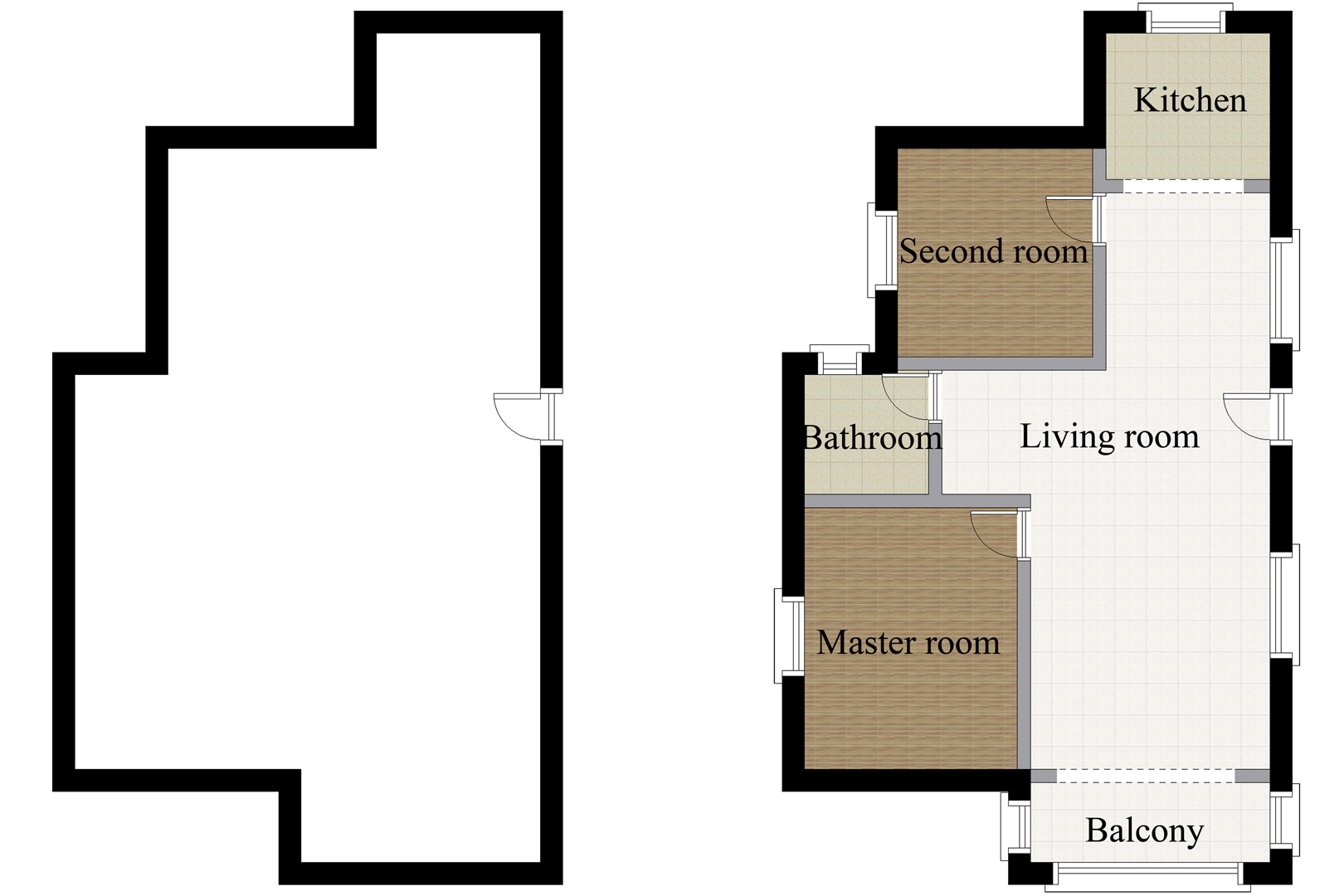
We propose a novel data-driven technique for automatically and efficiently generating floor plans for residential buildings with given boundaries. Central to this method is a two-stage approach that imitates the human design process by locating rooms first and then walls while adapting to the input building boundary. Based on observations of the presence of the living room in almost all floor plans, our designed learning network begins with positioning a living room and continues by iteratively generating other rooms. Then, walls are first determined by an encoder-decoder network, and then they are refined to vector representations using dedicated rules. To effectively train our networks, we construct RPLAN – a manually collected large-scale densely annotated dataset of floor plans from real residential buildings. Intensive experiments, including formative user studies and comparisons, are conducted to illustrate the feasibility and efficacy of our proposed approach. By comparing the plausibility of different floor plans, we have observed that our method substantially outperforms existing methods, and in many cases our floor plans are comparable to human-created ones.
References:
1. Daniel G. Aliaga, Carlos A. Vanegas, and Bedrich Benes. 2008. Interactive Example-based Urban Layout Synthesis. ACM Trans. Graph. 27, 5 (2008), 160:1–160:10.Google ScholarDigital Library
2. Scott A Arvin and Donald H House. 2002. Modeling architectural design objectives in physically based space planning. Automation in Construction 11, 2 (2002), 213 — 225.Google ScholarCross Ref
3. Alper Aydemir, Patric Jensfelt, and John Folkesson. 2012. What can we learn from 38,000 rooms? Reasoning about unexplored space in indoor environments. In 2012 IEEE/RSJ International Conference on Intelligent Robots and Systems. IEEE, 4675–4682.Google ScholarCross Ref
4. Arash Bahrehmand, Thomas Batard, Ricardo Marques, Alun Evans, and Josep Blat. 2017. Optimizing layout using spatial quality metrics and user preferences. Graphical Models 93 (2017), 25 — 38.Google ScholarDigital Library
5. Fan Bao, Dong-Ming Yan, Niloy J. Mitra, and Peter Wonka. 2013. Generating and Exploring Good Building Layouts. ACM Trans. Graph. 32, 4 (2013), 122:1–122:10.Google ScholarDigital Library
6. Guoning Chen, Gregory Esch, Peter Wonka, Pascal Müller, and Eugene Zhang. 2008. Interactive Procedural Street Modeling. ACM Trans. Graph. 27, 3 (2008), 103:1–103:10.Google ScholarDigital Library
7. Liang-Chieh Chen, George Papandreou, Iasonas Kokkinos, Kevin Murphy, and Alan L Yuille. 2018. Deeplab: Semantic image segmentation with deep convolutional nets, atrous convolution, and fully connected crfs. IEEE transactions on pattern analysis and machine intelligence 40, 4 (2018), 834–848.Google Scholar
8. Tian Feng, Lap-Fai Yu, Sai-Kit Yeung, KangKang Yin, and Kun Zhou. 2016. Crowd-driven Mid-scale Layout Design. ACM Trans. Graph. 35, 4 (2016), 132:1–132:14.Google ScholarDigital Library
9. Matthew Fisher, Daniel Ritchie, Manolis Savva, Thomas Funkhouser, and Pat Hanrahan. 2012. Example-based Synthesis of 3D Object Arrangements. ACM Trans. Graph. 31, 6 (2012), 135:1–135:11.Google ScholarDigital Library
10. Ross Girshick. 2015. Fast r-cnn. In Proceedings of the IEEE international conference on computer vision. 1440–1448.Google ScholarDigital Library
11. Evan Hahn, Prosenjit Bose, and Anthony Whitehead. 2006. Persistent Realtime Building Interior Generation. In Proceedings of the 2006 ACM SIGGRAPH Symposium on Videogames. 179–186.Google ScholarDigital Library
12. Mikako Harada, Andrew Witkin, and David Baraff. 1995. Interactive Physically-based Manipulation of Discrete/Continuous Models. In Proc. SIGGRAPH. 199–208.Google ScholarDigital Library
13. Kaiming He, Xiangyu Zhang, Shaoqing Ren, and Jian Sun. 2016. Deep residual learning for image recognition. In Proceedings of the IEEE conference on computer vision and pattern recognition. 770–778.Google ScholarCross Ref
14. Mark Hendrikx, Sebastiaan Meijer, Joeri Van Der Velden, and Alexandru Iosup. 2013. Procedural Content Generation for Games: A Survey. ACM Trans. Multimedia Comput. Commun. Appl. 9, 1 (2013), 1:1–1:22.Google ScholarDigital Library
15. Hao Hua. 2016. Irregular architectural layout synthesis with graphical inputs. Automation in Construction 72 (2016), 388 — 396.Google ScholarCross Ref
16. Ahti Kalervo, Juha Ylioinas, Markus Häikiö, Antti Karhu, and Juho Kannala. 2019. CubiCasa5K: A Dataset and an Improved Multi-Task Model for Floorplan Image Analysis. In Scandinavian Conference on Image Analysis. Springer, 28–40.Google ScholarCross Ref
17. Jianan Li, Tingfa Xu, Jianming Zhang, Aaron Hertzmann, and Jimei Yang. 2019. LayoutGAN: Generating Graphic Layouts with Wireframe Discriminator. In International Conference on Learning Representations.Google Scholar
18. Robin S Liggett. 2000. Automated facilities layout: past, present and future. Automation in Construction 9, 2 (2000), 197 — 215.Google ScholarCross Ref
19. Chen Liu, Jiaye Wu, and Yasutaka Furukawa. 2018. FloorNet: A Unified Framework for Floorplan Reconstruction from 3D Scans. In ECCV 2018. 203–219.Google ScholarCross Ref
20. Chen Liu, Jiajun Wu, Pushmeet Kohli, and Yasutaka Furukawa. 2017. Raster-to-Vector: Revisiting Floorplan Transformation. In ICCV 2017. 2214–2222.Google Scholar
21. Han Liu, Yong-Liang Yang, Sawsan AlHalawani, and Niloy J. Mitra. 2013. Constraint-aware interior layout exploration for pre-cast concrete-based buildings. The Visual Computer 29, 6 (2013), 663–673.Google ScholarDigital Library
22. Chongyang Ma, Nicholas Vining, Sylvain Lefebvre, and Alla Sheffer. 2014. Game Level Layout from Design Specification. Comput. Graph. Forum (EG) 33, 2 (2014), 95–104.Google ScholarDigital Library
23. Paul Merrell, Eric Schkufza, and Vladlen Koltun. 2010. Computer-generated Residential Building Layouts. ACM Trans. Graph. 29, 6 (2010), 181:1–181:12.Google ScholarDigital Library
24. Paul Merrell, Eric Schkufza, Zeyang Li, Maneesh Agrawala, and Vladlen Koltun. 2011. Interactive Furniture Layout Using Interior Design Guidelines. ACM Trans. Graph. 30, 4 (2011), 87:1–87:10.Google ScholarDigital Library
25. Jeremy Michalek, Ruchi Choudhary, and Panos Papalambros. 2002. Architectural layout design optimization. Engineering optimization 34, 5 (2002), 461–484.Google Scholar
26. Pascal Müller, Peter Wonka, Simon Haegler, Andreas Ulmer, and Luc Van Gool. 2006. Procedural Modeling of Buildings. ACM Trans. Graph. 25, 3 (2006), 614–623.Google ScholarDigital Library
27. Peter O’Donovan, Aseem Agarwala, and Aaron Hertzmann. 2014. Learning Layouts for Single-Page Graphic Designs. IEEE. T. Vis. Comput. Gr. 20, 8 (2014), 1200–1213.Google ScholarDigital Library
28. Chi-Han Peng, Yong-Liang Yang, Fan Bao, Daniel Fink, Dong-Ming Yan, Peter Wonka, and Niloy J. Mitra. 2016. Computational Network Design from Functional Specifications. ACM Trans. Graph. 35, 4 (2016), 131:1–131:12.Google ScholarDigital Library
29. Chi-Han Peng, Yong-Liang Yang, and Peter Wonka. 2014. Computing Layouts with Deformable Templates. ACM Trans. Graph. 33, 4 (2014), 99:1–99:11.Google ScholarDigital Library
30. Roberto J. Rengel. 2011. The Interior Plan: Concepts and Exercises. Fairchild Books.Google Scholar
31. Daniel Ritchie, Kai Wang, and Yu an Lin. 2019. Fast and Flexible Indoor Scene Synthesis via Deep Convolutional Generative Models. In CVPR 2019.Google ScholarCross Ref
32. Eugénio Rodrigues, Adélio Rodrigues Gaspar, and Álvaro Gomes. 2013a. An approach to the multi-level space allocation problem in architecture using a hybrid evolutionary technique. Automation in Construction 35 (2013), 482–498.Google ScholarCross Ref
33. Eugénio Rodrigues, Adélio Rodrigues Gaspar, and Álvaro Gomes. 2013b. An evolutionary strategy enhanced with a local search technique for the space allocation problem in architecture, Part 1: Methodology. Computer-Aided Design 45, 5 (2013), 887–897.Google ScholarDigital Library
34. Eugénio Rodrigues, Adélio Rodrigues Gaspar, and Álvaro Gomes. 2013c. An evolutionary strategy enhanced with a local search technique for the space allocation problem in architecture, Part 2: Validation and performance tests. Computer-Aided Design 45, 5 (2013), 898–910.Google ScholarDigital Library
35. Julian F. Rosser, Gavin Smith, and Jeremy G. Morley. 2017. Data-driven estimation of building interior plans. International Journal of Geographical Information Science 31, 8 (2017), 1652–1674.Google ScholarDigital Library
36. Ruben M. Smelik, Tim Tutenel, Rafael Bidarra, and Bedrich Benes. 2014. A Survey on Procedural Modelling for Virtual Worlds. Comput. Graph. Forum 33, 6 (2014), 31–50.Google ScholarDigital Library
37. Shuran Song, Fisher Yu, Andy Zeng, Angel X Chang, Manolis Savva, and Thomas Funkhouser. 2017. Semantic scene completion from a single depth image. In CVPR. 1746–1754.Google Scholar
38. Kai Wang, Manolis Savva, Angel X. Chang, and Daniel Ritchie. 2018. Deep Convolutional Priors for Indoor Scene Synthesis. ACM Trans. Graph. 37, 4 (2018), 70:1–70:14.Google ScholarDigital Library
39. Wenming Wu, Lubin Fan, Ligang Liu, and Peter Wonka. 2018. MIQP-based Layout Design for Building Interiors. Comput. Graph. Forum (EG) 37, 2 (2018), 511–521.Google ScholarCross Ref
40. Shang-Ta Yang, Fu-En Wang, Chi-Han Peng, Peter Wonka, Min Sun, and Hung-Kuo Chu. 2019. DuLa-Net: A Dual-Projection Network for Estimating Room Layouts from a Single RGB Panorama. In CVPR 2019.Google ScholarCross Ref
41. Yong-Liang Yang, Jun Wang, Etienne Vouga, and Peter Wonka. 2013. Urban Pattern: Layout Design by Hierarchical Domain Splitting. ACM Trans. Graph. 32, 6 (2013), 181:1–181:12.Google ScholarDigital Library
42. Lap-Fai Yu, Sai-Kit Yeung, Chi-Keung Tang, Demetri Terzopoulos, Tony F. Chan, and Stanley J. Osher. 2011. Make It Home: Automatic Optimization of Furniture Arrangement. ACM Trans. Graph. 30, 4 (2011), 86:1–86:12.Google ScholarDigital Library
43. Chuhang Zou, Alex Colburn, Qi Shan, and Derek Hoiem. 2018. Layoutnet: Reconstructing the 3d room layout from a single rgb image. In CVPR 2018. 2051–2059.Google ScholarCross Ref



