“Non-linear sphere tracing for rendering deformed signed distance fields” by Seyb, Jacobson, Nowrouzezahrai and Jarosz
Conference:
Type(s):
Title:
- Non-linear sphere tracing for rendering deformed signed distance fields
Session/Category Title:
- Differentiable Rendering
Presenter(s)/Author(s):
Moderator(s):
Abstract:
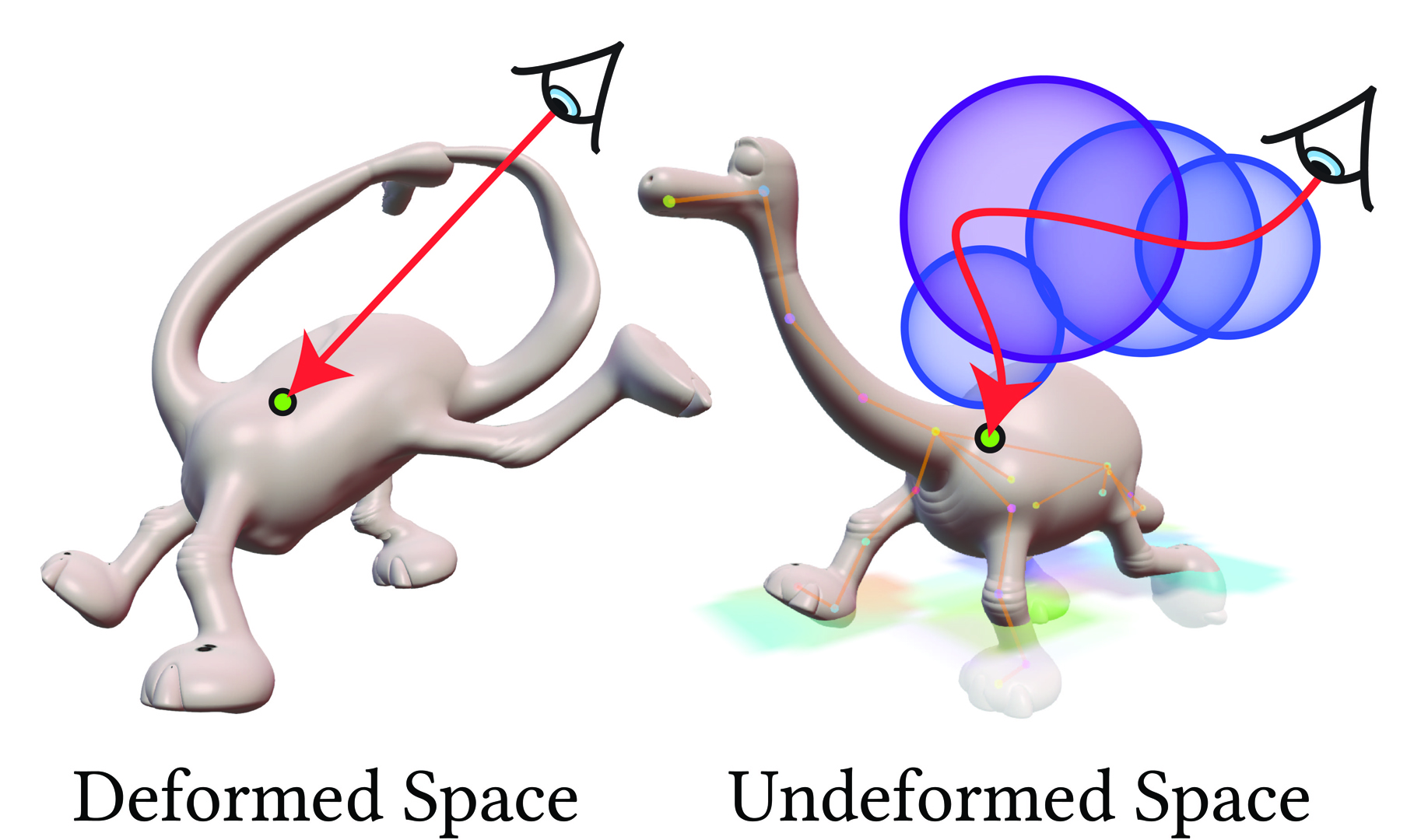
Signed distance fields (SDFs) are a powerful implicit representation for modeling solids, volumes and surfaces. Their infinite resolution, controllable continuity and robust constructive solid geometry operations, coupled with smooth blending, enable powerful and intuitive sculpting tools for creating complex SDF models. SDF metric properties also admit efficient surface rendering with sphere tracing. Unfortunately, SDFs remain incompatible with many popular direct deformation techniques which re-position a surface via its explicit representation. Linear blend skinning used in character articulation, for example, directly displaces each vertex of a triangle mesh. To overcome this limitation, we propose a variant of sphere tracing for directly rendering deformed SDFs. We show that this problem reduces to integrating a non-linear ordinary differential equation. We propose an efficient numerical solution, with controllable error, which first automatically computes an initial value along each cast ray before walking conservatively along a curved ray in the undeformed space according to the signed distance. Importantly, our approach does not require knowledge, computation or even global existence of the inverse deformation, which allows us to readily apply many existing forward deformations. We demonstrate our method’s effectiveness for interactive rendering of a variety of popular deformation techniques that were, to date, limited to explicit surfaces.
References:
1. Chandrajit Bajaj, Jim Blinn, Brian Wyvill, Marie-Paule Cani, Alyn Rockwood, and Geoff Wyvill. 1997. Introduction to Implicit Surfaces. Morgan Kaufmann.Google Scholar
2. Csaba Bálint and Gábor Valasek. 2018. Accelerating Sphere Tracing. Proceedings of Eurographics Short Papers (2018), 4 pages. https://doi.org/10/gfz542Google Scholar
3. Ilya Baran and Jovan Popović. 2007. Automatic Rigging and Animation of 3D Characters. ACM Transactions on Graphics (Proceedings of SIGGRAPH) 26, 3 (July 2007), 72. https://doi.org/10/d2ck5vGoogle ScholarDigital Library
4. Michael F. Barnsley, Robert L. Devaney, Benoit B. Mandelbrot, Heinz-Otto Peitgen, Dietmar Saupe, Richard F. Voss, Yuval Fisher, and Michael McGuire. 1988. The Science of Fractal Images (1st ed.). Springer-Verlag. https://doi.org/frdznzGoogle Scholar
5. Alan H. Barr. 1984. Global and Local Deformations of Solid Primitives. Computer Graphics (Proceedings of SIGGRAPH) 18, 3 (July 1984), 21–30. https://doi.org/10/fcwvgwGoogle ScholarDigital Library
6. Alan H. Barr. 1986. Ray Tracing Deformed Surfaces. Computer Graphics (Proceedings of SIGGRAPH) 20, 4 (Aug. 1986), 287–296. https://doi.org/10/cpqr6gGoogle Scholar
7. Thaddeus Beier and Shawn Neely. 1992. Feature-Based Image Metamorphosis. Computer Graphics (Proceedings of SIGGRAPH) 26, 2 (July 1992), 35–42. https://doi.org/10/crjpphGoogle ScholarDigital Library
8. M. Berger, T. Trout, and N. Levit. 1990. Ray Tracing Mirages. IEEE Computer Graphics & Applications 10, 3 (May 1990), 36–41. https://doi.org/10/cfbfc3Google ScholarDigital Library
9. James F. Blinn. 1982. A Generalization of Algebraic Surface Drawing. Computer Graphics (Proceedings of SIGGRAPH) 16, 3 (July 1982), 273. https://doi.org/10/fgvzkfGoogle ScholarDigital Library
10. P. Bogacki and L.F. Shampine. 1989. A 3(2) Pair of Runge-Kutta Formulas. Applied Mathematics Letters 2, 4 (1989), 321 — 325. https://doi.org/10/cwcdkxGoogle ScholarCross Ref
11. Brinx Software. 2019. MasterpieceVR. https://www.masterpiecevr.com/Google Scholar
12. John Charles Butcher and Nicolette Goodwin. 2008. Numerical methods for ordinary differential equations. Vol. 2. Wiley Online Library. https://doi.org/10/fhv3h9Google Scholar
13. M. Cani-Gascuel and M. Desbrun. 1997. Animation of Deformable Models Using Implicit Surfaces. IEEE Transactions on Visualization and Computer Graphics 3, 1 (Jan. 1997), 39–50. https://doi.org/10/c6bqg2Google ScholarDigital Library
14. Chen Cao, Zhong Ren, Baining Guo, and Kun Zhou. 2010. Interactive Rendering of Non-Constant, Refractive Media Using the Ray Equations of Gradient-Index Optics. Computer Graphics Forum 29, 4 (2010), 1375–1382. https://doi.org/10/fbff4nGoogle ScholarDigital Library
15. Huawei Chen, Jürgen Hesser, and Reinhard Männer. 2001. Fast Volume Deformation Using Inverse-Ray-Deformation and FFD. In GraphiCon.Google Scholar
16. Brian Curless and Marc Levoy. 1996. A Volumetric Method for Building Complex Models from Range Images. In Annual Conference Series (Proceedings of SIGGRAPH). ACM Press, New York, NY, USA, 303–312. https://doi.org/10/crn3vrGoogle Scholar
17. Fernando De Goes and Doug L. James. 2017. Regularized Kelvinlets: Sculpting Brushes Based on Fundamental Solutions of Elasticity. ACM Transactions on Graphics (Proceedings of SIGGRAPH) 36, 4 (July 2017), 40:1–40:11. https://doi.org/10/gfz56kGoogle Scholar
18. Mathieu Desbrun and Marie-Paule Gascuel. 1995. Animating Soft Substances with Implicit Surfaces. In Annual Conference Series (Proceedings of SIGGRAPH). ACM, New York, NY, USA, 287–290. https://doi.org/10/b96ndxGoogle Scholar
19. J. R. Dormand and P. J. Prince. 1980. A Family of Embedded Runge-Kutta Formulae. J. Comput. Appl. Math. 6, 1 (March 1980), 19–26. https://doi.org/10/cfw5fcGoogle ScholarCross Ref
20. David S. Ebert, F. Kenton Musgrave, Darwyn Peachey, Kenneth Perlin, and Steven Worley. 2003. Texturing and modeling: a procedural approach (3rd ed.). Morgan Kaufmann, San Francisco, CA, USA.Google ScholarDigital Library
21. Alex Evans. 2015. Learning from Failure: a Survey of Promising, Unconventional and Mostly Abandoned Renderers for “Dreams PS4”, a Geometrically Dense, Painterly UGC Game. ACM SIGGRAPH Course Notes, Article 2 (2015). https://doi.org/10/gf2v8vGoogle Scholar
22. Facebook Technologies. 2019. Oculus Medium. https://www.oculus.com/medium/Google Scholar
23. E. Fehlberg. 1970. Klassische Runge-Kutta-Formeln vierter und niedrigerer Ordnung mit Schrittweiten-Kontrolle und ihre Anwendung auf Wärmeleitungsprobleme. Computing 6, 1 (March 1970), 61–71. https://doi.org/10/cc7qv5Google ScholarCross Ref
24. Takushi Fujita, Katsuhiko Hirota, and Kouichi Murakami. 1990. Representation of splashing water using metaball model. Fujitsu 41, 2 (1990), 159–165. (in Japanese).Google Scholar
25. Kyle Genova, Forrester Cole, Daniel Vlasic, Aaron Sarna, William T. Freeman, and Thomas Funkhouser. 2019. Learning Shape Templates with Structured Implicit Functions. arXiv:1904.06447 [cs] (April 2019). arXiv:cs/1904.06447Google Scholar
26. Olivier Gourmel, Loic Barthe, Marie-Paule Cani, Brian Wyvill, Adrien Bernhardt, Mathias Paulin, and Herbert Grasberger. 2013. A Gradient-based Implicit Blend. ACM Transactions on Graphics 32, 2 (2013), 12. https://doi.org/10/gf6wk7Google ScholarDigital Library
27. Eduard Gröller. 1995. Nonlinear Ray Tracing: Visualizing Strange Worlds. The Visual Computer 11, 5 (May 1995), 263–274. https://doi.org/10/ffcq74Google ScholarCross Ref
28. Diego Gutierrez, Adolfo Muñoz, Oscar Anson, and Francisco J. Seron. 2005. Non-Linear Volume Photon Mapping. In Rendering Techniques (Proceedings of the Eurographics Symposium on Rendering). Eurographics Association, 291–300. https://doi.org/10/gfzngkGoogle Scholar
29. J.C. Hart, E. Bachta, W. Jarosz, and T. Fleury. 2002. Using Particles to Sample and Control More Complex Implicit Surfaces. In Shape Modeling International. https://doi.org/10/dfw2ssGoogle Scholar
30. John C. Hart. 1996. Sphere Tracing: A Geometric Method for the Antialiased Ray Tracing of Implicit Surfaces. The Visual Computer 12, 10 (Dec. 1996), 527–545. https://doi.org/10/b3q2p6Google ScholarCross Ref
31. S. Ilic and P. Fua. 2006. Implicit Meshes for Surface Reconstruction. IEEE Transactions on Pattern Analysis and Machine Intelligence 28, 2 (Feb. 2006), 328–333. https://doi.org/10/ctgm5gGoogle ScholarDigital Library
32. Alec Jacobson, Ilya Baran, Jovan Popović, and Olga Sorkine. 2011. Bounded Biharmonic Weights for Real-Time Deformation. ACM Transactions on Graphics (Proceedings of SIGGRAPH) 30, 4 (July 2011), 78:1–78:8. https://doi.org/10/ckcmsjGoogle ScholarDigital Library
33. Alec Jacobson, Zhigang Deng, Ladislav Kavan, and JP Lewis. 2014. Skinning: Real-Time Shape Deformation. In ACM SIGGRAPH Course Notes. https://doi.org/10/gf2ng4Google Scholar
34. Oliver James, Eugénie von Tunzelmann, Paul Franklin, and Kip S. Thorne. 2015. Gravitational Lensing by Spinning Black Holes in Astrophysics, and in the Movie Interstellar. Classical and Quantum Gravity 32, 6 (Feb. 2015), 065001. https://doi.org/10/gdvj4rGoogle ScholarCross Ref
35. Stefan Jeschke, Stephan Mantler, and Michael Wimmer. 2007. Interactive Smooth and Curved Shell Mapping. In Rendering Techniques (Proceedings of the Eurographics Symposium on Rendering), Jan Kautz and Sumanta Pattanaik (Eds.). The Eurographics Association, 351–360. https://doi.org/10/gfz557Google Scholar
36. M. W. Jones, J. A. Baerentzen, and M. Sramek. 2006. 3D Distance Fields: A Survey of Techniques and Applications. IEEE Transactions on Visualization and Computer Graphics 12, 4 (July 2006), 581–599. https://doi.org/10/bwnmjsGoogle ScholarDigital Library
37. Pushkar Joshi, Mark Meyer, Tony DeRose, Brian Green, and Tom Sanocki. 2007. Harmonic Coordinates for Character Articulation. ACM Transactions on Graphics (Proceedings of SIGGRAPH) 26, 3 (July 2007). https://doi.org/10/bqj5jkGoogle ScholarDigital Library
38. Tao Ju, Frank Losasso, Scott Schaefer, and Joe Warren. 2002. Dual Contouring of Hermite Data. ACM Transactions on Graphics (Proceedings of SIGGRAPH) 21, 3 (July 2002), 339–346. https://doi.org/10/bdg3spGoogle ScholarDigital Library
39. Benjamin Keinert, Henry Schäfer, Johann Korndörfer, Urs Ganse, and Marc Stamminger. 2013. Improved Ray Casting of Procedural Distance Bounds. Journal of Graphics Tools 17, 4 (Oct. 2013), 127–138. https://doi.org/10/gfz54sGoogle ScholarCross Ref
40. Benjamin Keinert, Henry Schäfer, Johann Korndörfer, Urs Ganse, and Marc Stamminger. 2014. Enhanced Sphere Tracing. In STAG: Smart Tools & Apps for Graphics. 8. https://doi.org/10/gfz549Google Scholar
41. A. Knoll, Y. Hijazi, C. Hansen, I. Wald, and H. Hagen. 2007. Interactive Ray Tracing of Arbitrary Implicits with SIMD Interval Arithmetic. In Proceedings of IEEE Symposium on Interactive Ray Tracing. 11–18. https://doi.org/10/fkxrdvGoogle Scholar
42. A. Knoll, Y. Hijazi, A. Kensler, M. Schott, C. Hansen, and H. Hagen. 2009. Fast Ray Tracing of Arbitrary Implicit Surfaces with Interval and Affine Arithmetic. Computer Graphics Forum 28, 1 (2009), 26–40. https://doi.org/10/d5s7khGoogle ScholarCross Ref
43. Leif P. Kobbelt, Mario Botsch, Ulrich Schwanecke, and Hans-Peter Seidel. 2001. Feature Sensitive Surface Extraction from Volume Data. In Annual Conference Series (Proceedings of SIGGRAPH) (SIGGRAPH ’01). ACM, New York, NY, USA, 57–66. https://doi.org/10/cbh7f9Google ScholarDigital Library
44. Johann Korndorfer. 2015. The Timeless Way of Building Geometry – How to create content with Signed Distance Functions. https://www.youtube.com/watch?v=s8nFqwOho-sGoogle Scholar
45. Dan Koschier, Crispin Deul, and Jan Bender. 2016. Hierarchical Hp-Adaptive Signed Distance Fields. In Proceedings of the Eurographics/ACM SIGGRAPH Symposium on Computer Animation. Eurographics Association, Goslar Germany, Germany, 189–198.Google Scholar
46. Yair Kurzion and Roni Yagel. 1995. Space Deformation Using Ray Deflectors. In Rendering Techniques (Proceedings of the Eurographics Workshop on Rendering), Patrick M. Hanrahan and Werner Purgathofer (Eds.). Springer-Verlag, 21–30. https://doi.org/10/gfz54wGoogle Scholar
47. Yijing Li and Jernej Barbič. 2018. Immersion of Self-Intersecting Solids and Surfaces. ACM Transactions on Graphics 37, 4 (2018). https://doi.org/10/gd52q5Google ScholarDigital Library
48. William E. Lorensen and Harvey E. Cline. 1987. Marching Cubes: A High Resolution 3D Surface Construction Algorithm. Computer Graphics (Proceedings of SIGGRAPH) 21, 4 (Aug. 1987), 163–169. https://doi.org/10/ft9gshGoogle ScholarDigital Library
49. Media Molecule. 2019. Dreams PS4. https://www.mediamolecule.com/games/dreamsGoogle Scholar
50. Don Mitchell. 1990. Robust Ray Intersection with Interval Arithmetic. In Proceedings of Graphics Interface, Vol. Halifax. 68–74. https://doi.org/10/gfz56mGoogle Scholar
51. Fabrice Neyret. 1996. Local Illumination in Deformed Space. Technical Report RR-2856. INRIA.Google Scholar
52. Stanley Osher and James A Sethian. 1988. Fronts Propagating with Curvature-Dependent Speed: Algorithms Based on Hamilton-Jacobi Formulations. J. Comput. Phys. 79, 1 (Nov. 1988), 12–49. https://doi.org/10/cq9w6rGoogle ScholarDigital Library
53. Jeong Joon Park, Peter Florence, Julian Straub, Richard Newcombe, and Steven Love-grove. 2019. DeepSDF: Learning Continuous Signed Distance Functions for Shape Representation. arXiv:1901.05103 [cs] (Jan. 2019). arXiv:cs/1901.05103Google Scholar
54. A. Pasko, V. Adzhiev, A. Sourin, and V. Savchenko. 1995. Function Representation in Geometric Modeling: Concepts, Implementation and Applications. The Visual Computer 11, 8 (Aug. 1995), 429–446. https://doi.org/10/fsqzrwGoogle ScholarCross Ref
55. Ken H. Perlin and Eric M. Hoffert. 1989. Hypertexture. Computer Graphics (Proceedings of SIGGRAPH) 23, 3 (July 1989), 253–262. https://doi.org/10/fdmsxdGoogle ScholarDigital Library
56. Serban D. Porumbescu, Brian Budge, Louis Feng, and Kenneth I. Joy. 2005. Shell Maps. ACM Transactions on Graphics (Proceedings of SIGGRAPH) 24, 3 (July 2005), 626. https://doi.org/10/d4bh4gGoogle ScholarDigital Library
57. Tim Reiner, Gregor Mückl, and Carsten Dachsbacher. 2011. Interactive Modeling of Implicit Surfaces Using a Direct Visualization Approach with Signed Distance Functions. Computers & Graphics 35, 3 (June 2011), 596–603. https://doi.org/10/fsnj24Google ScholarDigital Library
58. Kenneth B. Russell. 1999. IMPS: Implicit Surfaces for Interactive Animated Characters. Masters Thesis. Massachusetts Institute of Technology.Google Scholar
59. Tetsu R. Satoh. 2003. Symplectic Ray Tracing: A New Approach to Non-Linear Ray Tracing by Using Hamiltonian Dynamics. In Visualization and Data Analysis, Vol. 5009. International Society for Optics and Photonics, 277–286. https://doi.org/10/fr5tg6Google Scholar
60. Tanner Schmidt, Richard Newcombe, and Dieter Fox. 2014. DART: Dense Articulated Real-Time Tracking. In Robotics: Science and Systems, Vol. 2. Robotics: Science and Systems Foundation. https://doi.org/10/gf2dr2Google Scholar
61. Thomas W. Sederberg and Scott R. Parry. 1986. Free-Form Deformation of Solid Geometric Models. Computer Graphics (Proceedings of SIGGRAPH) 20, 4 (Aug. 1986), 151–160. https://doi.org/10/cb8rr3Google ScholarDigital Library
62. F. J. Seron, D. Gutierrez, G. Gutierrez, and E. Cerezo. 2004. Visualizing Sunsets through Inhomogeneous Atmospheres. In Proceedings of Computer Graphics International (CGI). 349–356. https://doi.org/10/fg79hzGoogle Scholar
63. J. A. Sethian and Peter Smereka. 2003. Level Set Methods for Fluid Interfaces. Annual Review of Fluid Mechanics 35, 1 (2003), 341–372. https://doi.org/10/ffqv25Google ScholarCross Ref
64. Miroslava Slavcheva, Maximilian Baust, and Slobodan Ilic. 2017. Towards Implicit Correspondence in Signed Distance Field Evolution. In Proceedings of the International Conference on Computer Vision (ICCV). https://doi.org/10/c935Google ScholarCross Ref
65. J. Sloup. 2003. Visual Simulation of Refraction Phenomena in the Earth’s Atmosphere. In Proceedings on Seventh International Conference on Information Visualization (IV). 452–457. https://doi.org/10/czt7csGoogle ScholarCross Ref
66. Jos Stam and Eric Languénou. 1996. Ray Tracing in Non-Constant Media. In Rendering Techniques (Proceedings of the Eurographics Workshop on Rendering), Xavier Pueyo and Peter Schröder (Eds.). Springer-Verlag, 225–234.Google Scholar
67. Barton T. Stander and John C. Hart. 1994. A Lipschitz Method for Accelerated Volume Rendering. In Proceedings of the 1994 Symposium on Volume Visualization (VVS ’94). ACM, New York, NY, USA, 107–114. https://doi.org/10/dxj3vzGoogle Scholar
68. Masamichi Sugihara, Brian Wyvill, and Ryan Schmidt. 2010. WarpCurves: A Tool for Explicit Manipulation of Implicit Surfaces. Computers & Graphics 34, 3 (June 2010), 282–291. https://doi.org/10/dqnmqjGoogle ScholarDigital Library
69. Jonathan Taylor, Vladimir Tankovich, Danhang Tang, Cem Keskin, David Kim, Philip Davidson, Adarsh Kowdle, and Shahram Izadi. 2017. Articulated Distance Fields for Ultra-Fast Tracking of Hands Interacting. ACM Transactions on Graphics (Proceedings of SIGGRAPH Asia) 36, 6 (Nov. 2017), 244:1–244:12. https://doi.org/10/gcqbhtGoogle ScholarDigital Library
70. Shubham Tulsiani, Hao Su, Leonidas J Guibas, Alexei A Efros, and Jitendra Malik. 2017. Learning Shape Abstractions by Assembling Volumetric Primitives. In IEEE Conference on Computer Vision and Pattern Recognition (CVPR). IEEE Computer Society, 1466–1474. https://doi.org/10/gfz56dGoogle ScholarCross Ref
71. Greg Turk and James F. O’Brien. 1999. Variational Implicit Surfaces. Technical Report GIT-GVU-99-15. Georgia Institute of Technology.Google Scholar
72. Greg Turk and James F O’Brien. 2005. Shape Transformation using Variational Implicit Functions. In ACM SIGGRAPH Course Notes. ACM, 13. https://doi.org/10/b6hfjfGoogle Scholar
73. Unbound Technologies. 2019. Unbound. http://unbound.io/Google Scholar
74. Unity Technologies. 2019. Unity3D. https://unity.com/Google Scholar
75. Rodolphe Vaillant, Loïc Barthe, Gaël Guennebaud, Marie-Paule Cani, Damien Rohmer, Brian Wyvill, Olivier Gourmel, and Mathias Paulin. 2013. Implicit Skinning: RealTime Skin Deformation with Contact Modeling. ACM Transactions on Graphics (Proceedings of SIGGRAPH) 32, 4 (July 2013), 125:1–125:12. https://doi.org/10/gfz54qGoogle ScholarDigital Library
76. Rodolphe Vaillant, Gäel Guennebaud, Loïc Barthe, Brian Wyvill, and Marie-Paule Cani. 2014. Robust Iso-Surface Tracking for Interactive Character Skinning. ACM Transactions on Graphics (Proceedings of SIGGRAPH Asia) 33, 6 (Nov. 2014), 189:1–189:11. https://doi.org/10/gfz54rGoogle ScholarDigital Library
77. Andrew P. Witkin and Paul S. Heckbert. 1994. Using Particles to Sample and Control Implicit Surfaces. In Annual Conference Series (Proceedings of SIGGRAPH). ACM, New York, NY, USA, 269–277. https://doi.org/10/bv24kcGoogle Scholar
78. Brian Wyvill, Andrew Guy, and Eric Galin. 1998. The Blob Tree- Warping, Blending and Boolean Operations in an Implicit Surface Modeling System. Technical Report. University of Calgary. https://doi.org/gfz57dGoogle Scholar
79. Brian Wyvill, Andrew Guy, and Eric Galin. 1999. Extending the CSG Tree: Warping, Blending and Boolean Operations in an Implicit Surface Modeling System. Computer Graphics Forum 18, 2 (1999), 149–158. https://doi.org/10/ffd743Google ScholarCross Ref
80. Brian Wyvill, Craig McPheeters, and Geoff Wyvill. 1986a. Animating Soft Objects. The Visual Computer 2, 4 (Aug. 1986), 235–242. https://doi.org/10/ct7psxGoogle ScholarCross Ref
81. Geoff Wyvill, Craig McPheeters, and Brian Wyvill. 1986b. Data Structure for Soft Objects. The Visual Computer 2, 4 (Aug. 1986), 227–234. https://doi.org/10/dndmwcGoogle ScholarCross Ref
82. Geoff Wyvill and Andrew Trotman. 1990. Ray-Tracing Soft Objects. In Proceedings of Computer Graphics International (CGI), Tat-Seng Chua and Tosiyasu L. Kunii (Eds.). Springer Japan, 469–476.Google ScholarCross Ref