
“Reducing simulator sickness with perceptual camera control” by Hu, Sun, Didyk, Wei and Kaufman
Conference:
Type(s):
Title:
- Reducing simulator sickness with perceptual camera control
Session/Category Title:
- Thoughts on Display
Presenter(s)/Author(s):
Moderator(s):
Abstract:
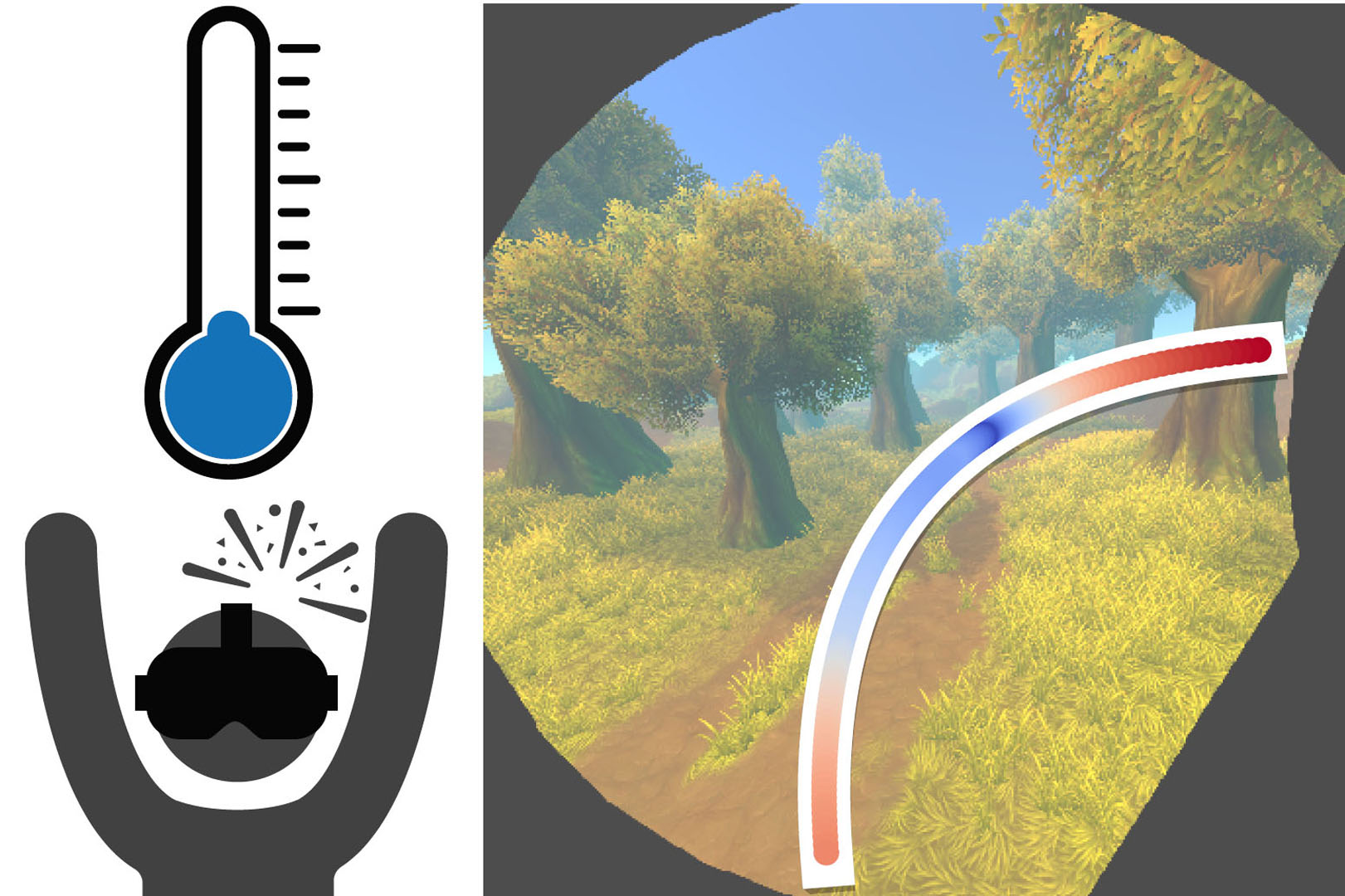
Virtual-reality provides an immersive environment but can induce cybersickness due to the discrepancy between visual and vestibular cues. To avoid this problem, the movement of the virtual camera needs to match the motion of the user in the real world. Unfortunately, this is usually difficult due to the mismatch between the size of the virtual environments and the space available to the users in the physical domain. The resulting constraints on the camera movement significantly hamper the adoption of virtual-reality headsets in many scenarios and make the design of the virtual environments very challenging. In this work, we study how the characteristics of the virtual camera movement (e.g., translational acceleration and rotational velocity) and the composition of the virtual environment (e.g., scene depth) contribute to perceived discomfort. Based on the results from our user experiments, we devise a computational model for predicting the magnitude of the discomfort for a given scene and camera trajectory. We further apply our model to a new path planning method which optimizes the input motion trajectory to reduce perceptual sickness. We evaluate the effectiveness of our method in improving perceptual comfort in a series of user studies targeting different applications. The results indicate that our method can reduce the perceived discomfort while maintaining the fidelity of the original navigation, and perform better than simpler alternatives.
References:
1. Marcos Allue, Ana Serrano, Manuel G Bedia, and Belen Masia. 2016. Crossmodal Perception in Immersive Environments. In CEIG ’16. 1–7.Google Scholar
2. Carlos Andújar, P Vázquez, and Marta Fairén. 2004. Way-finder: guided tours through complex walkthrough models. In Computer Graphics Forum, Vol. 23. 499–508.Google ScholarCross Ref
3. Ferran Argelaguet and Carlos Andujar. 2010. Automatic Speed Graph Generation for Predefined Camera Paths. In SG ’10. 115–126.Google Scholar
4. April Ash, Stephen Palmisano, Deborah Apthorp, and Robert S Allison. 2013. Vection in Depth During Treadmill Walking. Perception 42, 5 (2013), 562–576.Google ScholarCross Ref
5. Blaine Bell, Steven Feiner, and Tobias Höllerer. 2001. View Management for Virtual and Augmented Reality. In UIST ’01. 101–110.Google Scholar
6. Jelte E Bos, Willem Bles, and Eric L Groen. 2008. A Theory on Visually Induced Motion Sickness. Displays 29, 2 (2008), 47–57.Google ScholarCross Ref
7. Thomas Brandt, Johannes Dichgans, and E Koenig. 1973. Differential Effects of Central versus Peripheral Vision on Egocentric and Exocentric Motion Perception. Experimental Brain Research 16, 5 (1973), 476–491.Google ScholarCross Ref
8. Thomas Brandt, Eugene R Wist, and Johannes Dichgans. 1975. Foreground and Background in Dynamic Spatial Orientation. Perception & Psychophysics 17, 5 (1975), 497–503.Google ScholarCross Ref
9. Pulkit Budhiraja, Mark Roman Miller, Abhishek K Modi, and David Forsyth. 2017. Rotation Blurring: Use of Artificial Blurring to Reduce Cybersickness in Virtual Reality First Person Shooters. arXiv preprint arXiv:1710.02599 (2017).Google Scholar
10. Paolo Burelli, Luca Di Gaspero, Andrea Ermetici, and Roberto Ranon. 2008. Virtual Camera Composition with Particle Swarm Optimization. In International Symposium on Smart Graphics. 130–141.Google Scholar
11. Paolo. Burelli and Georgios. N. Yannakakis. 2010. Global Search for Occlusion Minimisation in Virtual Camera Control. In IEEE Congress on Evolutionary Computation. 1–8.Google Scholar
12. Rui CH Chiou, Arie E Kaufman, Zhengrong Liang, Lichan Hong, and Miranda Achniotou. 1998. Interactive Path Planning for Virtual Endoscopy [Colon CT]. In IEEE Nuclear Science Symposium. Conference Record., Vol. 3. IEEE, 2069–2072.Google ScholarCross Ref
13. Marc Christie and Jean-Marie Normand. 2005. A Semantic Space Partitioning Approach to Virtual Camera Composition. In Computer Graphics Forum, Vol. 24. 247–256.Google ScholarCross Ref
14. Marc Christie, Patrick Olivier, and Jean-Marie Normand. 2008. Camera Control in Computer Graphics. Computer Graphics Forum 27, 8 (2008), 2197–2218.Google ScholarCross Ref
15. James Cutting and Peter Vishton. 1994. Perceiving Layout and Knowing Distances.Google Scholar
16. Gregory C DeAngelis and Dora E Angelaki. 2011. The Neural Bases of Multisensory Processes. Chapter Visual-vestibular integration for self-motion perception.Google Scholar
17. Johannes Dichgans and Thomas Brandt. 1978. Visual-Vestibular Interaction: Effects on self-motion perception and postural control. In Perception. 755–804.Google Scholar
18. Hartwig K Distler, Karl R Gegenfurtner, Hendrik AHC Van Veen, and Michael J Hawken.Google Scholar
19. 2000. Velocity Constancy in a Virtual Reality Environment. Perception 29, 12 (2000), 1423–1435.Google ScholarCross Ref
20. Alexander Domahidi and Juan Jerez. 2014. FORCES Professional. embotech GmbH (http://embotech.com/FORCES-Pro).Google Scholar
21. Zhi-Chao Dong, Xiao-Ming Fu, Chi Zhang, Kang Wu, and Ligang Liu. 2017. Smooth Assembled Mappings for Large-scale Real Walking. ACM Transactions on Graphics 36, 6, Article 211 (2017), 13 pages.Google ScholarDigital Library
22. Ajoy S Fernandes and Steven K Feiner. 2016. Combating VR Sickness Through Subtle Dynamic Field-of-View Modification. In 2016 IEEE Symposium on 3D User Interfaces (3DUI). IEEE, 201–210.Google Scholar
23. James J Gibson. 1950. The Perception of the Visual World. Oxford, England. xii+242 pages.Google Scholar
24. Li-wei He, Michael F. Cohen, and David H. Salesin. 1996. The Virtual Cinematographer: A Paradigm for Automatic Real-time Camera Control and Directing. In SIGGRAPH ’96. 217–224.Google Scholar
25. Pieter Hintjens. 2013. ZeroMQ: messaging for many applications.Google Scholar
26. Lichan Hong, Shigeru Muraki, Arie Kaufman, Dirk Bartz, and Taosong He. 1997. Virtual Voyage: Interactive Navigation in the Human Colon. In SIGGRAPH ’97. 27–34.Google ScholarDigital Library
27. Ian P Howard and Thomas Heckmann. 1989. Circular Vection as a Function of the Relative Sizes, Distances, and Positions of Two Competing Visual Displays. Perception 18, 5 (1989), 657–665.Google ScholarCross Ref
28. Hui Huang, Dani Lischinski, Zhuming Hao, Minglun Gong, Marc Christie, and Daniel Cohen-Or. 2016. Trip Synopsis: 60km in 60sec. Computer Graphics Forum 35, 7 (2016), 107–116.Google ScholarDigital Library
29. Frank Jardillier and Eric Languénou. 1998. Screen-Space Constraints for Camera Movements: the Virtual Cameraman. In Computer Graphics Forum, Vol. 17. 175–186.Google ScholarCross Ref
30. Robert S Kennedy, Norman E Lane, Kevin S Berbaum, and Michael G Lilienthal. 1993. Simulator Sickness Questionnaire: An enhanced method for quantifying simulator sickness. The International Journal of Aviation Psychology 3, 3 (1993), 203–220.Google ScholarCross Ref
31. Behrang Keshavarz, Bernhard E Riecke, Lawrence J Hettinger, and Jennifer L Campos. 2015. Vection and Visually Induced Motion Sickness: how are they related? Frontiers in Psychology 6 (2015).Google Scholar
32. Nam-Gyoon Kim and Beom-Su Kim. 2019. The Effect of Retinal Eccentricity on Visually Induced Motion Sickness and Postural Control. Applied Sciences 9, 9 (2019), 1919.Google ScholarCross Ref
33. Vamsi Kiran Adhikarla, Marek Vinkler, Denis Sumin, Rafal K Mantiuk, Karol Myszkowski, Hans-Peter Seidel, and Piotr Didyk. 2017. Towards a Quality Metric for Dense Light Fields. In CVPR ’17. 58–67.Google ScholarCross Ref
34. Denise Lam, Chris Manzie, and Malcolm Good. 2010. Model Predictive Contouring Control. In 49th IEEE Conference on Decision and Control (CDC). IEEE, 6137–6142.Google Scholar
35. Eike Langbehn, Frank Steinicke, Markus Lappe, Gregory F Welch, and Gerd Bruder. 2018. In the Blink of an Eye: Leveraging Blink-Induced Suppression for Imperceptible Position and Orientation Redirection in Virtual Reality. ACM Transactions on Graphics 37, 4, Article 66 (2018).Google ScholarDigital Library
36. Markus Lappe, Frank Bremmer, and AV Van den Berg. 1999. Perception of Self-Motion from Visual Flow. Trends in Cognitive Sciences 3, 9 (1999), 329–336.Google ScholarCross Ref
37. Joseph J LaViola Jr. 2000. A Discussion of Cybersickness in Virtual Environments. ACM SIGCHI Bulletin 32, 1 (2000), 47–56.Google ScholarDigital Library
38. Christophe Lino and Marc Christie. 2015. Intuitive and Efficient Camera Control with the Toric Space. ACM Transactions on Graphics 34, 4, Article 82 (2015), 12 pages.Google ScholarDigital Library
39. Belen Masia, Gordon Wetzstein, Piotr Didyk, and Diego Gutierrez. 2013. Special Section on Advanced Displays: A Survey on Computational Displays: Pushing the Boundaries of Optics, Computation, and Perception. Computers and Graphics 37, 8 (2013), 1012–1038.Google ScholarDigital Library
40. Michael E McCauley and Thomas J Sharkey. 1992. Cybersickness: Perception of Self-motion in Virtual Environments. Presence: Teleoperators & Virtual Environments 1, 3 (1992), 311–318.Google ScholarDigital Library
41. Mark McGill, Alexander Ng, and Stephen Brewster. 2017. I Am The Passenger: How Visual Motion Cues Can Influence Sickness For In-Car VR. In CHI ’17. 5655–5668.Google ScholarDigital Library
42. Tobias Nägeli, Lukas Meier, Alexander Domahidi, Javier Alonso-Mora, and Otmar Hilliges. 2017. Real-time Planning for Automated Multi-view Drone Cinematography. ACM Transactions on Graphics 36, 4, Article 132 (2017), 10 pages.Google ScholarDigital Library
43. Shinji Nakamura. 2006. Depth Separation between Foreground and Background on Visually Induced Perception of Self-Motion. Perceptual and Motor Skills 102, 3 (2006), 871–877.Google ScholarCross Ref
44. Shinji Nakamura, Stephen Palmisano, and Juno Kim. 2016. Relative Visual Oscillation Can Facilitate Visually Induced Self-Motion Perception. i-Perception 7, 4 (2016), 1–18.Google ScholarCross Ref
45. Shinji Nakamura and Shinsuke Shimojo. 2000. A Slowly Moving Foreground can Capture an Observer’s Self-Motion – a Report of a New Motion Illusion: Inverted vection. Vision Research 40, 21 (2000), 2915–2923.Google ScholarCross Ref
46. Nitish Padmanaban, Timon Ruban, Vincent Sitzmann, Anthony M Norcia, and Gordon Wetzstein. 2018. Towards a Machine-Learning Approach for Sickness Prediction in 360° Stereoscopic Videos. IEEE Transactions on Visualization and Computer Graphics 1 (2018), 1594–1603.Google ScholarDigital Library
47. Fred H Previc and Michael Donnelly. 1993. The Effects of Visual Depth and Eccentricity on Manual Bias, Induced Motion, and Vection. Perception 22, 8 (1993), 929–945.Google ScholarCross Ref
48. Jerrold D Prothero, Mark H Draper, DE Parker, and MJ Wells. 1999. The use of an independent visual background to reduce simulator side-effects. Aviation, Space, and Environmental Medicine 70, 3 Pt 1 (1999), 277–283.Google Scholar
49. Sharif Razzaque, David Swapp, Mel Slater, Mary C. Whitton, and Anthony Steed. 2002. Redirected Walking in Place. In EGVE ’02. 123–130.Google ScholarDigital Library
50. James T Reason and Joseph John Brand. 1975. Motion sickness.Google Scholar
51. Lisa Rebenitsch and Charles Owen. 2016. Review on Cybersickness in Applications and Visual Displays. Virtual Reality 20, 2 (2016), 101–125.Google ScholarDigital Library
52. Bernhard E Riecke, Daniel Feuereissen, John J Rieser, and Timothy P McNamara. 2012. Self-Motion Illusions (Vection) in VR: Are they good for anything?. In 2012 IEEE Virtual Reality Workshops (VRW). 35–38.Google ScholarDigital Library
53. Michael Rietzler, Teresa Hirzle, Jan Gugenheimer, Julian Frommel, Thomas Dreja, and Enrico Rukzio. 2018. VRSpinning: Exploring the Design Space of a 1D Rotation Platform to Increase the Perception of Self-Motion in VR. In Proceedings of the 2018 Designing Interactive Systems Conference. ACM, 99–108.Google ScholarDigital Library
54. Takeharu Seno, Hiroyuki Ito, and Shoji Sunaga. 2009. The Object and Background Hypothesis for Vection. Vision Research 49, 24 (2009), 2973–2982.Google ScholarCross Ref
55. Yasuhiro Seya, Takayuki Tsuji, and Hiroyuki Shinoda. 2014. Effect of Depth Order on Linear Vection with Optical Flows. i-Perception 5, 7 (2014), 630–640.Google Scholar
56. Takashi Shibata, Joohwan Kim, David M Hoffman, and Martin S Banks. 2011. The Zone of Comfort: Predicting Visual Discomfort with Stereo Displays. Journal of Vision 11, 8 (2011), 11–11.Google ScholarCross Ref
57. D Amnon Silverstein and Joyce E Farrell. 2001. Efficient Method for Paired Comparison. Journal of Electronic Imaging 10, 2 (2001), 394–398.Google ScholarCross Ref
58. Richard HY So, Andy Ho, and WT Lo. 2001a. A Metric to Quantify Virtual Scene Movement for the Study of Cybersickness: Definition, implementation, and verification. Presence: Teleoperators and Virtual Environments 10, 2 (2001), 193–215.Google ScholarDigital Library
59. Richard HY So, WT Lo, and Andy TK Ho. 2001b. Effects of Navigation Speed on Motion Sickness Caused by an Immersive Virtual Environment. Human Factors: The Journal of the Human Factors and Ergonomics Society 43, 3 (2001), 452–461.Google ScholarCross Ref
60. Qi Sun, Anjul Patney, Li-Yi Wei, Omer Shapira, Jingwan Lu, Paul Asente, Suwen Zhu, Morgan McGuire, David Luebke, and Arie E Kaufman. 2018. Towards Virtual Reality Infinite Walking: Dynamic Saccadic Redirection. ACM Transactions on Graphics 37, 4, Article 67 (2018), 13 pages.Google ScholarDigital Library
61. Qi Sun, Li-Yi Wei, and Arie E Kaufman. 2016. Mapping Virtual and Physical Reality. ACM Transactions on Graphics 35, 4, Article 64 (2016), 12 pages.Google ScholarDigital Library
62. William H. Warren. 2004. Optic Flow. In The Visual Neurosciences, Leo M. Chalupa John Simon Werner (Ed.). Cambridge, Chapter 10, 1247–1259.Google Scholar
63. Martin. Weier, Michael. Stengel, Thorsten. Roth, Piotr. Didyk, Elmar. Eisemann, Martin. Eisemann, Steve. Grogorick, Andr’e. Hinkenjann, Ernst. Kruijff, Marcus. Magnor, Karol. Myszkowski, and Philipp. Slusallek. 2017. Perception-driven Accelerated Rendering. Computer Graphics Forum 36, 2 (2017), 611–643.Google ScholarDigital Library
64. Robert Xiao and Hrvoje Benko. 2016. Augmenting the Field-of-View of Head-Mounted Displays with Sparse Peripheral Displays. In CHI ’16. 1221–1232.Google Scholar
65. Richard Yao, Tom Heath, Aaron Davies, Tom Forsyth, Nate Mitchell, and Perry Hoberman. 2014. Oculus VR best practices guide. https://scontent.oculuscdn.com/v/t64.5771-25/12482206_237917063479780_486464407014998016_n.pdf.Google Scholar



