
“Neural state machine for character-scene interactions” by Starke, Zhang, Komura and Saito
Conference:
Type(s):
Title:
- Neural state machine for character-scene interactions
Session/Category Title:
- Learning to Move
Presenter(s)/Author(s):
Moderator(s):
Abstract:
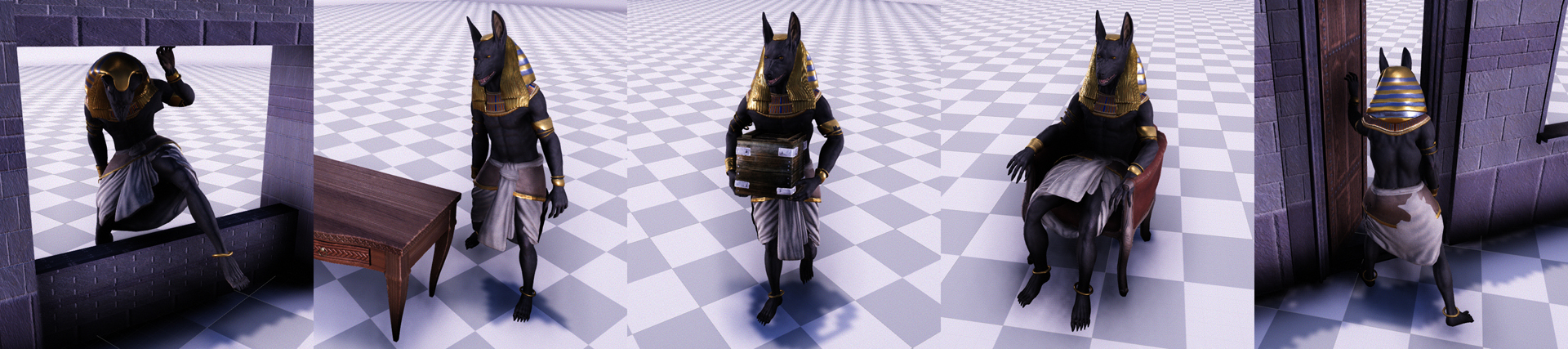
We propose Neural State Machine, a novel data-driven framework to guide characters to achieve goal-driven actions with precise scene interactions. Even a seemingly simple task such as sitting on a chair is notoriously hard to model with supervised learning. This difficulty is because such a task involves complex planning with periodic and non-periodic motions reacting to the scene geometry to precisely position and orient the character. Our proposed deep auto-regressive framework enables modeling of multi-modal scene interaction behaviors purely from data. Given high-level instructions such as the goal location and the action to be launched there, our system computes a series of movements and transitions to reach the goal in the desired state. To allow characters to adapt to a wide range of geometry such as different shapes of furniture and obstacles, we incorporate an efficient data augmentation scheme to randomly switch the 3D geometry while maintaining the context of the original motion. To increase the precision to reach the goal during runtime, we introduce a control scheme that combines egocentric inference and goal-centric inference. We demonstrate the versatility of our model with various scene interaction tasks such as sitting on a chair, avoiding obstacles, opening and entering through a door, and picking and carrying objects generated in real-time just from a single model.
References:
1. Shailen Agrawal and Michiel van de Panne. 2016. Task-based Locomotion. ACM Trans on Graph 35, 4 (2016). Google ScholarDigital Library
2. Rami Ali Al-Asqhar, Taku Komura, and Myung Geol Choi. 2013. Relationship descriptors for interactive motion adaptation. In Proc. SCA. 45–53. Google ScholarDigital Library
3. Shaojie Bai, J Zico Kolter, and Vladlen Koltun. 2018. An empirical evaluation of generic convolutional and recurrent networks for sequence modeling. arXiv preprint arXiv:1803.01271 (2018). http://arxiv.org/abs/1803.01271Google Scholar
4. Angel X Chang, Thomas Funkhouser, Leonidas Guibas, Pat Hanrahan, Qixing Huang, Zimo Li, Silvio Savarese, Manolis Savva, Shuran Song, Hao Su, et al. 2015. Shapenet: An information-rich 3d model repository. arXiv preprint arXiv:1512.03012 (2015). http://arxiv.org/abs/1512.03012Google Scholar
5. Myung Geol Choi, Manmyung Kim, Kyung Lyul Hyun, and Jehee Lee. 2011. Deformable motion: Squeezing into cluttered environments. In Computer Graphics Forum, Vol. 30. Wiley Online Library. Google ScholarCross Ref
6. Min Gyu Choi, Jehee Lee, and Sung Yong Shin. 2003. Planning biped locomotion using motion capture data and probabilistic roadmaps. ACM Trans on Graph 22, 2 (2003). Google ScholarDigital Library
7. Alexander Clegg, Wenhao Yu, Jie Tan, C Karen Liu, and Greg Turk. 2018. Learning to dress: synthesizing human dressing motion via deep reinforcement learning. ACM Trans on Graph 37, 4 (2018). Google ScholarDigital Library
8. Djork-Arné Clevert, Thomas Unterthiner, and Sepp Hochreiter. 2015. Fast and Accurate Deep Network Learning by Exponential Linear Units (ELUs). CoRR abs/1511.07289 (2015). arXiv:1511.07289 http://arxiv.org/abs/1511.07289Google Scholar
9. Katerina Fragkiadaki, Sergey Levine, Panna Felsen, and Jitendra Malik. 2015. Recurrent network models for human dynamics. In Proc. ICCV. 4346–4354. Google ScholarDigital Library
10. Félix G. Harvey and Christopher J. Pal. 2018. Recurrent Transition Networks for Character Locomotion. CoRR abs/1810.02363 (2018). arXiv:1810.02363 http://arxiv.org/abs/1810.02363Google Scholar
11. Nicolas Heess, Srinivasan Sriram, Jay Lemmon, Josh Merel, Greg Wayne, Yuval Tassa, Tom Erez, Ziyu Wang, Ali Eslami, Martin Riedmiller, et al. 2017. Emergence of locomotion behaviours in rich environments. arXiv preprint arXiv:1707.02286 (2017). Google ScholarDigital Library
12. Daniel Holden, Taku Komura, and Jun Saito. 2017. Phase-functioned neural networks for character control. ACM Trans on Graph 36, 4 (2017), 42. Google ScholarDigital Library
13. Daniel Holden, Jun Saito, and Taku Komura. 2016. A deep learning framework for character motion synthesis and editing. ACM Trans on Graph 35, 4 (2016). Google ScholarDigital Library
14. Robert A Jacobs, Michael I Jordan, Steven J Nowlan, and Geoffrey E Hinton. 1991. Adaptive mixtures of local experts. Neural Computation 3, 1 (1991), 79–87. Google ScholarCross Ref
15. Manmyung Kim, Youngseok Hwang, Kyunglyul Hyun, and Jehee Lee. 2012. Tiling motion patches. In Proc. SCA. 117–126. http://dl.acm.org/citation.cfm?id=2422356.2422375Google Scholar
16. Jehee Lee, Jinxiang Chai, Paul SA Reitsma, Jessica K Hodgins, and Nancy S Pollard. 2002. Interactive control of avatars animated with human motion data. ACM Trans on Graph 21, 3 (2002). Google ScholarDigital Library
17. Kyungho Lee, Seyoung Lee, and Jehee Lee. 2018. Interactive Character Animation by Learning Multi-objective Control. ACM Trans on Graph 37, 6 (2018). Google ScholarDigital Library
18. Kang Hoon Lee, Myung Geol Choi, and Jehee Lee. 2006. Motion patches: building blocks for virtual environments annotated with motion data. ACM Trans on Graph 25, 3 (2006). Google ScholarDigital Library
19. Zimo Li, Yi Zhou, Shuangjiu Xiao, Chong He, Zeng Huang, and Hao Li. 2017. Auto-conditioned recurrent networks for extended complex human motion synthesis. arXiv preprint arXiv:1707.05363 (2017). http://arxiv.org/abs/1707.05363Google Scholar
20. Libin Liu, KangKang Yin, Michiel van de Panne, Tianjia Shao, and Weiwei Xu. 2010. Sampling-based contact-rich motion control. ACM Trans on Graph 29, 4 (2010), 128. Google ScholarDigital Library
21. Wan-Yen Lo, Claude Knaus, and Matthias Zwicker. 2012. Learning motion controllers with adaptive depth perception. In Proc. SCA. 145–154. http://dl.acm.org/citation.cfm?id=2422356.2422378Google Scholar
22. Wan-Yen Lo and Matthias Zwicker. 2008. Real-time planning for parameterized human motion. In Proc. SCA. 29–38. http://dl.acm.org/citation.cfm?id=1632592.1632598Google Scholar
23. Jianyuan Min and Jinxiang Chai. 2012. Motion Graphs++: A Compact Generative Model for Semantic Motion Analysis and Synthesis. ACM Trans on Graph 31, 6 (2012), 153:1–153:12. Google ScholarDigital Library
24. Igor Mordatch, Emanuel Todorov, and Zoran Popović. 2012. Discovery of complex behaviors through contact-invariant optimization. ACM Trans on Graph 31, 4 (2012). Google ScholarDigital Library
25. Tomohiko Mukai and Shigeru Kuriyama. 2005. Geostatistical motion interpolation. ACM Trans on Graph 24, 3 (2005). Google ScholarDigital Library
26. Xue Bin Peng, Pieter Abbeel, Sergey Levine, and Michiel van de Panne. 2018a. Deep-Mimic: Example-guided Deep Reinforcement Learning of Physics-based Character Skills. ACM Trans on Graph 37, 4 (2018). Google ScholarDigital Library
27. Xue Bin Peng, Glen Berseth, and Michiel van de Panne. 2016. Terrain-Adaptive Locomotion Skills Using Deep Reinforcement Learning. ACM Trans on Graph 35, 4 (2016). Google ScholarDigital Library
28. Xue Bin Peng, Glen Berseth, KangKang Yin, and Michiel Van De Panne. 2017. Deeploco: Dynamic locomotion skills using hierarchical deep reinforcement learning. ACM Trans on Graph 36, 4 (2017). Google ScholarDigital Library
29. Xue Bin Peng, Angjoo Kanazawa, Jitendra Malik, Pieter Abbeel, and Sergey Levine. 2018b. SFV: reinforcement learning of physical skills from videos. ACM Trans on Graph 37, 6 (2018). Google ScholarDigital Library
30. Charles Ruizhongtai Qi, Li Yi, Hao Su, and Leonidas J Guibas. 2017. Point-Net++: Deep Hierarchical Feature Learning on Point Sets in a Metric Space. In Proc. NIPS. 5099–5108. http://papers.nips.cc/paper/7095-pointnet-deep-hierarchical-feature-learning-on-point-sets-in-a-metric-space.pdfGoogle Scholar
31. Charles Rose, Michael F. Cohen, and Bobby Bodenheimer. 1998. Verbs and Adverbs: Multidimensional Motion Interpolation. IEEE Computer Graphics and Applications 18, 5 (1998), 32–40. Google ScholarDigital Library
32. Charles F Rose III, Peter-Pike J Sloan, and Michael F Cohen. 2001. Artist-Directed Inverse-Kinematics Using Radial Basis Function Interpolation. Computer Graphics Forum 20, 3 (2001), 239–250. Google ScholarCross Ref
33. Alla Safonova and Jessica K Hodgins. 2007. Construction and optimal search of interpolated motion graphs. ACM Trans on Graph 26, 3 (2007). Google ScholarDigital Library
34. Hubert PH Shum, Taku Komura, Masashi Shiraishi, and Shuntaro Yamazaki. 2008. Interaction patches for multi-character animation. ACM Trans on Graph 27, 5 (2008). Google ScholarDigital Library
35. Ruben Villegas, Jimei Yang, Duygu Ceylan, and Honglak Lee. 2018. Neural Kinematic Networks for Unsupervised Motion Retargetting. Proceedings of CVPR 2018. Google ScholarCross Ref
36. J.M. Wang, D.J. Fleet, and A. Hertzmann. 2008. Gaussian Process Dynamical Models for Human Motion. IEEE PAMI 30, 2 (Feb 2008), 283–298. Google ScholarDigital Library
37. Jungdam Won, Kyungho Lee, Carol O’Sullivan, Jessica K Hodgins, and Jehee Lee. 2014. Generating and ranking diverse multi-character interactions. ACM Trans on Graph 33, 6 (2014). Google ScholarDigital Library
38. Jungdam Won, Jongho Park, Kwanyu Kim, and Jehee Lee. 2017. How to train your dragon: example-guided control of flapping flight. ACM Trans on Graph 36, 6 (2017). Google ScholarDigital Library
39. Yuting Ye and C Karen Liu. 2012. Synthesis of detailed hand manipulations using contact sampling. ACM Trans on Graph 31, 4 (2012). Google ScholarDigital Library
40. Wenhao Yu, Greg Turk, and C Karen Liu. 2018. Learning symmetric and low-energy locomotion. ACM Trans on Graph 37, 4 (2018). Google ScholarDigital Library
41. He Zhang, Sebastian Starke, Taku Komura, and Jun Saito. 2018. Mode-adaptive neural networks for quadruped motion control. ACM Trans on Graph 37, 4 (2018). Google ScholarDigital Library
42. Wenping Zhao, Jianjie Zhang, Jianyuan Min, and Jinxiang Chai. 2013. Robust realtime physics-based motion control for human grasping. ACM Trans on Graph 32, 6 (2013). Google ScholarDigital Library



