
“Metasilicone: design and fabrication of composite silicone with desired mechanical properties”
Conference:
Type(s):
Title:
- Metasilicone: design and fabrication of composite silicone with desired mechanical properties
Session/Category Title:
- Design and Fabrication
Presenter(s)/Author(s):
Abstract:
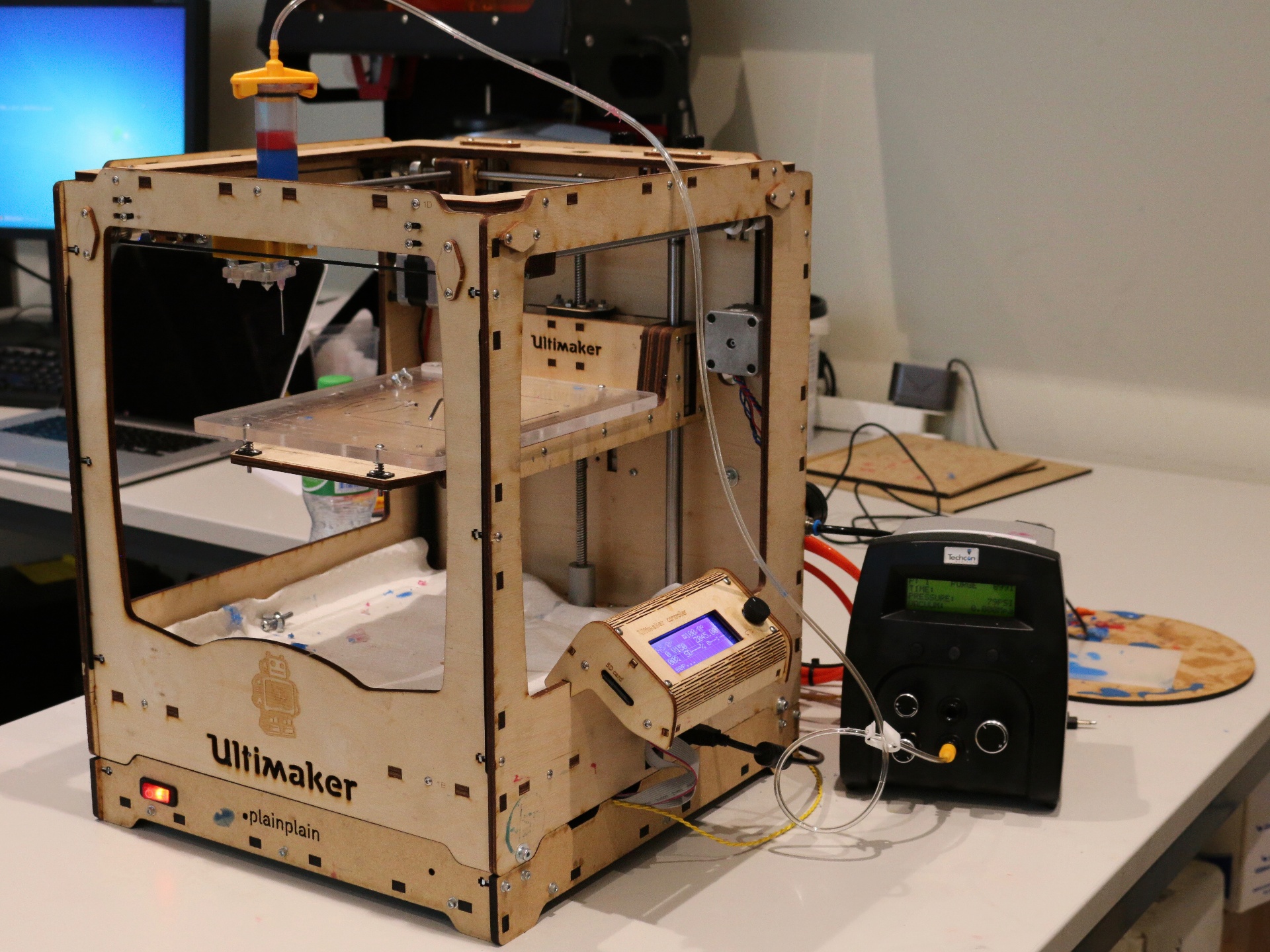
We present a method for designing and fabricating MetaSilicones—composite silicone rubbers that exhibit desired macroscopic mechanical properties. The underlying principle of our approach is to inject spherical inclusions of a liquid dopant material into a silicone matrix material. By varying the number, size, and locations of these inclusions as well as their material, a broad range of mechanical properties can be achieved. The technical core of our approach is formed by an optimization algorithm that, combining a simulation model based on extended finite elements (XFEM) and sensitivity analysis, computes inclusion distributions that lead to desired stiffness properties on the macroscopic level. We explore the design space of MetaSilicone on an extensive set of simulation experiments involving materials with optimized uni- and bi-directional stiffness, spatially-graded properties, as well as multi-material composites. We present validation through standard measurements on physical prototypes, which we fabricate on a modified filament-based 3D printer, thus combining the advantages of digital fabrication with the mechanical performance of silicone elastomers.
References:
1. Grégoire Allaire. 2015. A review of adjoint methods for sensitivity analysis, uncertainty quantification and optimization in numerical codes. Ingénieurs de l’Automobile 836 (July 2015), 33–36. https://hal.archives-ouvertes.fr/hal-01242950
2. Moritz Bächer, Benjamin Hepp, Fabrizio Pece, Paul G. Kry, Bernd Bickel, Bernhard Thomaszewski, and Otmar Hilliges. 2016. DefSense: Computational Design of Customized Deformable Input Devices. In Proceedings of the 2016 CHI Conference on Human Factors in Computing Systems (CHI ’16). 3806–3816.
3. Adam W. Bargteil and Elaine Cohen. 2014. Animation of Deformable Bodies with Quadratic Bézier Finite Elements. ACM Trans. Graph. 33, 3, Article 27 (June 2014), 10 pages.
4. Adam W. Bargteil, Chris Wojtan, Jessica K. Hodgins, and Greg Turk. 2007. A Finite Element Method for Animating Large Viscoplastic Flow. ACM Trans. Graph. 26, 3, Article 16 (July 2007).
5. Bernd Bickel, Moritz Bächer, Miguel A. Otaduy, Hyunho Richard Lee, Hanspeter Pfister, Markus Gross, and Wojciech Matusik. 2010. Design and Fabrication of Materials with Desired Deformation Behavior. Proc. of ACM SIGGRAPH ’10 (2010).
6. Bernd Bickel, Peter Kaufmann, Mélina Skouras, Bernhard Thomaszewski, DerekBradley, Thabo Beeler, Phil Jackson, Steve Marschner, Wojciech Matusik, and Markus Gross. 2012. Physical face cloning. In Proc. of ACM SIGGRAPH ’12.
7. Desai Chen, David I. W. Levin, Shinjiro Sueda, and Wojciech Matusik. 2015. Data-Driven Finite Elements for Geometry and Material Design. ACM Trans. Graph. 34, 4, Article 74 (July 2015), 10 pages.
8. Nuttapong Chentanez, Ron Alterovitz, Daniel Ritchie, Lita Cho, Kris K. Hauser, Ken Goldberg, Jonathan R. Shewchuk, and James F. O’Brien. 2009. Interactive Simulation of Surgical Needle Insertion and Steering. ACM Trans. Graph. 28, 3, Article 88 (July 2009), 10 pages.
9. Pascal Clausen, Martin Wicke, Jonathan R. Shewchuk, and James F. O’Brien. 2013. Simulating Liquids and Solid-Liquid Interactions with Lagrangian Meshes. ACM Trans. Graph. 32, 2, Article 17 (April 2013), 15 pages.
10. Philipp Herholz, Wojciech Matusik, and Marc Alexa. 2015. Approximating Free-form Geometry with Height Fields for Manufacturing. Computer Graphics Forum (Proc. of Eurographics) 34, 2 (2015), 239–251.
11. Peter Kaufmann, Sebastian Martin, Mario Botsch, Eitan Grinspun, and Markus Gross. 2009. Enrichment Textures for Detailed Cutting of Shells. ACM Trans. Graph. 28, 3, Article 50 (July 2009), 10 pages.
12. Lily Kharevych, Patrick Mullen, Houman Owhadi, and Mathieu Desbrun. 2009. Numerical Coarsening of Inhomogeneous Elastic Materials. ACM Trans. Graph. 28, 3, Article 51 (July 2009), 8 pages.
13. D.B. Kolesky, R. L. Truby, A. S. Gladman, T. A. Busbee, K. A. Homan, and J.A. Lewis. 2014. 3D Bioprinting of Vascularized, Heterogeneous Cell-Laden Tissue Constructs. Advanced Materials 26 (2014), 3124–3130. Cross Ref
14. Jae-Hwang Lee, Jonathan P. Singer, and Edwin L. Thomas. 2012. Micro-/Nanostructured Mechanical Metamaterials. Advanced Materials 24, 36 (2012), 4782–4810. Cross Ref
15. Ming C. Lin and Miguel Otaduy. 2008. Haptic Rendering: Foundations, Algorithms, and Applications. A K Peters, Ltd.
16. Jeffrey I Lipton, Daniel Cohen, Michael Heinz, Maxim Lobovsky, Warren Parad, Garrett Bernstien, Tianyou Li, Justin Quartiere, Kamaal Washington, A Umaru, and others. 2009. [email protected] home model 2: Towards ubiquitous personal fabrication devices. In Solid freeform fabrication symposium (SFF’09). 70–81.
17. Pengbo Liu, Daolong Liu, Huawei Zou, Ping Fan, and Wen Xu. 2009. Structure and properties of closed-cell foam prepared from irradiation crosslinked silicone rubber. Journal of applied polymer science 113, 6 (2009), 3590–3595. Cross Ref
18. Tiantian Liu, Sofien Bouaziz, and Ladislav Kavan. 2016. Towards Real-time Simulation of Hyperelastic Materials. CoRR abs/1604.07378 (2016). http://arxiv.org/abs/1604.07378
19. P. Lopour, Z. Plichta, Z. Volfova, P. Hron, and P. Vondracek. 1993. Silicone rubber-hydrogel composites as polymeric biomaterials: IV. Silicone matrix-hydrogel filler interaction and mechanical properties. Biomaterials 14, 14 (1993), 1051 — 1055. Cross Ref
20. R. MacCurdy, R. Katzschmann, Youbin Kim, and D. Rus. 2016. Printable hydraulics: A method for fabricating robots by 3D co-printing solids and liquids. In 2016 IEEE International Conference on Robotics and Automation (ICRA). 3878–3885.
21. Luigi Malomo, Nico Pietroni, Bernd Bickel, and Paolo Cignoni. 2016. FlexMolds: Automatic Design of Flexible Shells for Molding. ACM Trans. on Graphics – Siggraph Asia 2016 35, 6 (dec 2016).
22. Pierre-Luc Manteaux, Wei-Lun Sun, François Faure, Marie-Paule Cani, and James F. O’Brien. 2015. Interactive Detailed Cutting of Thin Sheets. In Proceedings of the 8th ACM SIGGRAPH Conference on Motion in Games (MIG ’15). ACM, New York, NY, USA, 125–132.
23. Jonàs Martínez, Jérémie Dumas, and Sylvain Lefebvre. 2016. Procedural Voronoi Foams for Additive Manufacturing. ACM Trans. Graph. 35, 4, Article 44 (July 2016), 12 pages.
24. N. Moës, M. Cloirec, P. Cartraud, and J.-F. Remacle. 2003. A computational approach to handle complex microstructure geometries. Computer Methods in Applied Mechanics and Engineering 192, 28-30 (2003), 3163 — 3177. Cross Ref
25. Nicolas Moës, John Dolbow, and Ted Belytschko. 1999. A finite element method for crack growth without remeshing. Internat. J. Numer. Methods Engrg. 46, 1 (1999), 131–150. <131::AID-NME726>3.0.CO;2-J Cross Ref
26. Sean V Murphy and Anthony Atala. 2014. 3D bioprinting of tissues and organs. Nature Biotechnology 32 (August 2014), 773–785.
27. J. T. Muth, D. M. Vogt, R. L. Truby, Y. Menguc, D.B. Kolesky, R.J. Wood, and J.A. Lewis. 2014. Embedded 3D Printing of Strain Sensors within Highly Stretchable Elastomers. Advanced Materials 26 (2014), 6307–6312. Cross Ref
28. Rahul Narain, Matthew Overby, and George E. Brown. 2016. ADMM ⊇ Projective Dynamics: Fast Simulation of General Constitutive Models. In Proceedings of the ACM SIGGRAPH/Eurographics Symposium on Computer Animation (SCA ’16). Eurographics Association, Aire-la-Ville, Switzerland, Switzerland, 21–28. http://dl.acm.org/citation.cfm?id=2982818.2982822
29. Matthieu Nesme, Paul G. Kry, Lenka Jeřábková, and François Faure. 2009. Preserving Topology and Elasticity for Embedded Deformable Models. ACM Trans. Graph. 28, 3, Article 52 (July 2009), 9 pages.
30. Lise Noël, Laurent Van Miegroet, and Pierre Duysinx. 2016. Analytical sensitivity analysis using the extended finite element method in shape optimization of bimaterial structures. Internat. J. Numer. Methods Engrg. 107, 8 (2016), 669–695. Cross Ref
31. Shigeru Owada. 2006. Jello Printer. Computer Software 23, 4 (2006), 47–50.
32. Neri Oxman, Elizabeth Tsai, and Michal Firstenberg. 2012. Digital anisotropy: A variable elasticity rapid prototyping platform. Virtual and Physical Prototyping 7, 4 (2012), 261–274. Cross Ref
33. Julian Panetta, Qingnan Zhou, Luigi Malomo, Nico Pietroni, Paolo Cignoni, and Denis Zorin. 2015. Elastic Textures for Additive Fabrication. ACM Trans. Graph. 34, 4, Article 135 (July 2015), 12 pages.
34. Daniela Rus and Michael T. Tolley. 2015. Design, fabrication and control of soft robots. Nature 521 (May 2015), 467–475.
35. Christian Schumacher, Bernd Bickel, Jan Rys, Steve Marschner, Chiara Daraio, and Markus Gross. 2015. Microstructures to Control Elasticity in 3D Printing. ACM Trans. Graph. 34, 4, Article 136 (July 2015), 13 pages.
36. Pitchaya Sitthi-Amorn, Javier E. Ramos, Yuwang Wangy, Joyce Kwan, Justin Lan, Wenshou Wang, and Wojciech Matusik. 2015. MultiFab: A Machine Vision Assisted Platform for Multi-material 3D Printing. ACM Trans. Graph. 34, 4, Article 129 (July 2015), 11 pages.
37. Mélina Skouras, Bernhard Thomaszewski, Stelian Coros, Bernd Bickel, and Markus Gross. 2013. Computational design of actuated deformable characters. In Proc. of ACM SIGGRAPH ’13.
38. Stratasys. 2017. Stratasys PolyJet Series. http://www.stratasys.com/. (2017). Accessed: 2017-01-14.
39. N. Sukumar, D.L. Chopp, N. Moës, and T. Belytschko. 2001. Modeling holes and inclusions by level sets in the extended finite-element method. Computer Methods in Applied Mechanics and Engineering 190, 46–47 (2001), 6183 — 6200. Cross Ref
40. R. L. Truby and J. A. Lewis. 2016. Printing Soft Matter in Three Dimensions. Nature 540 (2016), 371–378. Cross Ref
41. Ilse M. Van Meerbeek, Benjamin C. Mac Murray, Jae Woo Kim, Sanlin S. Robinson, Perry X. Zou, Meredith N. Silberstein, and Robert F. Shepherd. 2016. Morphing Metal and Elastomer Bicontinuous Foams for Reversible Stiffness, Shape Memory, and Self-Healing Soft Machines. Advanced Materials 28, 14 (2016), 2801–2806. Cross Ref
42. Kiril Vidimče, Alexandre Kaspar, Ye Wang, and Wojciech Matusik. 2016. Foundry: Hierarchical Material Design for Multi-Material Fabrication. In Proceedings of the 29th Annual Symposium on User Interface Software and Technology (UIST ’16). ACM, New York, NY, USA, 563–574.
43. Kiril Vidimče, Szu-Po Wang, Jonathan Ragan-Kelley, and Wojciech Matusik. 2013. Open-Fab: A Programmable Pipeline for Multi-Material Fabrication. ACM Transactions on Graphics 32 (July 2013), 11. Issue 4.
44. M. Wehner, R. L. Truby, D. J. Fitzgerald, B. Mosadegh, G. M. Whitesides, J. A. Lewis, and R. J. Wood. 2016. An integrated design and fabrication strategy for entirely soft, autonomous robots. Nature 536 (2016), 451–466. Cross Ref
45. Martin Wicke, Daniel Ritchie, Bryan M. Klingner, Sebastian Burke, Jonathan R. Shewchuk, and James F. O’Brien. 2010. Dynamic Local Remeshing for Elasto-plastic Simulation. ACM Trans. Graph. 29, 4, Article 49 (July 2010), 11 pages.
46. Hongyi Xu, Yijing Li, Yong Chen, and Jernej Barbič. 2015. Interactive Material Design Using Model Reduction. ACM Trans. Graph. 34, 2, Article 18 (March 2015), 14 pages.



