
“WarpDriver: context-aware probabilistic motion prediction for crowd simulation”
Conference:
Type(s):
Title:
- WarpDriver: context-aware probabilistic motion prediction for crowd simulation
Session/Category Title:
- Human Motion
Presenter(s)/Author(s):
Abstract:
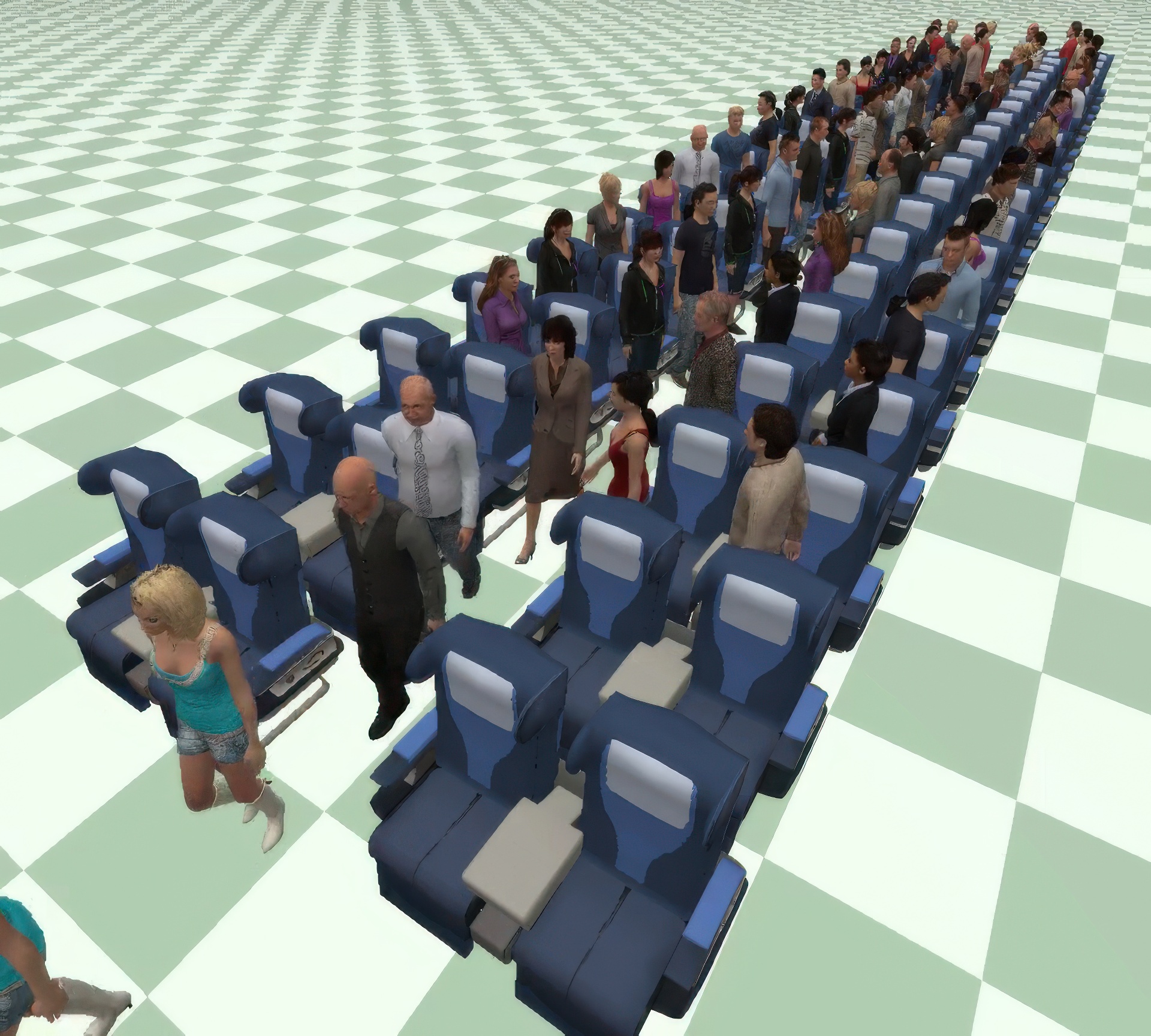
Microscopic crowd simulators rely on models of local interaction (e.g. collision avoidance) to synthesize the individual motion of each virtual agent. The quality of the resulting motions heavily depends on this component, which has significantly improved in the past few years. Recent advances have been in particular due to the introduction of a short-horizon motion prediction strategy that enables anticipated motion adaptation during local interactions among agents. However, the simplicity of prediction techniques of existing models somewhat limits their domain of validity. In this paper, our key objective is to significantly improve the quality of simulations by expanding the applicable range of motion predictions. To this end, we present a novel local interaction algorithm with a new context-aware, probabilistic motion prediction model. By context-aware, we mean that this approach allows crowd simulators to account for many factors, such as the influence of environment layouts or in-progress interactions among agents, and has the ability to simultaneously maintain several possible alternate scenarios for future motions and to cope with uncertainties on sensing and other agent’s motions. Technically, this model introduces “collision probability fields” between agents, efficiently computed through the cumulative application of Warp Operators on a source Intrinsic Field. We demonstrate how this model significantly improves the quality of simulated motions in challenging scenarios, such as dense crowds and complex environments.
References:
1. Chenney, S. 2004. Flow tiles. In Proceedings of the 2004 ACM SIGGRAPH/Eurographics Symposium on Computer animation, Eurographics Association, Aire-la-Ville, Switzerland, 233–242.
2. Cividini, J., Appert-Rolland, C., and Hilhorst, H.-J. 2013. Diagonal patterns and chevron effect in intersecting traffic flows. EPL (Europhysics Letters) 102, 2, 20002. Cross Ref
3. Feurtey, F. 2000. Simulating the Collision Avoidance Behavior of Pedestrians. Master’s thesis, Department of Electronic Engineering, University of Tokyo.
4. Golas, A., Narain, R., and Lin, M. 2013. Hybrid long-range collision avoidance for crowd simulation. In Proceedings of the ACM SIGGRAPH Symposium on Interactive 3D Graphics and Games, ACM, New York, NY, USA, I3D ’13, 29–36.
5. Guy, S. J., Chhugani, J., Kim, C., Satish, N., Lin, M., Manocha, D., and Dubey, P. 2009. Clearpath: Highly parallel collision avoidance for multi-agent simulation. In Proceedings of the 2009 ACM SIGGRAPH/Eurographics Symposium on Computer Animation, 177–187.
6. Guy, S. J., Curtis, S., Lin, M. C., and Manocha, D. 2012. Least-effort trajectories lead to emergent crowd behaviors. Phys. Rev. E 85 (Jan), 016110. Cross Ref
7. Guy, S. J., van den Berg, J., Liu, W., Lau, R., Lin, M. C., and Manocha, D. 2012. A statistical similarity measure for aggregate crowd dynamics. ACM Trans. Graph. 31.
8. Helbing, D., and Molnár, P. 1995. Social force model for pedestrian dynamics. Physical Review E 51, 5, 4282–4286. Cross Ref
9. Helbing, D., Farkas, I., and Vicsek, T. 2000. Simulating dynamical features of escape panic. Nature 407, 6803, 487–490.
10. Jin, X., Xu, J., Wang, C. C. L., Huang, S., and Zhang, J. 2008. Interactive control of large-crowd navigation in virtual environments using vector fields. IEEE Comput. Graph. Appl. 28, 6 (Nov.), 37–46.
11. Ju, E., Choi, M., Park, M., Lee, J., Lee, K., and Takahashi, S. 2010. Morphable crowds. ACM Trans. Graph. 29.
12. Kapadia, M., Singh, S., Hewlett, W., and Faloutsos, P. 2009. Egocentric affordance fields in pedestrian steering. In Proceedings of the 2009 Symposium on Interactive 3D Graphics and Games, ACM, New York, NY, USA, I3D ’09, 215–223.
13. Karamouzas, I., Heil, P., Beek, P., and Overmars, M. H. 2009. A predictive collision avoidance model for pedestrian simulation. In Proceedings of the 2nd International Workshop on Motion in Games, Springer-Verlag, Berlin, Heidelberg, 41–52.
14. Karamouzas, I., Skinner, B., and Guy, S. J. 2014. Universal power law governing pedestrian interactions. Phys. Rev. Lett. 113 (Dec), 238701. Cross Ref
15. Kendall, M. G. 1938. A new measure of rank correlation. Biometrika 30, 1/2, 81–93.
16. Kim, S., Guy, S. J., Liu, W., Wilkie, D., Lau, R. W., Lin, M. C., and Manocha, D. 2014. Brvo: Predicting pedestrian trajectories using velocity-space reasoning. The International Journal of Robotics Research.
17. Kretz, T., and Schreckenberg, M. 2008. The f.a.s.t.-model. CoRR abs/0804.1893.
18. Lerner, A., Chrysanthou, Y., and Lischinski, D. 2007. Crowds by example. Computer Graphics Forum 26, 3, 655–664. Cross Ref
19. Liu, C. K., Hertzmann, A., and Popović, Z. 2005. Learning physics-based motion style with nonlinear inverse optimization. ACM Trans. Graph. 24, 3 (July), 1071–1081.
20. Narain, R., Golas, A., Curtis, S., and Lin, M. C. 2009. Aggregate dynamics for dense crowd simulation. ACM Transactions on Graphics 28, 122:1–122:8.
21. Olivier, A.-H., Marin, A., Crétual, A., and Pettré, J. 2012. Minimal predicted distance: A common metric for collision avoidance during pairwise interactions between walkers. Gait & posture 36, 3, 399–404.
22. Ondřej, J., Pettré, J., Olivier, A.-H., and Donikian, S. 2010. A synthetic-vision based steering approach for crowd simulation. ACM Trans. Graph. 29, 4 (July), 123:1–123:9.
23. Paris, S., Pettr, J., and Donikian, S. 2007. Pedestrian reactive navigation for crowd simulation: a predictive approach. Computer Graphics Forum 26, 3, 665–674. Cross Ref
24. Patil, S., van den Berg, J., Curtis, S., Lin, M. C., and Manocha, D. 2011. Directing crowd simulations using navigation fields. IEEE Transactions on Visualization and Computer Graphics 17 (February), 244–254.
25. Pellegrini, S., Ess, A., Schindler, K., and Van Gool, L. 2009. You’ll never walk alone: Modeling social behavior for multi-target tracking. In Computer Vision, 2009 IEEE 12th International Conference on, 261–268. Cross Ref
26. Pettré, J., Ondřej, J., Olivier, A.-H., Cretual, A., and Donikian, S. 2009. Experiment-based modeling, simulation and validation of interactions between virtual walkers. In Proceedings of the 2009 ACM SIGGRAPH/Eurographics Symposium on Computer Animation, ACM, NY, USA, 189–198.
27. Reynolds, C. W. 1987. Flocks, herds and schools: A distributed behavioral model. SIGGRAPH Computer Graphics 21, 25–34.
28. Reynolds, C. 1999. Steering behaviors for autonomous characters. In Game Developers Conference 1999, 763–782.
29. Schadschneider, A. 2001. Cellular automaton approach to pedestrian dynamics – theory. 11.
30. Treuille, A., Cooper, S., and Popović, Z. 2006. Continuum crowds. In SIGGRAPH ’06, ACM, NY, USA, 1160–1168.
31. van den Berg, J., Lin, M., and Manocha, D. 2008. Reciprocal velocity obstacles for real-time multi-agent navigation. In IEEE International Conference on Robotics and Automation.
32. van den Berg, J., Snape, J., Guy, S., and Manocha, D. 2011. Reciprocal collision avoidance with acceleration-velocity obstacles. In Robotics and Automation (ICRA), 2011 IEEE International Conference on, 3475–3482.
33. Van Den Berg, J., Guy, S. J., Lin, M., and Manocha, D. 2011. Reciprocal n-body collision avoidance. In Robotics Research. Springer, 3–19.
34. Wolinski, D., Guy, S., Olivier, A.-H., Lin, M., Manocha, D., and Pettré, J. 2014. Parameter Estimation and Comparative Evaluation of Crowd Simulations. Computer Graphics Forum 33, 2, 303–312.
35. Zhou, B., Tang, X., and Wang, X. 2012. Coherent filtering: detecting coherent motions from crowd clutters. In Computer Vision-ECCV 2012. Springer, 857–871.



