
“Rendering volumetric haptic shapes in mid-air using ultrasound” by Long, Seah, Carter and Subramanian
Conference:
Type(s):
Title:
- Rendering volumetric haptic shapes in mid-air using ultrasound
Session/Category Title:
- Light In, Light Out
Presenter(s)/Author(s):
Abstract:
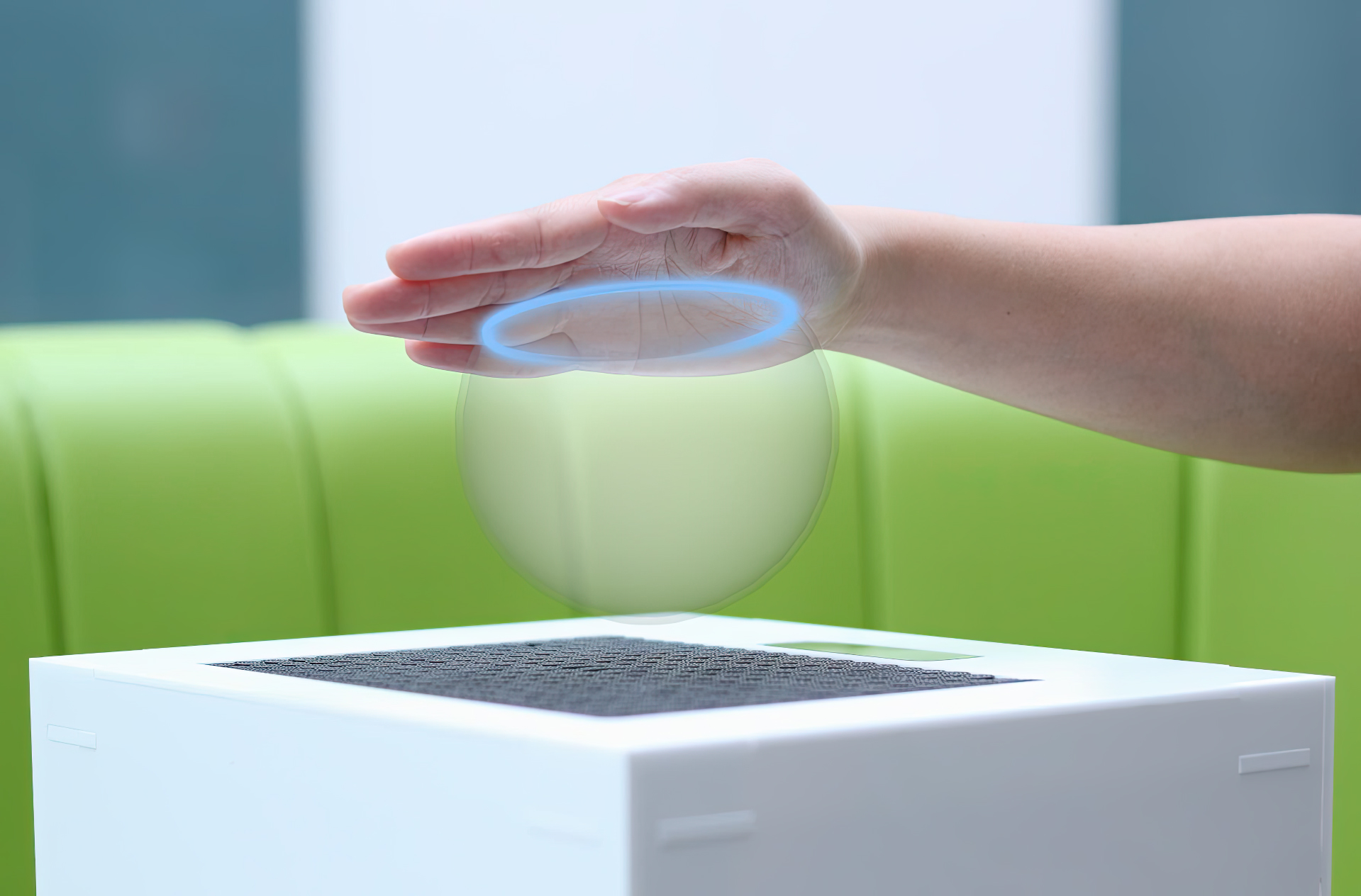
We present a method for creating three-dimensional haptic shapes in mid-air using focused ultrasound. This approach applies the principles of acoustic radiation force, whereby the non-linear effects of sound produce forces on the skin which are strong enough to generate tactile sensations. This mid-air haptic feedback eliminates the need for any attachment of actuators or contact with physical devices. The user perceives a discernible haptic shape when the corresponding acoustic interference pattern is generated above a precisely controlled two-dimensional phased array of ultrasound transducers. In this paper, we outline our algorithm for controlling the volumetric distribution of the acoustic radiation force field in the form of a three-dimensional shape. We demonstrate how we create this acoustic radiation force field and how we interact with it. We then describe our implementation of the system and provide evidence from both visual and technical evaluations of its ability to render different shapes. We conclude with a subjective user evaluation to examine users’ performance for different shapes.
References:
1. Alexander, J., Marshall, M. T., and Subramanian, S. 2011. Adding haptic feedback to mobile tv. In CHI ’11 Extended Abstracts on Human Factors in Computing Systems, ACM, New York, NY, USA, CHI EA ’11, 1975–1980.
2. Berkelman, P. J., Butler, Z. J., and Hollis, R. L. 1996. Design of a hemispherical magnetic levitation haptic interface device. In in Proceedings of the ASME Winter Annual Meeting, Symposium on Haptic Interfaces for Virtual Environment and Teleoperator Systems, 17–22.
3. Bianchi, G., Knoerlein, B., Székely, G., and Harders, M. 2006. High precision augmented reality haptics. In Proc. EuroHaptics, 169–178.
4. Carter, T., Seah, S. A., Long, B., Drinkwater, B., and Subramanian, S. 2013. Ultrahaptics: multi-point mid-air haptic feedback for touch surfaces. In Proceedings of the 26th annual ACM symposium on User interface software and technology, ACM, 505–514.
5. Dalecki, D., Child, S., Raeman, C., and Carstensen, E. 1995. Tactile perception of ultrasound. The Journal of the Acoustical Society of America 97, 3165.Cross Ref
6. Dipietro, L., Sabatini, A. M., and Dario, P. 2008. A survey of glove-based systems and their applications. Trans. Sys. Man Cyber Part C 38, 4 (July), 461–482.
7. Ebbini, E. S., and Cain, C. A. 1989. Multiple-focus ultrasound phased-array pattern synthesis: optimal driving-signal distributions for hyperthermia. Ultrasonics, Ferroelectrics and Frequency Control, IEEE Transactions on 36, 5, 540–548.
8. Gavrilov, L., and Tsirulnikov, E. 2002. Mechanisms of stimulation effects of focused ultrasound on neural structures: Role of nonlinear effects. Nonlinear Acoustics at the Beginning of the 21st Century 1, 445–448.
9. Gavrilov, L., and Tsirulnikov, E. 2012. Focused ultrasound as a tool to input sensory information to humans (review). Acoustical Physics 58, 1–21.Cross Ref
10. Gavrilov, L. 2008. The possibility of generating focal regions of complex configurations in application to the problems of stimulation of human receptor structures by focused ultrasound. Acoustical Physics 54, 269–278.Cross Ref
11. Gescheider, G., and Wright, J. 2008. Information-processing channels in the tactile sensory system: A psychophysical and physiological analysis. Psychology Press.
12. Hayward, V., Astley, O., Cruz-Hernandez, M., Grant, D., and Robles-De-La-Torre, G. 2004. Haptic interfaces and devices. Sensor Review 24, 1, 16–29.Cross Ref
13. Hertzberg, Y., Naor, O., Volovick, A., and Shoham, S. 2010. Towards multifocal ultrasonic neural stimulation: pattern generation algorithms. Journal of neural engineering 7, 5, 056002.Cross Ref
14. Hoshi, T., Takahashi, M., Iwamoto, T., and Shinoda, H. 2010. Noncontact tactile display based on radiation pressure of airborne ultrasound. IEEE Transactions on Haptics 3, 3, 155–165.
15. Leap Motion Inc., 2012. Leap Motion Controller. http://leapmotion.com.
16. Lederman, S. J., and Klatzky, R. L. 1987. Hand movements: A window into haptic object recognition. Cognitive psychology 19, 3, 342–368.
17. Nascov, V., and Logofătu, P. C. 2009. Fast computation algorithm for the Rayleigh-Sommerfeld diffraction formula using a type of scaled convolution. Appl. Opt. 48, 22 (Aug), 4310–4319.Cross Ref
18. Plaisier, M. A., Bergmann Tiest, W. M., and Kappers, A. M. L. 2009. Salient features in 3-d haptic shape perception. Attention, Perception, & Psychophysics 71, 2, 421–430.Cross Ref
19. Reiner, M. 2004. The role of haptics in immersive telecommunication environments. IEEE Transactions on Circuits and Systems for Video Technology 14, 3 (march), 392–401.
20. Sodhi, R., Poupyrev, I., Glisson, M., and Israr, A. 2013. Aireal: interactive tactile experiences in free air. ACM Transactions on Graphics (TOG) 32, 4, 134.
21. Suzuki, Y., and Kobayashi, M. 2005. Air jet driven force feedback in virtual reality. Computer Graphics and Applications, IEEE 25, 1 (Jan), 44–47.
22. Wilson, G., Carter, T., Subramanian, S., and Brewster, S. A. 2014. Perception of ultrasonic haptic feedback on the hand: Localisation and apparent motion. In Proceedings of the 32Nd Annual ACM Conference on Human Factors in Computing Systems, ACM, New York, NY, USA, CHI ’14, 1133–1142.
23. Wusheng, C., Tianmiao, W., and Lei, H. 2003. Design of data glove and arm type haptic interface. In Haptic Interfaces for Virtual Environment and Teleoperator Systems, 2003. HAPTICS 2003. Proceedings. 11th Symposium on, 422–427.



