“Modeling and estimation of internal friction in cloth”
Conference:
Type(s):
Title:
- Modeling and estimation of internal friction in cloth
Session/Category Title:
- Dressing and Jiggling Soft Bodies
Presenter(s)/Author(s):
Abstract:
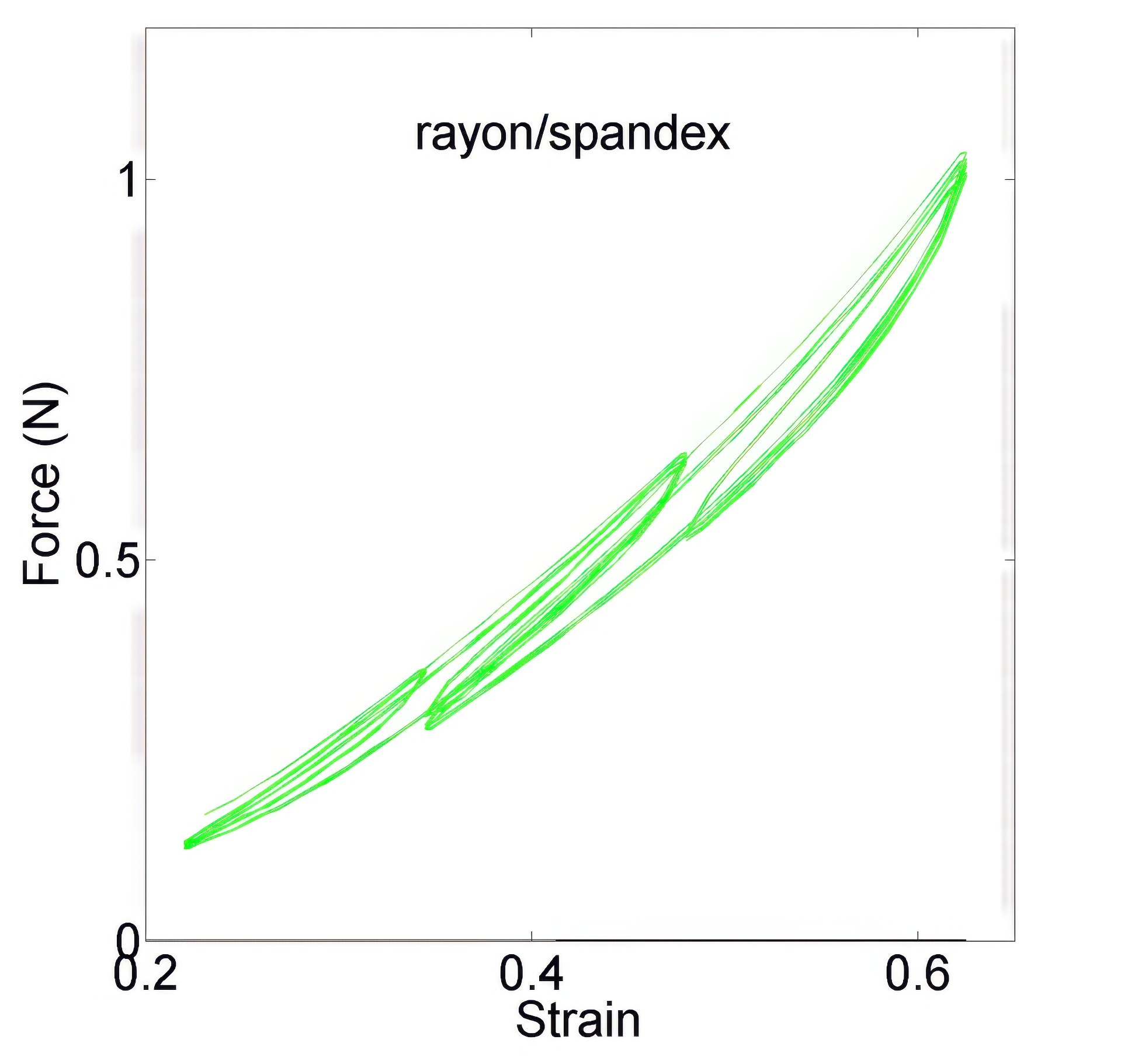
Force-deformation measurements of cloth exhibit significant hysteresis, and many researchers have identified internal friction as the source of this effect. However, it has not been incorporated into computer animation models of cloth. In this paper, we propose a model of internal friction based on an augmented reparameterization of Dahl’s model, and we show that this model provides a good match to several important features of cloth hysteresis even with a minimal set of parameters. We also propose novel parameter estimation procedures that are based on simple and inexpensive setups and need only sparse data, as opposed to the complex hardware and dense data acquisition of previous methods. Finally, we provide an algorithm for the efficient simulation of internal friction, and we demonstrate it on simulation examples that show disparate behavior with and without internal friction.
References:
1. Baraff, D., and Witkin, A. 1998. Large steps in cloth simulation. In Proc. of ACM SIGGRAPH, 43–54.
2. Baraff, D. 1991. Coping with friction for non-penetrating rigid body simulation. In Computer Graphics (Proceedings of SIGGRAPH 91), 31–40.
3. Bergou, M., Mathur, S., Wardetzky, M., and Grinspun, E. 2007. Tracks: Toward directable thin shells. ACM Transactions on Graphics 26, 3 (July), 50:1–50:10.
4. Bliman, P. A., and Sorine, M. 1991. Friction modelling by hysteresis operators. application to dahl, stiction and stribeck effects. Proc. Models of Hysteresis.
5. Breen, D., House, D., and Wozny, M. 1994. Predicting the drape of woven cloth using interacting particles. In Proc. of ACM SIGGRAPH, 365–372.
6. Bridson, R., Fedkiw, R., and Anderson, J. 2002. Robust treatment of collisions, contact and friction for cloth animation. In Proc. of ACM SIGGRAPH, 594–603.
7. Chen, Z., Feng, R., and Wang, H. 2013. Modeling friction and air effects between cloth and deformable bodies. ACM Transactions on Graphics 32, 4.
8. Choi, K.-J., and Ko, H.-S. 2002. Stable but responsive cloth. In Proc. of ACM SIGGRAPH, 604–611.
9. Clapp, T. G., Peng, H., Ghosh, T. K., and Eischen, J. W. 1990. Indirect measurement of the moment-curvature relationship for fabrics. Textile Research J. 60, 9.
10. Culpin, M. F. 1979. The shearing of fabrics: A novel approach. J. Textile Institute 70, 3, 81–88.
11. Dahl, P. R. 1968. A solid friction model. Tech. rep., The Aerospace Corporation.
12. de Joya, J. M., Narain, R., O’Brien, J., Samii, A., and Zordan, V. Berkeley garment library. http://graphics.berkeley.edu/resources/GarmentLibrary/.
13. Eberhardt, B., Weber, A., and Strasser, W. 1996. A fast, flexible, particle-system model for cloth draping. IEEE Computer Graphics and Applications 16, 5, 52–59.
14. Etzmuss, O., Keckeisen, M., and Strasser, W. 2003. A Fast Finite Element Solution for Cloth Modelling. In Proc. Pacific Graphics, 244–251.
15. Grinspun, E., Hirani, A., Desbrun, M., and Schröder, P. 2003. Discrete shells. In Proc. ACM SIGGRAPH/Eurographics SCA, 62–67.
16. Kaldor, J. M., James, D. L., and Marschner, S. 2008. Simulating knitted cloth at the yarn level. ACM Trans. Graph. (Proc. SIGGRAPH) 27, 3, 65:1–65:9.
17. Kawabata, S. 1980. The standardization and analysis of hand evaluation. Textile Machinery Soc. Japan.
18. Kim, B.-C., Oh, S., and Wohn, K. 2011. Persistent wrinkles and folds of clothes. International Journal of Virtual Reality 10, 1, 61–66.
19. Lahey, T. J. 2002. Modeling Hysteresis in the Bending of Fabrics. Master’s thesis, University of Waterloo.
20. Miguel, E., Bradley, D., Thomaszewski, B., Bickel, B., Matusik, W., Otaduy, M. A., and Marschner, S. 2012. Data-driven estimation of cloth simulation models. Computer Graphics Forum (Proc. of Eurographics) 31, 2.
21. Müller, M., and Gross, M. H. 2004. Interactive virtual materials. In Graphics Interface 2004, 239–246.
22. Narain, R., Pfaff, T., and O’Brien, J. F. 2013. Folding and crumpling adaptive sheets. ACM Transactions on Graphics 32, 4.
23. Ngo-Ngoc, C., and Boivin, S. 2004. Nonlinear cloth simulation. Tech. rep., INRIA.
24. Ogden, R. W. 1997. Non-Linear Elastic Deformations. Courier Dover Publications.
25. Padthe, A., Drincic, B., Oh, J., Rizos, D., Fassois, S., and Bernstein, D. 2008. Duhem modeling of friction-induced hysteresis. Control Systems, IEEE 28, 5, 90–107.
26. Sherburn, M. 2007. Geometric and Mechanical Modelling of Textiles. PhD thesis, University of Nottingham.
27. Terzopoulos, D., Platt, J., Barr, A., and Fleischer, K. 1987. Elastically deformable models. In Proc. of ACM SIGGRAPH, 205–214.
28. Thomaszewski, B., Pabst, S., and Strasser, W. 2009. Continuum-based strain limiting. Computer Graphics Forum (Proc. of Eurographics) 28, 569–576.
29. Volino, P., Courchesne, M., and Magnenat-Thalmann, N. 1995. Versatile and efficient techniques for simulating cloth and other deformable objects. In Proc. of ACM SIGGRAPH, 137–144.
30. Volino, P., Magnenat-Thalmann, N., and Faure, F. 2009. A simple approach to nonlinear tensile stiffness for accurate cloth simulation. ACM Trans. Graph. 28, 4.
31. Wang, H., Ramamoorthi, R., and O’Brien, J. 2011. Data-driven elastic models for cloth: Modeling and measurement. ACM Trans. Graph. (Proc. SIGGRAPH) 30, 4, 71.
32. Williams, R. W. 2010. Measuring and Modeling the anisotropic, nonlinear and hysteretic behavior of wooven fabrics. PhD thesis, University of Iowa.
33. Zhu, Y., and Bridson, R. 2005. Animating sand as a fluid. ACM Transactions on Graphics 24, 3 (Aug.), 965–972.