
“GPU-based out-of-core many-lights rendering”
Conference:
Type(s):
Title:
- GPU-based out-of-core many-lights rendering
Session/Category Title:
- Fast, Cheap and Out-of-Core Rendering
Presenter(s)/Author(s):
Abstract:
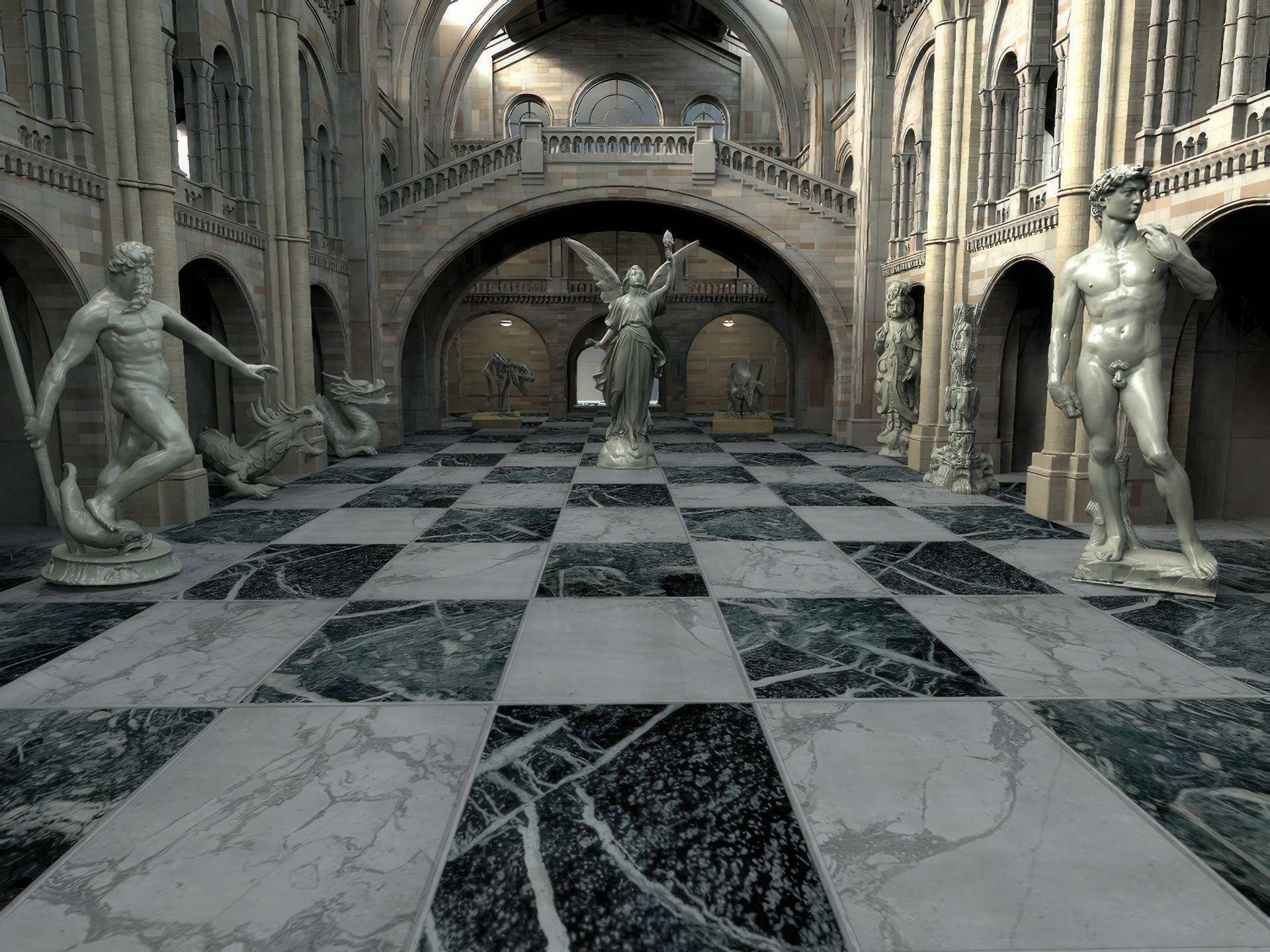
In this paper, we present a GPU-based out-of-core rendering approach under the many-lights rendering framework. Many-lights rendering is an efficient and scalable rendering framework for a large number of lights. But when the data sizes of lights and geometry are both beyond the in-core memory storage size, the data management of these two out-of-core data becomes critical and challenging. In our approach, we formulate such a data management as a graph traversal optimization problem that first builds out-of-core lights and geometry data into a graph, and then guides shading computations by finding a shortest path to visit all vertices in the graph. Based on the proposed data management, we develop a GPU-based out-of-GPU-core rendering algorithm that manages data between the CPU host memory and the GPU device memory. Two main steps are taken in the algorithm: the out-of-core data preparation to pack data into optimal data layouts for the many-lights rendering, and the out-of-core shading using graph-based data management. We demonstrate our algorithm on scenes with out-of-core detailed geometry and out-of-core lights. Results show that our approach generates complex global illumination effects with increased data access coherence and has one order of magnitude performance gain over the CPU-based approach.
References:
1. Aila, T., and Laine, S. 2009. Understanding the efficiency of ray traversal on gpus. In Proceedings of the Conference on High Performance Graphics 2009, ACM, New York, NY, USA, HPG ’09, 145–149.
2. Carsten Dachsbacher, Jaroslav Krivanek, M. H. A. K. A. A. B. W. 2013. Scalable realistic rendering with many-light methods. In Eurographics.
3. Christensen, P. H. 2008. Point-based approximate color bleeding. In Pixar Technical Memo, Pixar, 08–01.
4. Dietrich, A., Gobbetti, E., and Yoon, S.-E. 2007. Massive-model rendering techniques: A tutorial. IEEE Comput. Graph. Appl. 27, 6 (Nov.), 20–34.
5. Dorigo, M., and Stüzle, T. 2010. Ant Colony Optimization: Overview and Recent Advances, vol. 146 of International Series in Operations Research and Management Science. Springer US.
6. Frank, S., and Kaufman, A. 2009. Out-of-core and dynamic programming for data distribution on a volume visualization cluster. Computer Graphics Forum 28, 1, 141–153.
7. Ghiani, G., Guerriero, F., Laporte, G., and Musmanno, R. 2003. Real-time vehicle routing: Solution concepts, algorithms and parallel computing strategies. European Journal of Operational Research 151, 1, 1–11.
8. Gobbetti, E., Kasik, D., and Yoon, S.-e. 2008. Technical strategies for massive model visualization. In Proceedings of the 2008 ACM symposium on Solid and physical modeling, ACM, New York, NY, USA, SPM ’08, 405–415.
9. Hachisuka, T., Ogaki, S., and Jensen, H. W. 2008. Progressive photon mapping. ACM Trans. Graph. 27, 5 (Dec.), 130:1–130:8.
10. Hašan, M., Pellacini, F., and Bala, K. 2007. Matrix row-column sampling for the many-light problem. In ACM SIGGRAPH 2007 papers, ACM, New York, NY, USA, SIGGRAPH ’07.
11. Heckbert, P. S., and Hanrahan, P. 1984. Beam tracing polygonal objects. SIGGRAPH Comput. Graph. 18, 3 (Jan.), 119–127.
12. Johnson, D., and McGeoch, L. 1995. The traveling salesman problem: A case study in local optimization.
13. Kaplanyan, A. S., and Dachsbacher, C. 2013. Adaptive progressive photon mapping. ACM Trans. Graph. 32, 2 (Apr.), 16:1–16:13.
14. Keller, A. 1997. Instant radiosity. In Proceedings of the 24th annual conference on Computer graphics and interactive techniques, ACM Press/Addison-Wesley Publishing Co., New York, NY, USA, SIGGRAPH ’97, 49–56.
15. Kontkanen, J., Tabellion, E., and Overbeck, R. S. 2011. Coherent out-of-core point-based global illumination. Comput. Graph. Forum, 1353–1360.
16. Meneveaux, D., Bouatouch, K., and Maisel, E. 1998. Memory management schemes for radiosity computation in complex environments. In Computer Graphics International, 706–714.
17. Novák, J., Nowrouzezahrai, D., Dachsbacher, C., and Jarosz, W. 2012. Virtual ray lights for rendering scenes with participating media. ACM Trans. Graph. 31, 4, 60:1–60:11.
18. Ou, J., and Pellacini, F. 2011. Lightslice: matrix slice sampling for the many-lights problem. ACM Trans. Graph. 30, 6 (Dec.), 179:1–179:8.
19. Pantaleoni, J., and Luebke, D. 2010. Hlbvh: hierarchical lbvh construction for real-time ray tracing of dynamic geometry. In High Performance Graphics, 87–95.
20. Pantaleoni, J., Fascione, L., Hill, M., and Aila, T. 2010. Pantaray: fast ray-traced occlusion caching of massive scenes. ACM Trans. Graph. 29 (July), 37:1–37:10.
21. Parker, S. G., Bigler, J., Dietrich, A., Friedrich, H., Hoberock, J., Luebke, D., McAllister, D., McGuire, M., Morley, K., Robison, A., and Stich, M. 2010. Optix: a general purpose ray tracing engine. ACM Trans. Graph. 29, 4 (July), 66:1–66:13.
22. Prim, R. 1957. Shortest connection networks and some generalizations. BELL SYSTEM TECHNICAL JOURNAL.
23. Ritschel, T., Engelhardt, T., Grosch, T., Seidel, H.-P., Kautz, J., and Dachsbacher, C. 2009. Micro-rendering for scalable, parallel final gathering. ACM Trans. Graph. 28, 5 (Dec.), 132:1–132:8.
24. Schneider, P. J., and Eberly, D. 2002. Geometric Tools for Computer Graphics. Elsevier Science Inc., New York, NY, USA.
25. Stich, M., Friedrich, H., and Dietrich, A. 2009. Spatial splits in bounding volume hierarchies. In Proceedings of the Conference on High Performance Graphics 2009, ACM, New York, NY, USA, HPG ’09, 7–13.
26. Teller, S., Fowler, C., Funkhouser, T., and Hanrahan, P. 1994. Partitioning and ordering large radiosity computations. In Proceedings of the 21st annual conference on Computer graphics and interactive techniques, ACM, New York, NY, USA, SIGGRAPH ’94, 443–450.
27. Vitter, J. S. 2001. External memory algorithms and data structures: dealing with massive data. ACM Comput. Surv. 33, 2 (June), 209–271.
28. Wald, I., Slusallek, P., Benthin, C., and Wagner, M. 2001. Interactive rendering with coherent ray tracing. Computer Graphics Forum 20, 3, 153–165.
29. Walter, B., Fernandez, S., Arbree, A., Bala, K., Donikian, M., and Greenberg, D. P. 2005. Lightcuts: a scalable approach to illumination. ACM Trans. Graph. 24, 3, 1098–1107.
30. Walter, B., Arbree, A., Bala, K., and Greenberg, D. P. 2006. Multidimensional lightcuts. ACM Trans. Graph. 25, 3, 1081–1088.
31. Walter, B., Khungurn, P., and Bala, K. 2012. Bidirectional lightcuts. ACM Trans. Graph. 31, 4 (July), 59:1–59:11.
32. Wang, R., Wang, R., Zhou, K., Pan, M., and Bao, H. 2009. An efficient gpu-based approach for interactive global illumination. ACM Trans. Graph. 28 (July), 91:1–91:8.
33. Yoon, S.-e., and Lindstrom, P. 2007. Random-accessible compressed triangle meshes. IEEE Transactions on Visualization and Computer Graphics 13, 6 (Nov.), 1536–1543.
34. Zhou, K., Hou, Q., Wang, R., and Guo, B. 2008. Real-time kd-tree construction on graphics hardware. ACM Trans. Graph. 27, 5 (Dec.), 126:1–126:11.



