“The line of action: an intuitive interface for expressive character posing”
Conference:
Type(s):
Title:
- The line of action: an intuitive interface for expressive character posing
Session/Category Title: Modeling Humans
Presenter(s)/Author(s):
Abstract:
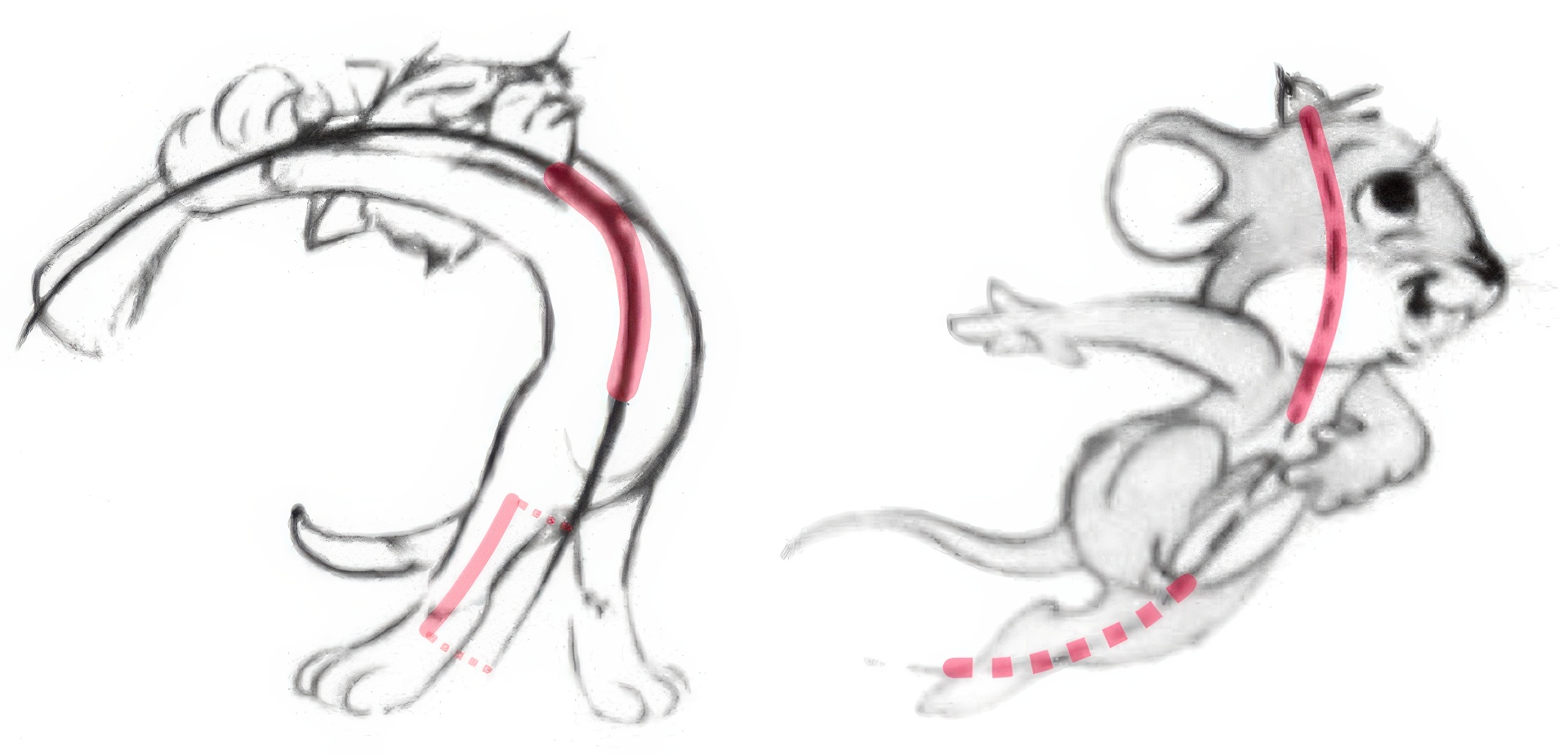
The line of action is a conceptual tool often used by cartoonists and illustrators to help make their figures more consistent and more dramatic. We often see the expression of characters—may it be the dynamism of a super hero, or the elegance of a fashion model—well captured and amplified by a single aesthetic line. Usually this line is laid down in early stages of the drawing and used to describe the body’s principal shape. By focusing on this simple abstraction, the person drawing can quickly adjust and refine the overall pose of his or her character from a given viewpoint. In this paper, we propose a mathematical definition of the line of action (LOA), which allows us to automatically align a 3D virtual character to a user-specified LOA by solving an optimization problem. We generalize this framework to other types of lines found in the drawing literature, such as secondary lines used to place arms. Finally, we show a wide range of poses and animations that were rapidly created using our system.
References:
1. Abling, B. 2012. Fashion Sketchbook. Fairchild Publications.
2. Autodesk. 2009. Maya. http://www.autodesk.com/maya.
3. Blair, P. 1994. Cartoon Animation. Walter Foster.
4. Brooks, B., and Pilcher, T. 2001. The Complete Cartooning Course. David & Charles Publishers.
5. Burtnyk, N., and Wein, M. 1976. Interactive skeleton techniques for enhancing motion dynamics in key frame animation. ACM Transactions on Graphics (TOG) 19, 10, 564–569.
6. Cherlin, J. J., Samavati, F., Sousa, M. C., and Jorge, J. A. 2005. Sketch-based modeling with few strokes. Proceedings of the 21st spring conference on Computer graphics, 137–145.
7. Choi, M., K., Y., Igarashi, T., Mitani, J., and J., L. 2012. Retrieval and visualization of human motion data via stick figures. Pacific Graphics.
8. Davis, J., Igarashi, M., Chuang, E., Popovic’, Z., and Salesin, D. 2003. A sketching interface for articulated figure animation. Proceedings of the 2003 ACM SIGGRAPH/Eurographics symposium on Computer animation, 320–328.
9. Doucet, R. 2011. Line of action-mickey’s christmas carol. http://floobynooby.blogspot.fr/2011/01/lines-of-action-mickeys-christmas-carol.html.
10. Gingold, Y., Igarashi, T., and Zorin, D. 2009. Structured annotations for 2D-to-3D modeling. ACM Transactions on Graphics (TOG) 28, 5, 148.
11. Girard, M., and Maciejewski, A. A. 1985. Computational modeling for the computer animation of legged figures. ACM Transactions on Graphics (TOG) 19, 3, 263–270.
12. Goldschmidt, G. 1991. The dialectics of sketching. Creativity Research Journal 4, 2, 123–143.
13. Hart, C. 1997. How to draw animation. Watson-Guptill.
14. Igarashi, T., Matsuoka, S., and Tanaka, H. 1999. Teddy: a sketching interface for 3d freeform design. ACM Transactions on Graphics (TOG), 409–416.
15. Karpenko, O. A., and Hughes, J. F. 2006. Smoothsketch: 3d free-form shapes from complex sketches. ACM Transactions on Graphics (TOG) 25, 589–598.
16. Lee, S., and Buscema, J. 1978. How To Draw Comics The Marvel Way. Simon & Schuster Inc.
17. Lin, J., Igarashi, T., Mitani, J., and Saul, G. 2010. A sketching interface for sitting-pose design. Proceedings of the Seventh Sketch-Based Interfaces and Modeling Symposium, 111–118.
18. Mao, C., Qin, S. F., and Wright, D. 2005. A sketch-based gesture interface for rough 3d stick figure animation. Proceedings of the 2005 Eurographics workshop on Sketch-Based Interfaces and Modeling.
19. Noble, P., and Tang, W. 2006. Automatic expressive deformations for stylizing motion. GRAPHITE ’06 Proceedings of the 4th international conference on Computer graphics and interactive techniques in Australasia and Southeast Asia, 57–63.
20. Noris, G., Sýkora, D., Shamir, A., Coros, S., Whited, B., Simmons, M., Hornung, A., Gross, M., and Sumner, R. 2013. Smart scribbles for sketch segmentation. Computer Graphics Forum 31, 8, 2516–2527.
21. Öztireli, A. C., Baran, I., Popa, T., Dalstein, B., Sumner, R. W., and Gross, M. 2013. Differential blending for expressive sketch-based posing. In Proceedings of the 2013 ACM SIGGRAPH/Eurographics Symposium on Computer Animation.
22. Thorne, M., Burke, D., and van de Panne, M. 2004. Motion doodles: an interface for sketching character motion. ACM Transactions on Graphics (TOG) 23, 424–431.
23. Wei, X. K., and Chai, J. 2011. Intuitive interactive human character posing with millions of example poses. IEEE Computer Graphics and Applications 31, 78–88.
24. Zhao, J., and Badler, N. 1994. Inverse kinematics positioning using nonlinear programming for highly articulated figures. ACM Transactions on Graphics 13, 313–336.