
“Smooth skinning decomposition with rigid bones”
Conference:
Type(s):
Title:
- Smooth skinning decomposition with rigid bones
Session/Category Title:
- Skinning
Presenter(s)/Author(s):
Abstract:
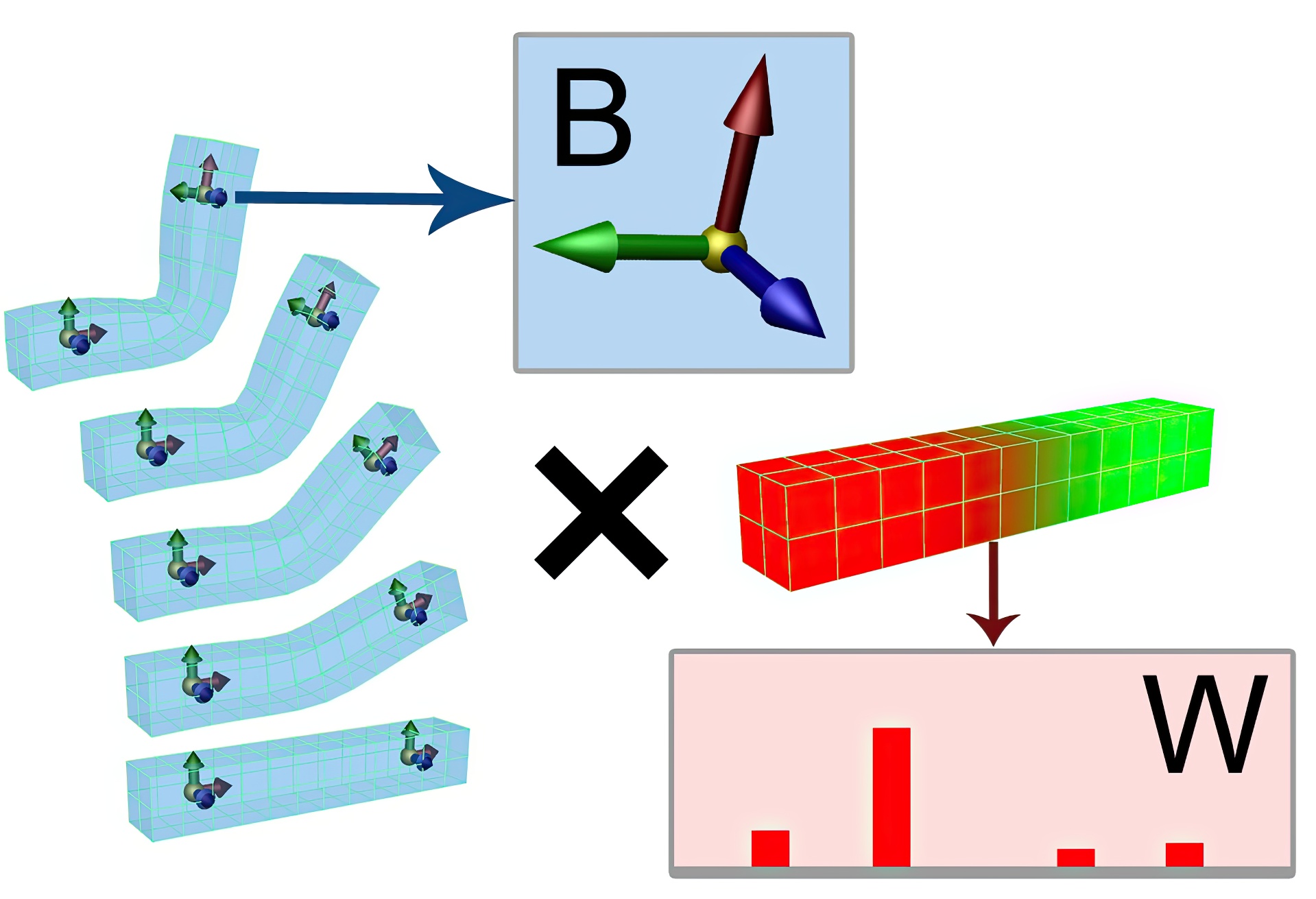
This paper introduces the Smooth Skinning Decomposition with Rigid Bones (SSDR), an automated algorithm to extract the linear blend skinning (LBS) from a set of example poses. The SSDR model can effectively approximate the skin deformation of nearly articulated models as well as highly deformable models by a low number of rigid bones and a sparse, convex bone-vertex weight map. Formulated as a constrained optimization problem where the least squared error of the reconstructed vertices by LBS is minimized, the SSDR model can be solved by a block coordinate descent-based algorithm to iteratively update the weight map and the bone transformations. By employing the sparseness and convex constraints on the weight map, the SSDR model can be used for traditional skinning decomposition tasks such as animation compression and hardware-accelerated rendering. Moreover, by imposing the orthogonal constraints on the bone rotation matrices (rigid bones), the SSDR model can also be applied in motion editing, skeleton extraction, and collision detection tasks. Through qualitative and quantitative evaluations, we show the SSDR model can measurably outperform the state-of-the-art skinning decomposition schemes in terms of accuracy and applicability.
References:
1. Alexa, M., Cohen-Or, D., and Levin, D. 2000. As-rigid-as-possible shape interpolation. In Proc. of ACM SIGGRAPH’00, 157–164.
2. Baran, I., and Popović, J. 2007. Automatic rigging and animation of 3D characters. ACM Trans. Graph. 26 (July).
3. Bertsekas, D. P. 1999. Nonlinear Programming, 2nd ed. Athena Scientific, Sept.
4. Briceño, H. M., Sander, P. V., McMillan, L., Gortler, S., and Hoppe, H. 2003. Geometry videos: a new representation for 3d animations. In SCA’03: Proc. of Symposium on Computer Animation, 136–146.
5. Bro, R., and De Jong, S. 1997. A fast non-negativity-constrained least squares algorithm. Journal of Chemometrics 11, 5, 393–401.
6. Capell, S., Burkhart, M., Curless, B., Duchamp, T., and Popović, Z. 2005. Physically based rigging for deformable characters. In SCA’05: Proc. of Symposium on Computer Animation 2005, 301–310.
7. de Aguiar, E., Theobalt, C., Thrun, S., and Seidel, H.-P. 2008. Automatic conversion of mesh animations into skeleton-based animations. Comput. Graph. Forum 27, 2 (April).
8. Feng, W.-W., Kim, B.-U., and Yu, Y. 2008. Real-time data driven deformation using kernel canonical correlation analysis. ACM Trans. Graph. 27 (August), 91:1–91:9.
9. Gain, J., and Bechmann, D. 2008. A survey of spatial deformation from a user-centered perspective. ACM Trans. Graph. 27 (November), 107:1–107:21.
10. Georgescu, B., Shimshoni, I., and Meer, P. 2003. Mean shift based clustering in high dimensions: a texture classification example. In ICCV’03, 456–463.
11. Guskov, I., and Khodakovsky, A. 2004. Wavelet compression of parametrically coherent mesh sequences. In SCA’04: Proc. of Symposium on Computer Animation, 183–192.
12. Hasler, N., Thormählen, T., Rosenhahn, B., and Seidel, H.-P. 2010. Learning skeletons for shape and pose. In I3D’10: Proc. of Symp. on Interactive 3D Graphics and Games, 23–30.
13. Horn, B. K. P. 1987. Closed-form solution of absolute orientation using unit quaternions. Journal of the Optical Society of America A 4, 4, 629–642.
14. Huang, H., Zhao, L., Yin, K., Qi, Y., Yu, Y., and Tong, X. 2011. Controllable hand deformation from sparse examples with rich details. In SCA’11: Proc. of Symposium on Computer Animation 2011, 73–82.
15. Huang, Q., Koltun, V., and Guibas, L. 2011. Joint shape segmentation with linear programming. ACM Trans. Graph. 30, 125:1–125:12.
16. Igarashi, T., Moscovich, T., and Hughes, J. F. 2005. As-rigid-as-possible shape manipulation. In ACM SIGGRAPH 2005 Papers, 1134–1141.
17. Jacobson, A., and Sorkine, O. 2011. Stretchable and twistable bones for skeletal shape deformation. ACM Trans. Graph. 30 (Dec.), 165:1–165:8.
18. James, D. L., and Twigg, C. D. 2005. Skinning mesh animations. ACM Trans. Graph. 24 (July), 399–407.
19. Kabsch, W. 1978. A discussion of the solution for the best rotation to relate two sets of vectors. Acta Crystallographica Section A 34, 827–828.
20. Kavan, L., and Žára, J. 2005. Spherical blend skinning: a real-time deformation of articulated models. In I3D’05: Proc. of Symp. on Interactive 3D Graphics and Games, 9–16.
21. Kavan, L., McDonnell, R., Dobbyn, S., Žára, J., and O’Sullivan, C. 2007. Skinning arbitrary deformations. In I3D’07: Proc. of Symp. on Interactive 3D Graphics and Games, 53–60.
22. Kavan, L., Collins, S., Žára, J., and O’Sullivan, C. 2008. Geometric skinning with approximate dual quaternion blending. ACM Trans. Graph. 27 (November), 105:1–105:23.
23. Kavan, L., Sloan, P.-P., and O’Sullivan, C. 2010. Fast and efficient skinning of animated meshes. Comput. Graph. Forum 29, 2, 327–336.
24. Kim, T., and James, D. L. 2011. Physics-based character skinning using multi-domain subspace deformations. In SCA’11: Proc. of Symposium on Computer Animation, 63–72.
25. Kry, P. G., James, D. L., and Pai, D. K. 2002. EigenSkin: real time large deformation character skinning in hardware. In SCA’02: Proc. of Symposium on Computer Animation, 153–159.
26. Lewis, J. P., Cordner, M., and Fong, N. 2000. Pose space deformation: a unified approach to shape interpolation and skeleton-driven deformation. In Proc. of SIGGRAPH’00, 165–172.
27. Lourakis, M., 2004. levmar: Levenberg-marquardt non-linear least squares algorithms in C/C++. {web page} http://www.ics.forth.gr/~lourakis/levmar/, July. {Accessed on 31 Jan. 2005}.
28. Marquardt, D. W. 1963. An Algorithm for Least-Squares Estimation of Nonlinear Parameters. SIAM Journal on Applied Mathematics 11, 2, 431–441.
29. Merry, B., Marais, P., and Gain, J. 2006. Animation space: A truly linear framework for character animation. ACM Trans. Graph. 25 (October), 1400–1423.
30. Miller, C., Arikan, O., and Fussell, D. 2010. Frankenrigs: building character rigs from multiple sources. In I3D’10: Proc. of Symp. on Interactive 3D Graphics and Games, 31–38.
31. Mohr, A., and Gleicher, M. 2003. Building efficient, accurate character skins from examples. ACM Trans. Graph. 22 (July), 562–568.
32. Mohr, A., Tokheim, L., and Gleicher, M. 2003. Direct manipulation of interactive character skins. In I3D’03: Proc. of Symp. on Interactive 3D Graphics, 27–30.
33. Müller, M., Heidelberger, B., Teschner, M., and Gross, M. 2005. Meshless deformations based on shape matching. ACM Trans. Graph. 24, 3 (July), 471–478.
34. Schaefer, S., and Yuksel, C. 2007. Example-based skeleton extraction. In SGP’07: Proc. of Eurographics Symposium on Geometry Processing, 153–162.
35. Sloan, P.-P. J., Rose, III, C. F., and Cohen, M. F. 2001. Shape by example. In I3D’01: Proc. of Symp. on Interactive 3D Graphics, 135–143.
36. Sumner, R. W., and Popović, J. 2004. Deformation transfer for triangle meshes. ACM Trans. Graph. 23 (August), 399–405.
37. Wang, X. C., and Phillips, C. 2002. Multi-weight enveloping: least-squares approximation techniques for skin animation. In SCA’02: Proc. of Symposium on Computer Animation, 129–138.
38. Wang, R. Y., Pulli, K., and Popović, J. 2007. Real-time enveloping with rotational regression. ACM Trans. Graph. 26 (July).
39. Zelnik-manor, L., and Perona, P. 2004. Self-tuning spectral clustering. In Advances in Neural Information Processing Systems 17, MIT Press, 1601–1608.
40. Zhang, Y. 2009. User’s guide for YALL1: Your ALgorithms for L1 optimization. Tech. rep., Rice University, May.
41. Zhu, Y., and Gortler, S. J. 2007. 3D deformation using moving least squares. harvard computer science technical report: TR-10-07. Tech. rep., Cambridge, MA.



