
“Correcting for optical aberrations using multilayer displays” by Huang, Lanman, Barsky and Raskar
Conference:
Type(s):
Title:
- Correcting for optical aberrations using multilayer displays
Session/Category Title:
- Stereo and Displays
Presenter(s)/Author(s):
Abstract:
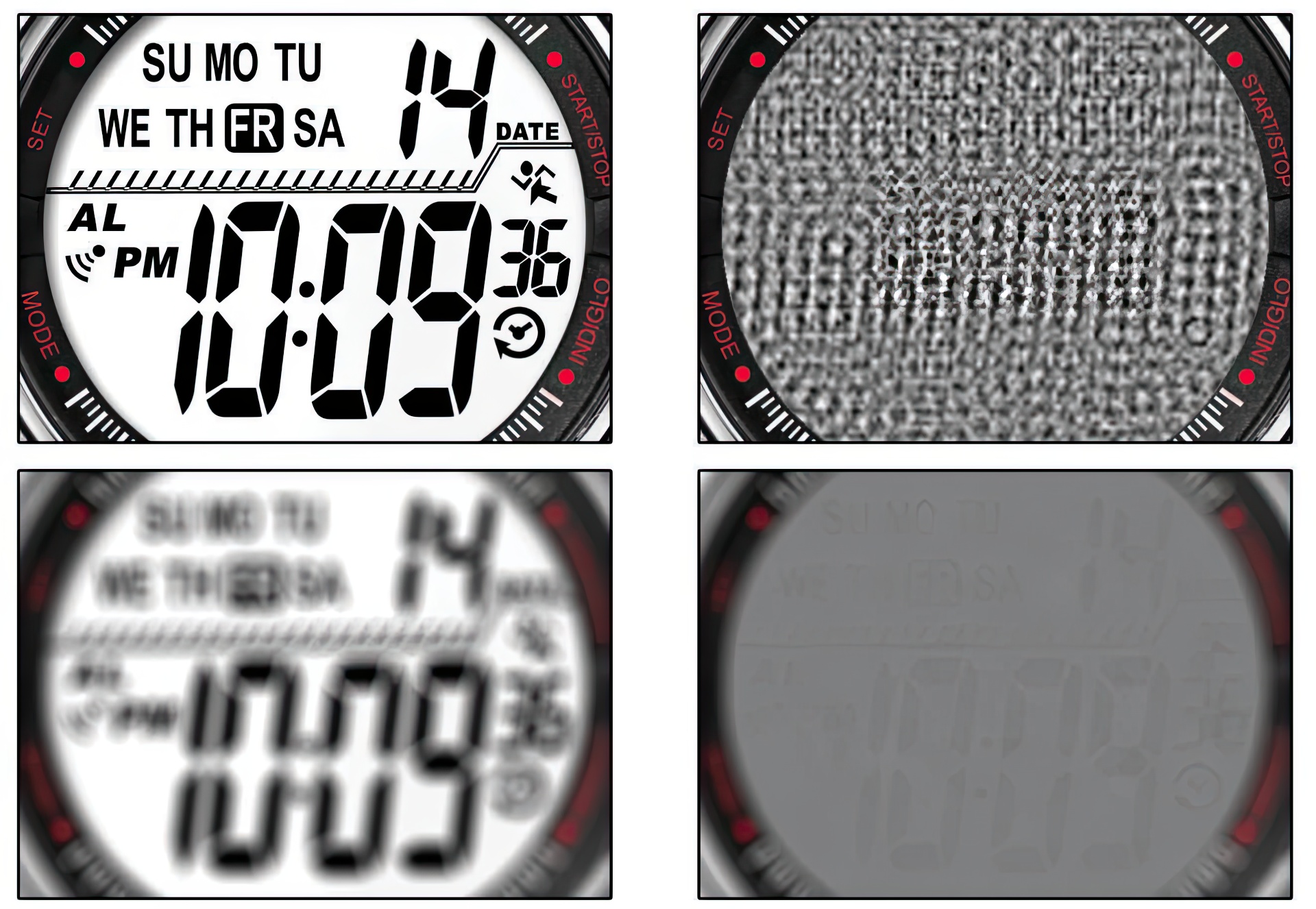
Optical aberrations of the human eye are currently corrected using eyeglasses, contact lenses, or surgery. We describe a fourth option: modifying the composition of displayed content such that the perceived image appears in focus, after passing through an eye with known optical defects. Prior approaches synthesize pre-filtered images by deconvolving the content by the point spread function of the aberrated eye. Such methods have not led to practical applications, due to severely reduced contrast and ringing artifacts. We address these limitations by introducing multilayer pre-filtering, implemented using stacks of semi-transparent, light-emitting layers. By optimizing the layer positions and the partition of spatial frequencies between layers, contrast is improved and ringing artifacts are eliminated. We assess design constraints for multilayer displays; autostereoscopic light field displays are identified as a preferred, thin form factor architecture, allowing synthetic layers to be displaced in response to viewer movement and refractive errors. We assess the benefits of multilayer pre-filtering versus prior light field pre-distortion methods, showing pre-filtering works within the constraints of current display resolutions. We conclude by analyzing benefits and limitations using a prototype multilayer LCD.
References:
1. Agrawal, A., Xu, Y., and Raskar, R. 2009. Invertible motion blur in video. ACM Trans. Graph. 28, 3, 95:1–95:8.
2. Akeley, K., Watt, S. J., Girshick, A. R., and Banks, M. S. 2004. A stereo display prototype with multiple focal distances. ACM Trans. Graph. 23, 3, 804–813.
3. Alonso Jr., M., and Barreto, A. B. 2003. Pre-compensation for high-order aberrations of the human eye using on-screen image deconvolution. In IEEE Engineering in Medicine and Biology Society, vol. 1, 556–559.
4. Archand, P., Pite, E., Guillemet, H., and Trocme, L., 2011. Systems and methods for rendering a display to compensate for a viewer’s visual impairment. International Patent Application PCT/US2011/039993.
5. Barsky, B. A. 2004. Vision-realistic rendering: simulation of the scanned foveal image from wavefront data of human subjects. In Applied Perception in Graphics and Visualization, 73–81.
6. Bell, G. P., Craig, R., Paxton, R., Wong, G., and Galbraith, D. 2008. Beyond flat panels: Multi-layered displays with real depth. SID Digest 39, 1, 352–355.
7. Brown, M. S., Song, P., and Cham, T.-J. 2006. Image preconditioning for out-of-focus projector blur. In IEEE Conference on Computer Vision and Pattern Recognition, 1956–1963.
8. Campisi, P., and Egiazarian, K. 2007. Blind Image Deconvolution: Theory and Applications. CRC Press.
9. Chai, J.-X., Tong, X., Chan, S.-C., and Shum, H.-Y. 2000. Plenoptic sampling. In ACM SIGGRAPH, 307–318.
10. Gonzalez, R. C., and Woods, R. E. 1992. Digital Image Processing (Third Edition). Addison-Wesley.
11. Goodman, J. W. 2004. Introduction to Fourier Optics (Third Edition). Roberts & Company Publishers.
12. Görrn, P., Sander, M., Meyer, J., Kröger, M., Becker, E., Johannes, H.-H., Kowalsky, W., and Riedl, T. 2006. Towards see-through displays: Fully transparent thin-film transistors driving transparent organic light-emitting diodes. Advanced Materials 18, 6, 738–741.
13. Gotoda, H. 2012. Implementation and analysis of an autostereoscopic display using multiple liquid crystal layers. In SPIE Stereoscopic Displays and Applications XXIII, vol. 8288.
14. Grosse, M., Wetzstein, G., Grundhöfer, A., and Bimber, O. 2010. Coded aperture projection. ACM Trans. Graph..
15. Holroyd, M., Baran, I., Lawrence, J., and Matusik, W. 2011. Computing and fabricating multilayer models. ACM Trans. Graph. 30, 6, 187:1–187:8.
16. Huang, F.-C., and Barsky, B. A. 2011. A framework for aberration compensated displays. Tech. Rep. UCB/EECS-2011-162, University of California, Berkeley, December.
17. Ives, F. E., 1903. Parallax stereogram and process of making same. U. S. Patent 725,567.
18. Kaufman, P., and Alm, A. 2002. Adler’s Physiology of the Eye (Tenth Edition). Mosby.
19. Kee, E., Paris, S., Chen, S., and Wang, J. 2011. Modeling and removing spatially-varying optical blur. In IEEE International Conference on Computational Photography.
20. Lanman, D., Wetzstein, G., Hirsch, M., Heidrich, W., and Raskar, R. 2011. Polarization fields: dynamic light field display using multi-layer LCDs. ACM Trans. Graph. 30, 6.
21. Levin, A., Fergus, R., Durand, F., and Freeman, W. T. 2007. Image and depth from a conventional camera with a coded aperture. ACM Trans. Graph. 26, 3.
22. Lippmann, G. 1908. Épreuves réversibles donnant la sensation du relief. Journal of Physics 7, 4, 821–825.
23. Oyamada, Y., and Saito, H. 2007. Focal pre-correction of projected image for deblurring screen image. In IEEE Conference on Computer Vision and Pattern Recognition.
24. Pamplona, V. F., Oliveira, M. M., Aliaga, D. G., and Raskar, R. 2012. Tailored displays to compensate for visual aberrations. ACM Trans. Graph 31, 4, 81:1–81:12.
25. Raskar, R., Agrawal, A., and Tumblin, J. 2006. Coded exposure photography: motion deblurring using fluttered shutter. ACM Trans. Graph. 25, 3, 795–804.
26. Urey, H., Chellappan, K., Erden, E., and Surman, P. 2011. State of the art in stereoscopic and autostereoscopic displays. Proceedings of the IEEE 99, 4, 540–555.
27. Veeraraghavan, A., Raskar, R., Agrawal, A., Mohan, A., and Tumblin, J. 2007. Dappled photography: mask enhanced cameras for heterodyned light fields and coded aperture refocusing. ACM Trans. Graph. 26, 3.
28. Vitale, S., Sperduto, R. D., and Ferris, III, F. L. 2009. Increased prevalence of myopia in the United States between 1971–1972 and 1999–2004. Arch. Ophthalmology 127, 12, 1632–1639.
29. Wetzstein, G., Lanman, D., Heidrich, W., and Raskar, R. 2011. Layered 3D: Tomographic image synthesis for attenuation-based light field and high dynamic range displays. ACM Trans. Graph. 30, 4.
30. Wetzstein, G., Lanman, D., Hirsch, M., and Raskar, R. 2012. Tensor displays: Compressive light field synthesis using multilayer displays with directional backlighting. ACM Trans. Graph 31, 4, 80:1–80:11.
31. Yellott, J. I., and Yellott, J. W. 2007. Correcting spurious resolution in defocused images. Proc. SPIE 6492.
32. Zhang, L., and Nayar, S. 2006. Projection defocus analysis for scene capture and image display. ACM Trans. Graph. 25, 3.
33. Zomet, A., and Nayar, S. 2006. Lensless imaging with a controllable aperture. In IEEE Conference on Computer Vision and Pattern Recognition.
34. Zwicker, M., Matusik, W., Durand, F., and Pfister, H. 2006. Antialiasing for automultiscopic 3D displays. In Eurographics Symposium on Rendering.



