“Gaze correction for home video conferencing”
Conference:
Type(s):
Title:
- Gaze correction for home video conferencing
Session/Category Title: Video and Image Manipulation
Presenter(s)/Author(s):
Abstract:
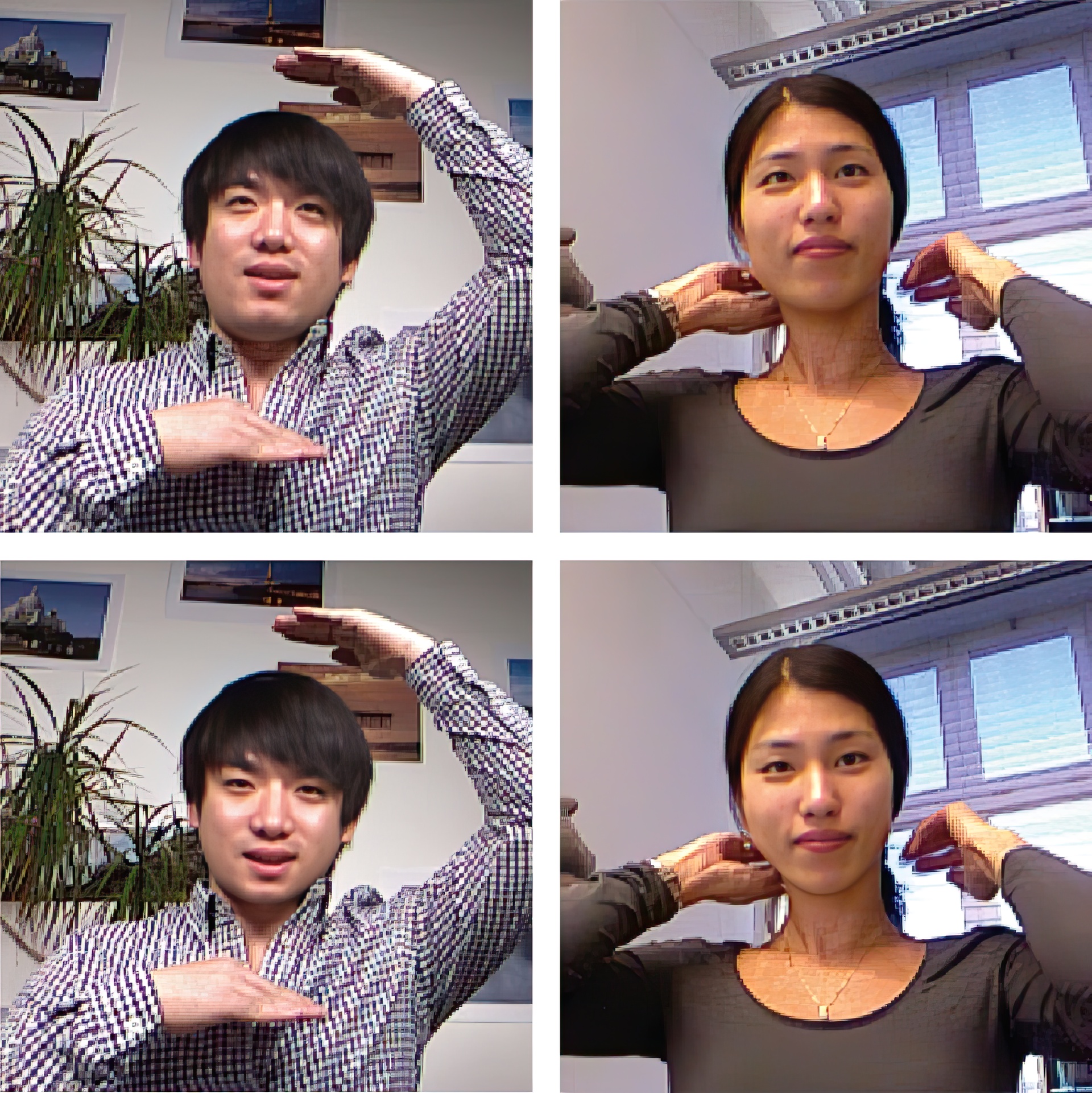
Effective communication using current video conferencing systems is severely hindered by the lack of eye contact caused by the disparity between the locations of the subject and the camera. While this problem has been partially solved for high-end expensive video conferencing systems, it has not been convincingly solved for consumer-level setups. We present a gaze correction approach based on a single Kinect sensor that preserves both the integrity and expressiveness of the face as well as the fidelity of the scene as a whole, producing nearly artifact-free imagery. Our method is suitable for mainstream home video conferencing: it uses inexpensive consumer hardware, achieves real-time performance and requires just a simple and short setup. Our approach is based on the observation that for our application it is sufficient to synthesize only the corrected face. Thus we render a gaze-corrected 3D model of the scene and, with the aid of a face tracker, transfer the gaze-corrected facial portion in a seamless manner onto the original image.
References:
1. Argyle, M., and Cook, M. 1976. Gaze and mutual gaze. Cambridge University Press.
2. Cham, T.-J., Krishnamoorthy, S., and Jones, M. 2002. Analogous view transfer for gaze correction in video sequences. In ICARCV, vol. 3, 1415–1420.
3. Chen, M. 2002. Leveraging the asymmetric sensitivity of eye contact for videoconference. In CHI, 49–56.
4. Criminisi, A., Shotton, J., Blake, A., and Torr, P. H. S. 2003. Gaze manipulation for one-to-one teleconferencing. In ICCV, 191–198.
5. Dale, K., Sunkavalli, K., Johnson, M. K., Vlasic, D., Matusik, W., and Pfister, H. 2011. Video face replacement. In SIGGRAPH Asia, 1–10.
6. Gemmell, J., Toyama, K., Zitnick, C. L., Kang, T., and Seitz, S. 2000. Gaze awareness for video-conferencing: A software approach. IEEE MultiMedia 7, 26–35.
7. Grayson, D. M., and Monk, A. F. 2003. Are you looking at me? eye contact and desktop video conferencing. ACM Trans. Comput.-Hum. Interact. 10, 221–243.
8. Gross, M., Würmlin, S., Naef, M., Lamboray, E., Spagno, C., Kunz, A., Koller-Meier, E., Svoboda, T., Van Gool, L., Lang, S., Strehlke, K., Moere, A. V., and Staadt, O. 2003. Blue-c: a spatially immersive display and 3D video portal for telepresence. In SIGGRAPH, 819–827.
9. Ishii, H., and Kobayashi, M. 1992. Clearboard: a seamless medium for shared drawing and conversation with eye contact. In CHI, 525–532.
10. Jones, A., Lang, M., Fyffe, G., Yu, X., Busch, J., McDowall, I., Bolas, M., and Debevec, P. 2009. Achieving eye contact in a one-to-many 3D video teleconferencing system. In SIGGRAPH, 64:1–64:8.
11. Kuster, C., Popa, T., Zach, C., Gotsman, C., and Gross, M. 2011. FreeCam: a hybrid camera system for interactive free-viewpoint video. In VMV, 17–24.
12. Macrae, C. N., Hood, B., Milne, A. B., Rowe, A. C., and Mason, M. F. 2002. Are you looking at me? eye gaze and person perception. In Psychological Science, 460–464.
13. Matusik, W., and Pfister, H. 2004. 3D TV: a scalable system for real-time acquisition, transmission, and autostereoscopic display of dynamic scenes. In SIGGRAPH, 814–824.
14. Matusik, W., Buehler, C., Raskar, R., Gortler, S. J., and McMillan, L. 2000. Image-based visual hulls. In SIGGRAPH, 369–374.
15. Microsoft, 2010. http://www.xbox.com/en-US/kinect.
16. Monk, A. F., and Gale, C. 2002. A look is worth a thousand words: Full gaze awareness in video-mediated conversation. Discourse Processes 33, 3, 257–278.
17. Mukawa, N., Oka, T., Arai, K., and Yuasa, M. 2005. What is connected by mutual gaze?: user’s behavior in video-mediated communication. In CHI, 1677–1680.
18. Nguyen, D., and Canny, J. 2005. Multiview: spatially faithful group video conferencing. In CHI, 799–808.
19. Okada, K.-I., Maeda, F., Ichikawaa, Y., and Matsushita, Y. 1994. Multiparty videoconferencing at virtual social distance: Majic design. In Proc. Conference on Computer supported cooperative work (CSW), 385–393.
20. Petit, B., Lesage, J.-D., Menier, C., Allard, J., Franco, J.-S., Raffin, B., Boyer, E., and Faure, F. 2010. Multi-camera real-time 3D modeling for telepresence and remote collaboration. Intern. Journ. of Digital Multi. Broadcasting.
21. Saragih, J., Lucey, S., and Cohn, J. 2011. Deformable model fitting by regularized landmark mean-shift. IJCV 91, 200–215.
22. Stokes, R. 1969. Human factors and appearance design considerations of the mod II picturephone station set. IEEE Transactions on Communication Technology 17, 2, 318–323.
23. Yang, R., and Zhang, Z. 2002. Eye gaze correction with stereovision for video-teleconferencing. In ECCV, 479–494.
24. Yip, B., and Jin, J. S. 2003. Face re-orientation in video conference using ellipsoid model. In OZCHI, 167–173.
25. Zhu, J., Yang, R., and Xiang, X. 2011. Eye contact in video conference via fusion of time-of-flight depth sensor and stereo. 3D Research 2, 1–10.
26. Zitnick, C. L., Kang, S. B., Uyttendaele, M., Winder, S., and Szeliski, R. 2004. High-quality video view interpolation using a layered representation. SIGGRAPH 23, 600–608.