
“Synthesis of concurrent object manipulation tasks”
Conference:
Type(s):
Title:
- Synthesis of concurrent object manipulation tasks
Session/Category Title:
- Full-Body Character Animation
Presenter(s)/Author(s):
Abstract:
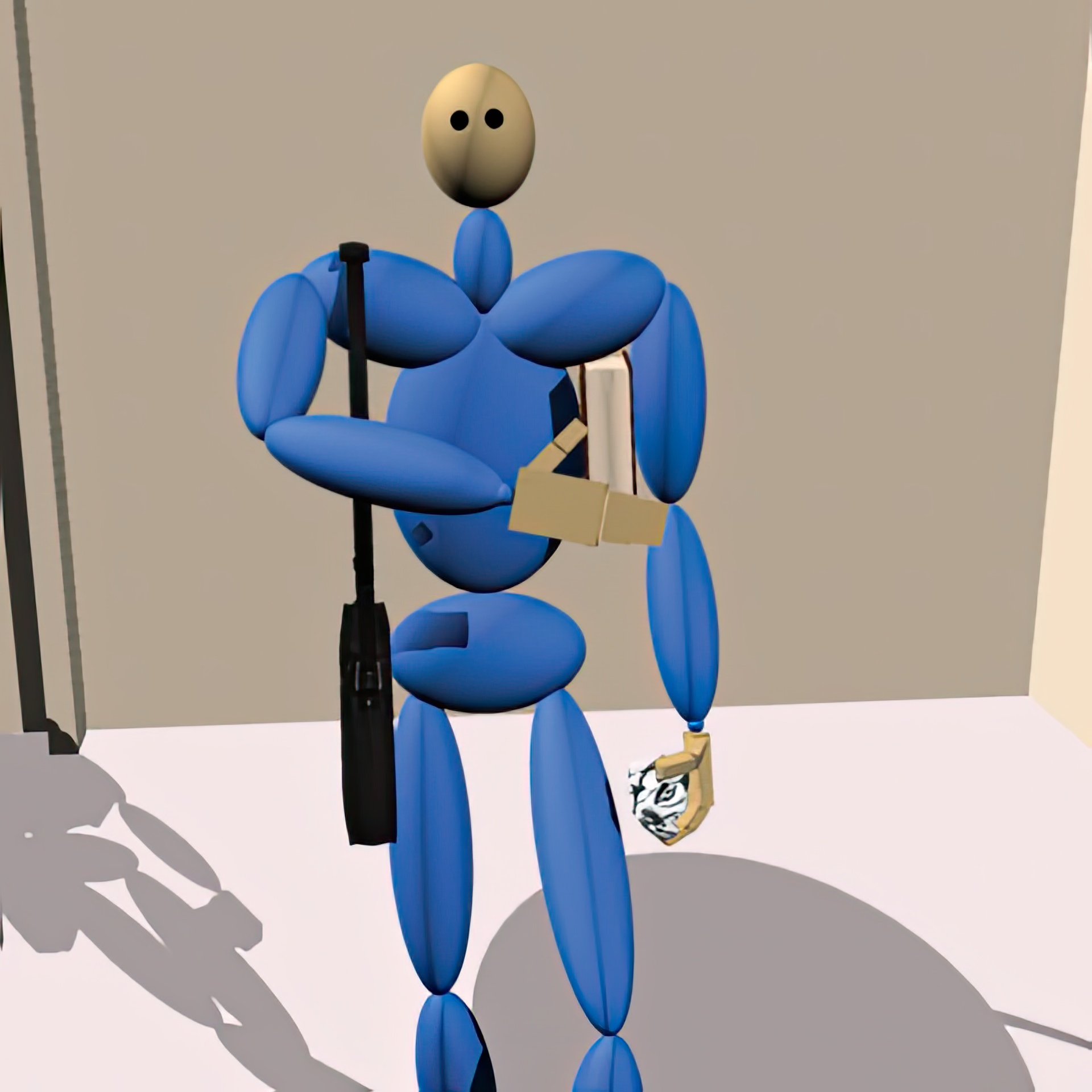
We introduce a physics-based method to synthesize concurrent object manipulation using a variety of manipulation strategies provided by different body parts, such as grasping objects with the hands, carrying objects on the shoulders, or pushing objects with the elbows or the torso. We design dynamic controllers to physically simulate upper-body manipulation and integrate it with procedurally generated locomotion and hand grasping motion. The output of the algorithm is a continuous animation of the character manipulating multiple objects and environment features concurrently at various locations in a constrained environment. To capture how humans deftly exploit different properties of body parts and objects for multitasking, we need to solve challenging planning and execution problems. We introduce a graph structure, a manipulation graph, to describe how each object can be manipulated using different strategies. The problem of manipulation planning can then be transformed to a standard graph traversal. To achieve the manipulation plan, our control algorithm optimally schedules and executes multiple tasks based on the dynamic space of the tasks and the state of the character. We introduce a “task consistency” metric to measure the physical feasibility of multitasking. Furthermore, we exploit the redundancy of control space to improve the character’s ability to multitask. As a result, the character will try its best to achieve the current tasks while adjusting its motion continuously to improve the multitasking consistency for future tasks.
References:
1. Abe, Y., and Popović, J. 2006. Interactive animation of dynamic manipulation. In Eurographics/SIGGRAPH Symposium on Computer Animation.
2. Bruderlin, A., and Williams, L. 1995. Motion signal processing. In SIGGRAPH, 97–104.
3. Choi, M. G., Lee, J., and Shin, S. Y. 2003. Planning biped locomotion using motion capture data and probabilistic roadmaps. ACM Trans. Graph. 22 (April), 182–203.
4. Coros, S., Beaudoin, P., and van de Panne, M. 2010. Generalized biped walking control. ACM Trans. Graph. 29 (July), 130:1–130:9.
5. DART: Dynamic Animation and Robotics Toolkit, http://dart.golems.org/.
6. de Lasa, M., and Hertzmann, A. 2009. Prioritized optimization for task-space control. In IEEE/RSJ international conference on Intelligent robots and systems, IROS’09, 5755–5762.
7. de Lasa, M., Mordatch, I., and Hertzmann, A. 2010. Feature-based locomotion controllers. ACM Trans. Graph. 29.
8. Feng, A. W., Xu, Y., and Shapiro, A. 2012. An example-based motion synthesis technique for locomotion and object manipulation. In ACM SIGGRAPH Symposium on Interactive 3D Graphics and Games.
9. Gill, P., Saunders, M., and Murray, W. 1996. Snopt: An sqp algorithm for large-scale constrained optimization. Tech. Rep. NA 96-2, University of California, San Diego.
10. Harada, K., Kajita, S., Kaneko, K., and Hirukawa, H. 2003. Pushing manipulation by humanoid considering two-kinds of zmps. In IEEE International Conference on Robotics and Automation, vol. 2, 1627–1632.
11. Huang, Y., Mahmudi, M., and Kallmann, M. 2011. Planning humanlike actions in blending spaces. In Proceedings of the IEEE/RSJ International Conference on Intelligent Robots and Systems (IROS).
12. Kallmann, M., Aubel, A., Abaci, T., and Thalmann, D. 2003. Planning collision-free reaching motions for interactive object manipulation and grasping. Computer graphics Forum 22, 3 (Sept), 313–322.
13. Kallmann, M. 2004. Interaction with 3-d objects. In Handbook of Virtual Humans. 303–322.
14. Kallmann, M. 2005. Scalable solutions for interactive virtual humans that can manipulate objects. In Proceedings of the Artificial Intelligence and Interactive Digital Entertainment, 69–74.
15. Kavraki, L., Svestka, P., Latombe, J.-C., and Overmars, M. H. 1996. Probabilistic roadmaps for path planning in high-dimensional configuration spaces. IEEE Trans. on Robotics and Automation 12, 4, 566–580.
16. Khatib, O., Sentis, L., Park, J., and Warren, J. 2004. Whole-body dynamic behavior and control of human-like robots. International Journal of Humanoid Robotics 1, 1, 29–43.
17. Khatib, O. 1987. A unified approach for motion and force control of robot manipulators: The operational space formulation. IEEE Journal of Robotics and Automation 3, 1 (february), 43–53.
18. Koga, Y., Kondo, K., Kuffner, J., and Latombe, J.-C. 1994. Planning motions with intentions. In SIGGRAPH, 395–408.
19. Kovar, L., Gleicher, M., and Pighin, F. 2002. Motion graphs. In SIGGRAPH, 473–482.
20. Lamarche, F., and Donikian, S. 2001. The orchestration of behaviours using resources and priority levels. In Eurographic workshop on Computer animation and simulation, 171–182.
21. Lau, M., and Kuffner, J. J. 2005. Behavior planning for character animation. In ACM SIGGRAPH/Eurographics symposium on Computer animation, 271–280.
22. Lavalle, S. M., and Kuffner, J. J. 2000. Rapidly-exploring random trees: Progress and prospects.
23. Liu, Y., and Badler, N. I. 2003. Real-time reach planning for animated characters using hardware acceleration. In International Conference on Computer Animation and Social Agents, 86–.
24. Mistry, M., and Righetti, L. 2011. Operational space control of constrained and underactuated systems. In Proceedings of Robotics: Science and Systems.
25. Nakamura, Y., Hanafusa, H., and Yoshikawa, T. 1987. Task-priority based redundancy control of robot manipulators. Int. J. Rob. Res. 6 (July), 3–15.
26. Nishiwaki, K., Yoon, W.-K., and Kagami, S. 2006. Motion control system that realizes physical interaction between robot’s hands and environment during walk. In International Conference on Humanoid Robots, 542–547.
27. Rijpkema, H., and Girard, M. 1991. Computer animation of knowledge-based human grasping. SIGGRAPH Comput. Graph. 25 (July), 339–348.
28. Rose, C., Cohen, M. F., and Bodenheimer, B. 1998. Verbs and adverbs: Multidimensional motion interpolation. IEEE Computer Graphics and Applications 18, 5 (Sept.).
29. Sentis, L., and Khatib, O. 2005. Control of free-floating humanoid robots through task prioritization. In IEEE International Conference on Robotics and Automation.
30. Shapiro, A., Kallmann, M., and Faloutsos, P. 2007. Interactive motion correction and object manipulation. In Symposium on Interactive 3D graphics and games, ACM, 137–144.
31. Stilman, M., Schamburek, J.-U., Kuffner, J., and Asfour, T. 2007. Manipulation planning among movable obstacles. In IEEE International Conference on Robotics and Automation.
32. Takubo, T., Inoue, K., and Arai, T. 2005. Pushing an object considering the hand reflect forces by humanoid robot in dynamic walking. In IEEE International Conference on Robotics and Automation, 1706–1711.
33. Yamane, K., Kuffner, J. J., and Hodgins, J. K. 2004. Synthesizing animations of human manipulation tasks. ACM Trans. Graph. 23 (Aug.), 532–539.
34. Yoshida, E., Belousov, I., Esteves, C., and Laumond, J.-P. 2005. Humanoid motion planning for dynamic tasks. In IEEE International Conference on Humanoid Robotics.



