“Multiple scattering from distributions of specular v-grooves”
Conference:
Type(s):
Title:
- Multiple scattering from distributions of specular v-grooves
Session/Category Title:
- Rendering & reflectance
Presenter(s)/Author(s):
Moderator(s):
Abstract:
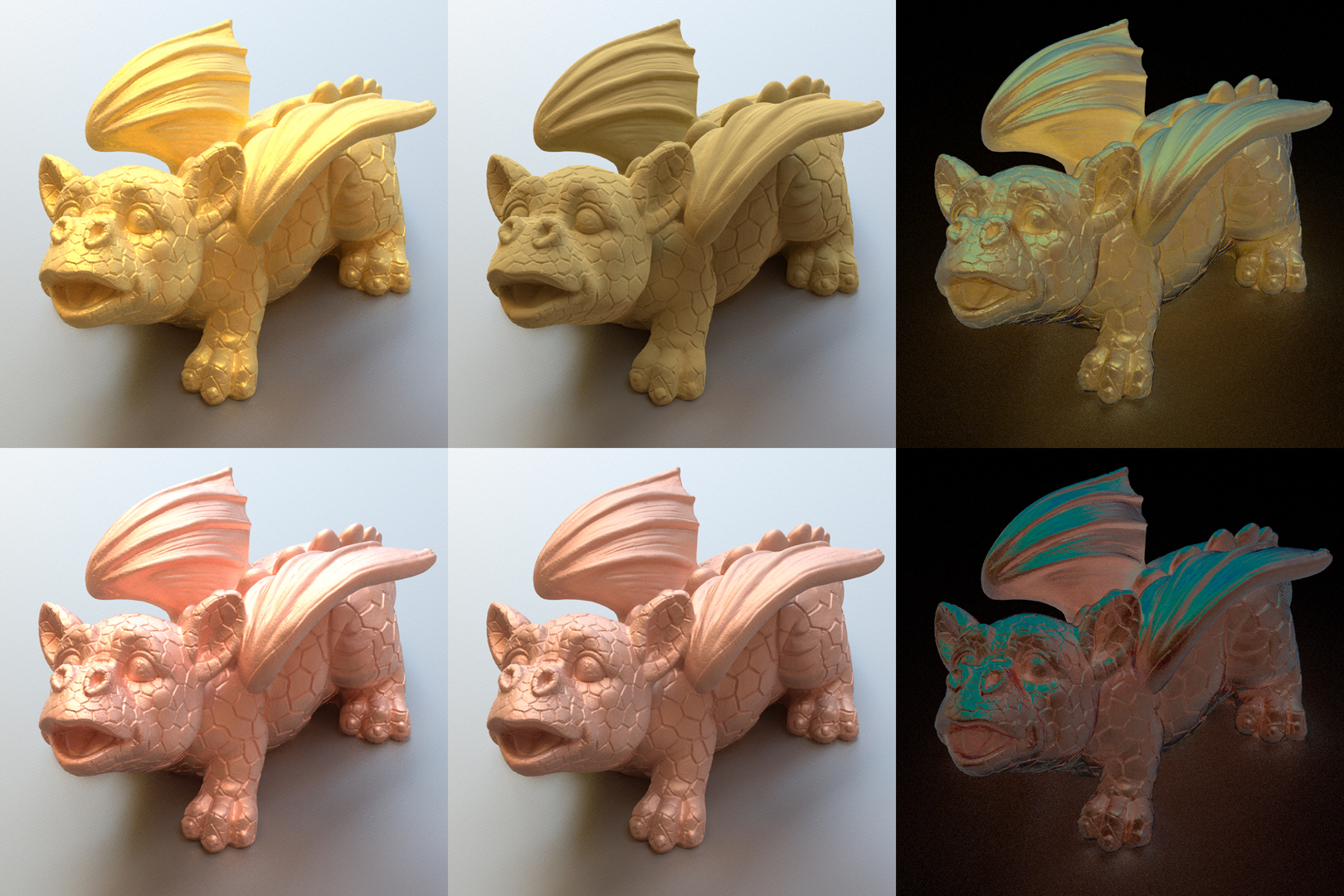
Microfacet-based reflection models are the most common way to represent reflection from rough surfaces. However, a major current limitation of these models is that they only account for single scattering. Unfortunately, single scattering models do not preserve energy. In this paper, we develop a microfacet BRDF for specular v-grooves that includes multiple scattering. Our approach is based on previous work by Zipin, who showed that the number of reflections inside a specular v-groove is bounded and analytically computable. Using his insight, we present a closed form solution for the BRDF and its probability density function (PDF); we also present a method for importance sampling the BRDF. As a result, our BRDF can be easily used within a path-traced rendering system such as PBRT. The model supports any microfacet distribution function, and spatially-varying surface roughness. The images produced by the model have a pleasing appearance compared to traditional single-scattering models.
References:
1. R. L. Cook and K. E. Torrance. 1982. A Reflectance Model for Computer Graphics. ACM Trans. Graph. 1, 1 (Jan. 1982), 7–24. Google ScholarDigital Library
2. Eric Heitz. 2014. Understanding the Masking-Shadowing Function in Microfacet-Based BRDFs. Journal of Computer Graphics Techniques (JCGT) 3, 2 (30 June 2014), 48–107. http://jcgt.org/published/0003/02/03/Google Scholar
3. Eric Heitz, Johannes Hanika, Eugene d’Eon, and Carsten Dachsbacher. 2016. Multiple-scattering Microfacet BSDFs with the Smith Model. ACM Trans. Graph. 35, 4, Article 58 (July 2016), 14 pages. Google ScholarDigital Library
4. Stephen Hill, Burley Brent McAuley, Martinez Adam Yoshiharu Gotanda, and Naty Hoffman Brian Smits. 2012. Physically Based Shading in Theory and Practice. In ACM SIGGRAPH 2012 Courses (SIGGRAPH ’12). ACM, New York, NY, USA, Article 7, 8 pages.Google Scholar
5. Stephen Hill, Stephen McAuley, Alejandro Conty, MichałDrobot, Eric Heitz, Christophe Hery, Christopher Kulla, Jon Lanz, Junyi Ling, Nathan Walster, Feng Xie, Adam Micciulla, and Ryusuke Villemin. 2017. Physically Based Shading in Theory and Practice. In ACM SIGGRAPH 2017 Courses (SIGGRAPH ’17). ACM, New York, NY, USA, Article 7, 8 pages. Google ScholarDigital Library
6. Csaba Kelemen and Laszlo Szirmay-Kalos. 2001. A Microfacet Based Coupled Specular-Matte BRDF Model with Importance Sampling. 25 (04 2001).Google Scholar
7. Jan J. Koenderink, Andrea J. Van Doorn, Kristin J. Dana, and Shree Nayar. 1999. Bidirectional Reflection Distribution Function of Thoroughly Pitted Surfaces. Int. J. Comput. Vision 31, 2–3 (April 1999), 129–144. Google ScholarDigital Library
8. Wojciech Matusik, Hanspeter Pfister, Matt Brand, and Leonard McMillan. 2003. A Data-Driven Reflectance Model. ACM Transactions on Graphics 22, 3 (July 2003), 759–769. Google ScholarDigital Library
9. Stephen McAuley, Stephen Hill, Naty Hoffman, Yoshiharu Gotanda, Brian Smits, Brent Burley, and Adam Martinez. 2012. Practical Physically-based Shading in Film and Game Production. In ACM SIGGRAPH 2012 Courses (SIGGRAPH ’12). ACM, New York, NY, USA, Article 10, 7 pages. Google ScholarDigital Library
10. S. K. Nayar, K. Ikeuchi, and T. Kanade. 1991. Surface reflection: physical and geometrical perspectives. IEEE Transactions on Pattern Analysis and Machine Intelligence 13, 7 (Jul 1991), 611–634. Google ScholarDigital Library
11. Michael Oren and Shree K. Nayar. 1994. Generalization of Lambert’s Reflectance Model. In Proceedings of the 21st Annual Conference on Computer Graphics and Interactive Techniques (SIGGRAPH ’94). ACM, New York, NY, USA, 239–246. Google ScholarDigital Library
12. Matt Pharr, Jakob Wenzel, and Greg Humphreys. 2016. Physically Based Rendering, Third Edition: From Theory To Implementation (3rd ed.). Morgan Kaufmann Publishers Inc., San Francisco, CA, USA. Google ScholarDigital Library
13. Sylvia C. Pont and Jan J. Koenderink. 2002. Bidirectional reflectance distribution function of specular surfaces with hemispherical pits. J. Opt. Soc. Am. A 19, 12 (Dec 2002), 2456–2466.Google ScholarCross Ref
14. E. M. Sparrow and S. H. Lin. 1962. Absorption of thermal radiation in a V-groove cavity. International Journal of Heat and Mass Transfer 5, 11 (November 1962), 1111–1115.Google ScholarCross Ref
15. Jos Stam. 2001. An Illumination Model for a Skin Layer Bounded by Rough Surfaces. In Proceedings of the 12th Eurographics Conference on Rendering (EGWR’01). Eurographics Association, Aire-la-Ville, Switzerland, Switzerland, 39–52. Google ScholarDigital Library
16. K.E. Torrance and E.M. Sparrow. 1967. Theory for Off-Specular Reflection from Roughened Surfaces. Journal of the Optical Society of America (JOSA) 57, 9 (Sept. 1967), 1105–1114. http://www.graphics.cornell.edu/~westin/pubs/TorranceSparrowJOSA1967.pdfGoogle ScholarCross Ref
17. Eric Veach. 1997. Robust Monte Carlo Methods for Light Transport Simulation. Ph.D. Dissertation. Stanford University, Palo Alto, CA. Google ScholarDigital Library
18. Bruce Walter, Stephen R. Marschner, Hongsong Li, and Kenneth E. Torrance. 2007. Microfacet Models for Refraction Through Rough Surfaces. In Proceedings of the 18th Eurographics Conference on Rendering Techniques (EGSR’07). Eurographics Association, Aire-la-Ville, Switzerland, Switzerland, 195–206. Google ScholarDigital Library
19. Richard Zipin. 1966. Apparent Thermal Radiation Properties of an Isothermal V-groove with Specularly Reflecting Walls. J. Res. Nat. Bur. Standards 70C, 4 (October-December 1966), 275–280.Google Scholar