“Set-in-stone: worst-case optimization of structures weak in tension”
Conference:
Type(s):
Title:
- Set-in-stone: worst-case optimization of structures weak in tension
Session/Category Title:
- Optimizing structures & materials
Presenter(s)/Author(s):
Moderator(s):
Abstract:
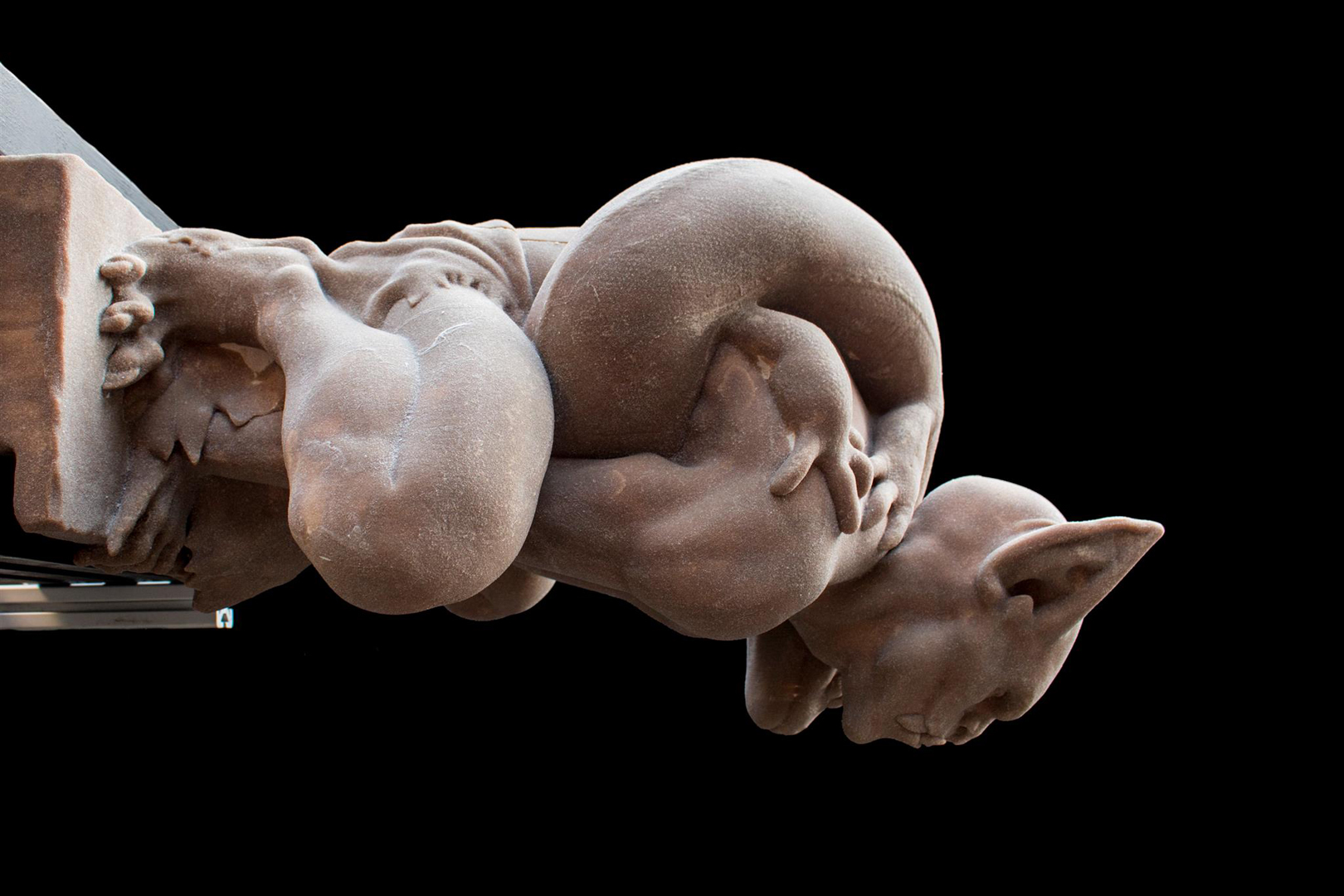
Large-scale binder jetting provides a promising alternative to manual sculpting of sandstone. The weak build material, however, severely limits its use in architectural ornamentation. We propose a structural optimization that jointly optimizes an ornament’s strength-to-weight ratio and balance under self-weight, thermal, wind, and live loads. To account for the difference in the tensile and compressive strength of the build material, we turn the Bresler-Pister criterion into a failure potential, measuring the distance to failure. Integrated into an XFEM-based level set formulation, we minimize this potential by changing the topology and shape of the internal structure. To deal with uncertainties in the location of live loads, and the direction of wind loads, we first estimate loads that lead to the weakest structure, then minimize the potential of failure under identified worst-case loads. With the help of first-order optimality constraints, we unify our worst-case load estimation and structural optimization into a continuous optimization. We demonstrate applications in art, furniture design, and architectural ornamentation with three large-scale 3D printed examples.
References:
1. Grégoire Allaire, Frédéric de Gournay, and François Jouve. 2009. Stress minimization and robust compliance optimization of structures by the level set method. In Proc. 8th World Congr. Struct. Multidisciplinary Optimization.Google Scholar
2. Grégoire Allaire, François Jouve, and Anca-Maria Toader. 2004. Structural optimization using sensitivity analysis and a level-set method. Journal of computational physics 194, 1 (2004), 363–393. Google ScholarDigital Library
3. Moritz Bächer, Emily Whiting, Bernd Bickel, and Olga Sorkine-Hornung. 2014. Spin-it: Optimizing Moment of Inertia for Spinnable Objects. ACM Trans. Graph. 33, 4, Article 96 (July 2014), 10 pages. Google ScholarDigital Library
4. Martin P. Bendsøe and Ole Sigmund. 2004. Topology Optimization: Theory, Methods, and Applications. Springer Berlin Heidelberg.Google Scholar
5. Amit H. Bermano, Thomas Funkhouser, and Szymon Rusinkiewicz. 2017. State of the Art in Methods and Representations for Fabrication-Aware Design. In Computer Graphics Forum, Vol. 36. Wiley Online Library, 509–535. Google ScholarDigital Library
6. Wai-Fah Chen and Atef F. Saleeb. 1994. Constitutive Equations for Engineering Materials. Elsevier.Google Scholar
7. Andrej Cherkaev and Elena Cherkaeva. 1999. Optimal design for uncertain loading condition. 193–213.Google Scholar
8. D-Shape. 2018. D-Shape. https://d-shape.com/. (2018). Accessed: 2018-06-04.Google Scholar
9. Frédéric de Gournay, Grégoire Allaire, and François Jouve. 2008. Shape and topology optimization of the robust compliance via the level set method. ESAIM: Control, Optimisation and Calculus of Variations 14, 1 (2008), 43–70.Google ScholarCross Ref
10. Joshua D. Deaton and Ramana V. Grandhi. 2014. A survey of structural and multidisciplinary continuum topology optimization: post 2000. Structural and Multidisciplinary Optimization 49, 1 (2014), 1–38. Google ScholarDigital Library
11. Chi-Wing Fu, Peng Song, Xiaoqi Yan, Lee Wei Yang, Pradeep Kumar Jayaraman, and Daniel Cohen-Or. 2015. Computational Interlocking Furniture Assembly. ACM Trans. Graph. 34, 4, Article 91 (July 2015), 11 pages. Google ScholarDigital Library
12. Timothy Langlois, Ariel Shamir, Daniel Dror, Wojciech Matusik, and David I. W. Levin. 2016. Stochastic Structural Analysis for Context-aware Design and Fabrication. ACM Trans. Graph. 35, 6, Article 226 (Nov. 2016), 13 pages. Google ScholarDigital Library
13. Lin Lu, Andrei Sharf, Haisen Zhao, Yuan Wei, Qingnan Fan, Xuelin Chen, Yann Savoye, Changhe Tu, Daniel Cohen-Or, and Baoquan Chen. 2014. Build-to-last: Strength to Weight 3D Printed Objects. ACM Trans. Graph. 33, 4, Article 97 (2014). Google ScholarDigital Library
14. Yangjun Luo and Zhan Kang. 2012. Topology optimization of continuum structures with Drucker-Prager yield stress constraints. Computers & Structures 90–91 (2012), 65–75.Google Scholar
15. Nicolas Moës, Mathieu Cloirec, Patrice Cartraud, and Jean-François Remacle. 2003. A computational approach to handle complex microstructure geometries. Computer Methods in Applied Mechanics and Engineering 192, 28–30 (2003), 3163–3177.Google ScholarCross Ref
16. Andrey Molotnikov, Ralf Gerbrand, Yuanshen Qi, George Philip Simon, and Yuri Estrin. 2015. Design of responsive materials using topologically interlocked elements. Smart Materials and Structures 24, 2 (2015), 025034.Google ScholarCross Ref
17. Nathaniel R. Morgan and Jacob I. Waltz. 2017. 3D level set methods for evolving fronts on tetrahedral meshes with adaptive mesh refinement. J. Comput. Phys. 336 (2017), 492–512. Google ScholarCross Ref
18. Przemyslaw Musialski, Thomas Auzinger, Michael Birsak, Michael Wimmer, and Leif Kobbelt. 2015. Reduced-Order Shape Optimization Using Offset Surfaces. ACM Trans. Graph. 34, 4 (Aug. 2015), 102:1–102:9. Google ScholarDigital Library
19. Lise Noël, Laurent Van Miegroet, and Pierre Duysinx. 2015. Analytical sensitivity analysis using the extended finite element method in shape optimization of bimaterial structures. Internat. J. Numer. Methods Engrg. 107, 8 (Dec. 2015).Google Scholar
20. Stanley Osher and Ronald Fedkiw. 2003. Level Set Methods and Dynamic Implicit Surfaces. Springer-Verlag New York.Google Scholar
21. Julian Panetta, Abtin Rahimian, and Denis Zorin. 2017. Worst-case Stress Relief for Microstructures. ACM Trans. Graph. 36, 4, Article 122 (2017), 16 pages. Google ScholarDigital Library
22. Romain Prévost, Emily Whiting, Sylvain Lefebvre, and Olga Sorkine-Hornung. 2013. Make It Stand: Balancing Shapes for 3D Fabrication. ACM Trans. Graph. 32, 4, Article 81 (July 2013), 10 pages. Google ScholarDigital Library
23. Ashesh Sharma and Kurt Maute. 2018. Stress-based topology optimization using spatial gradient stabilized XFEM. Structural and Multidisciplinary Optimization 57, 1 (Jan 2018), 17–38. Google ScholarDigital Library
24. Jan Sokolowski and Jean-Paul Zolesio. 1992. Introduction to Shape Optimization: Shape Sensitivity Analysis. Springer-Verlag Berlin Heidelberg.Google Scholar
25. Ondrej Stava, Juraj Vanek, Bedrich Benes, Nathan Carr, and Radomír Měch. 2012. Stress Relief: Improving Structural Strength of 3D Printable Objects. ACM Trans. Graph. 31, 4, Article 48 (2012). Google ScholarDigital Library
26. Erva Ulu, James Mccann, and Levent Burak Kara. 2017. Lightweight structure design under force location uncertainty. ACM Trans. Graph. 36, 4 (2017), 158. Google ScholarDigital Library
27. Nobuyuki Umetani and Ryan Schmidt. 2013. Cross-sectional Structural Analysis for 3D Printing Optimization. In SIGGRAPH Asia 2013 Technical Briefs. Article 5. Google ScholarDigital Library
28. Nico P. van Dijk, Kurt Maute, Matthijs Langelaar, and Fred Van Keulen. 2013. Level-set methods for structural topology optimization: a review. Multidisciplinary Optimization 48, 3 (2013), 437–472. Google ScholarDigital Library
29. Laurent Van Miegroet and Pierre Duysinx. 2007. Stress concentration minimization of 2D filets using X-FEM and level set description. Structural and Multidisciplinary Optimization 33, 4 (Apr 2007), 425–438.Google Scholar
30. Voxeljet. 2018. Voxeljet. https://www.voxeljet.com/. (2018). Accessed: 2018-06-04.Google Scholar
31. Michael Yu Wang, Xiaoming Wang, and Dongming Guo. 2003. A level set method for structural topology optimization. Computer Methods in Applied Mechanics and Engineering 192, 1–2 (2003), 227–246.Google ScholarCross Ref
32. Weiming Wang, Tuanfeng Y. Wang, Zhouwang Yang, Ligang Liu, Xin Tong, Weihua Tong, Jiansong Deng, Falai Chen, and Xiuping Liu. 2013. Cost-effective Printing of 3D Objects with Skin-frame Structures. ACM Trans. Graph. 32, 6, Article 177 (Nov. 2013), 10 pages. Google ScholarDigital Library
33. Jun Wu, Niels Aage, Rüdiger Westermann, and Ole Sigmund. 2018. Infill Optimization for Additive Manufacturing—Approaching Bone-Like Porous Structures. IEEE Transactions on Visualization and Computer Graphics 24, 2 (Feb 2018), 1127–1140.Google ScholarCross Ref
34. Jun Wu, Christian Dick, and Rudiger Westermann. 2016. A System for High-Resolution Topology Optimization. IEEE Transactions on Visualization and Computer Graphics 22, 3 (March 2016), 1195–1208. Google ScholarDigital Library
35. Hongyi Xu, Espen Knoop, Stelian Coros, and Moritz Bächer. 2018. Bend-It: Design and Fabrication of Kinetic Wire Characters. Proc. of ACM SIGGRAPH Asia 37, 6 (2018). Google ScholarDigital Library
36. Haiming Zhao, Weiwei Xu, Kun Zhou, Yin Yang, Xiaogang Jin, and Hongzhi Wu. 2017. Stress-Constrained Thickness Optimization for Shell Object Fabrication. Computer Graphics Forum 36, 6 (2017), 368–380. Google ScholarDigital Library
37. Qingnan Zhou, Julian Panetta, and Denis Zorin. 2013. Worst-case Structural Analysis. ACM Trans. Graph. 32, 4, Article 137 (2013). Google ScholarDigital Library
38. Yahan Zhou, Evangelos Kalogerakis, Rui Wang, and Ian R. Grosse. 2016. Direct shape optimization for strengthening 3D printable objects. Computer Graphics Forum 35, 7 (2016). Google ScholarDigital Library