
“Connecting measured BRDFs to analytic BRDFs by data-driven diffuse-specular separation”
Conference:
Type(s):
Title:
- Connecting measured BRDFs to analytic BRDFs by data-driven diffuse-specular separation
Session/Category Title:
- IM-material
Presenter(s)/Author(s):
Moderator(s):
Abstract:
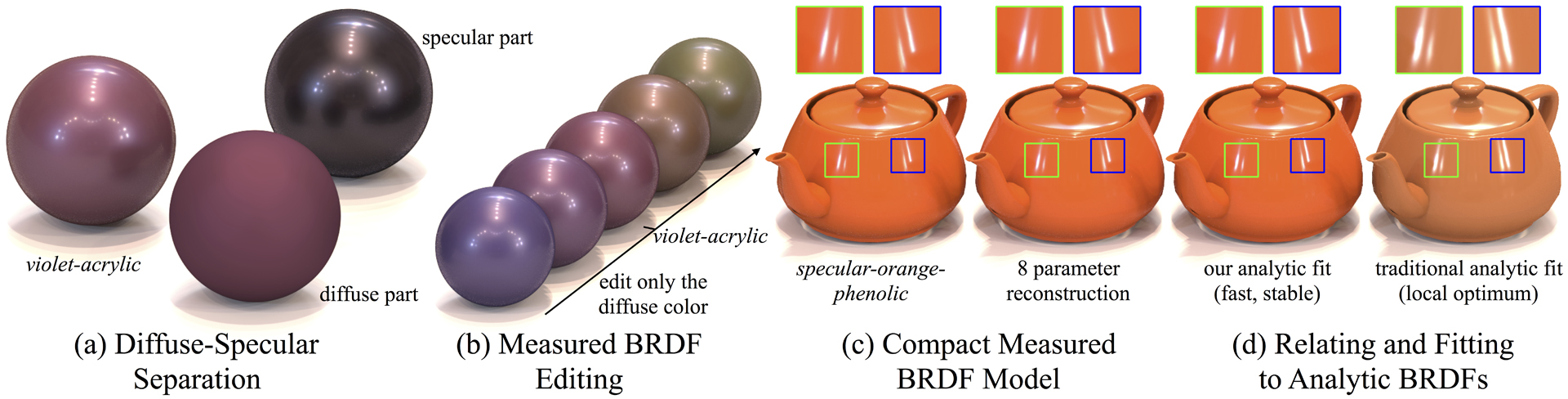
The bidirectional reflectance distribution function (BRDF) is crucial for modeling the appearance of real-world materials. In production rendering, analytic BRDF models are often used to approximate the surface appearance since they are compact and flexible. Measured BRDFs usually have a more realistic appearance, but consume much more storage and are hard to modify. In this paper, we propose a novel framework for connecting measured and analytic BRDFs. First, we develop a robust method for separating a measured BRDF into diffuse and specular components. This is commonly done in analytic models, but has been difficult previously to do explicitly for measured BRDFs. This diffuse-specular separation allows novel measured BRDF editing on the diffuse and specular parts separately. In addition, we conduct analysis on each part of the measured BRDF, and demonstrate a more intuitive and lower-dimensional PCA model than Nielsen et al. [2015]. In fact, our measured BRDF model has the same number of parameters (8 parameters) as the commonly used analytic models, such as the GGX model. Finally, we visualize the analytic and measured BRDFs in the same space, and directly demonstrate their similarities and differences. We also design an analytic fitting algorithm for two-lobe materials, which is more robust, efficient and simple, compared to previous non-convex optimization-based analytic fitting methods.
References:
1. Michael Ashikmin, Simon Premože, and Peter Shirley. 2000. A Microfacet-based BRDF Generator. In SIGGRAPH 00. 65–74. Google ScholarDigital Library
2. Mahdi M Bagher, John Snyder, and Derek Nowrouzezahrai. 2016. A non-parametric factor microfacet model for isotropic BRDFs. ACM Transactions on Graphics (TOG) 35, 5 (2016), 159. Google ScholarDigital Library
3. Mahdi M Bagher, Cyril Soler, and Nicolas Holzschuch. 2012. Accurate fitting of measured reflectances using a Shifted Gamma micro-facet distribution. In Computer Graphics Forum, Vol. 31. 1509–1518. Google ScholarDigital Library
4. Ahmet Bilgili, Aydn Öztürk, and Murat Kurt. 2011. A general BRDF representation based on tensor decomposition. In Computer Graphics Forum, Vol. 30. 2427–2439.Google ScholarCross Ref
5. James F Blinn. 1977. Models of light reflection for computer synthesized pictures. In SIGGRAPH 77. 192–198. Google ScholarDigital Library
6. Adam Brady, Jason Lawrence, Pieter Peers, and Westley Weimer. 2014. genBRDF: Discovering new analytic BRDFs with genetic programming. ACM Transactions on Graphics (TOG) 33, 4 (2014), 114. Google ScholarDigital Library
7. Robert L Cook and Kenneth E. Torrance. 1982. A reflectance model for computer graphics. ACM Transactions on Graphics (TOG) 1, 1 (1982), 7–24. Google ScholarDigital Library
8. Paul Debevec. 1998. Rendering synthetic objects into real scenes: Bridging traditional and image-based graphics with global illumination and high dynamic range photography. In SIGGRAPH 98. 189–198. Google ScholarDigital Library
9. Jonathan Dupuy, Eric Heitz, Jean-Claude Iehl, Pierre Poulin, and Victor Ostromoukhov. 2015. Extracting Microfacet-based BRDF Parameters from Arbitrary Materials with Power Iterations. In Computer Graphics Forum, Vol. 34. 21–30. Google ScholarDigital Library
10. Jirí Filip and Radomír Vávra. 2014. Template-based sampling of anisotropic BRDFs. In Computer Graphics Forum, Vol. 33. 91–99. Google ScholarDigital Library
11. Adria Fores, James Ferwerda, and Jinwei Gu. 2012. Toward a perceptually based metric for BRDF modeling. In Color and Imaging Conference. 142–148.Google Scholar
12. Dar’ya Guarnera, Giuseppe Claudio Guarnera, Abhijeet Ghosh, Cornelia Denk, and Mashhuda Glencross. 2016. BRDF representation and acquisition. In Computer Graphics Forum. 625–650.Google Scholar
13. Vlastimil Havran and Mateu Sbert. 2015. Surface reflectance characterization by statistical tools. In Proceedings of the 31st Spring Conference on Computer Graphics. 39–46. Google ScholarDigital Library
14. Nicolas Holzschuch and Romain Pacanowski. 2017. A two-scale microfacet reflectance model combining reflection and diffraction. ACM Transactions on Graphics (TOG) 36, 4 (2017), 66. Google ScholarDigital Library
15. Eric PF Lafortune, Sing-Choong Foo, Kenneth E Torrance, and Donald P Greenberg. 1997. Non-linear approximation of reflectance functions. In SIGGRAPH 97. 117–126. Google ScholarDigital Library
16. Jason Lawrence, Aner Ben-Artzi, Christopher DeCoro, Wojciech Matusik, Hanspeter Pfister, Ravi Ramamoorthi, and Szymon Rusinkiewicz. 2006. Inverse shade trees for non-parametric material representation and editing. ACM Transactions on Graphics (TOG) 25, 3, 735–745. Google ScholarDigital Library
17. Jason Lawrence, Szymon Rusinkiewicz, and Ravi Ramamoorthi. 2004. Efficient BRDF importance sampling using a factored representation. ACM Transactions on Graphics (TOG) 23, 3, 496–505. Google ScholarDigital Library
18. Joakim Löw, Joel Kronander, Anders Ynnerman, and Jonas Unger. 2012. BRDF models for accurate and efficient rendering of glossy surfaces. ACM Transactions on Graphics (TOG) 31, 1 (2012), 9. Google ScholarDigital Library
19. Wojciech Matusik, Hanspeter Pfister, Matt Brand, and Leonard McMillan. 2003a. A Data-Driven Reflectance Model. ACM Transactions on Graphics 22, 3 (2003), 759–769. Google ScholarDigital Library
20. Wojciech Matusik, Hanspeter Pfister, Matthew Brand, and Leonard McMillan. 2003b. Efficient isotropic BRDF measurement. In Proceedings of the 14th Eurographics workshop on Rendering. 241–247. Google ScholarDigital Library
21. Stephen McAuley, Stephen Hill, Naty Hoffman, Yoshiharu Gotanda, Brian Smits, Brent Burley, and Adam Martinez. 2012. Practical physically-based shading in film and game production. In ACM SIGGRAPH 2012 Courses. 10. Google ScholarDigital Library
22. Addy Ngan, Frédo Durand, and Wojciech Matusik. 2005. Experimental Analysis of BRDF Models. In Proceedings of the Eurographics Symposium on Rendering. 117–226. Google ScholarDigital Library
23. FE Nicodemus, JC Richmond, JJ Hsia, IW Ginsberg, and T Limperis. 1977. Geometrical considerations and nomenclature for reflectance. Final Report National Bureau of Standards, Washington, DC. Inst. for Basic Standards. (1977).Google ScholarCross Ref
24. Jannik Boll Nielsen, Henrik Wann Jensen, and Ravi Ramamoorthi. 2015. On optimal, minimal BRDF sampling for reflectance acquisition. ACM Transactions on Graphics (TOG) 34, 6 (2015), 186. Google ScholarDigital Library
25. Michael Oren and Shree K Nayar. 1995. Generalization of the Lambertian model and implications for machine vision. International Journal of Computer Vision 14, 3 (1995), 227–251. Google ScholarDigital Library
26. Thiago Pereira and Szymon Rusinkiewicz. 2012. Gamut mapping spatially varying reflectance with an improved BRDF similarity metric. In Computer Graphics Forum, Vol. 31. 1557–1566. Google ScholarDigital Library
27. Bui Tuong Phong. 1975. Illumination for computer generated pictures. Commun. ACM 18, 6 (1975), 311–317. Google ScholarDigital Library
28. Szymon M Rusinkiewicz. 1998. A new change of variables for efficient BRDF representation. In Rendering techniques 98. 11–22.Google Scholar
29. Ana Serrano, Diego Gutierrez, Karol Myszkowski, Hans-Peter Seidel, and Belen Masia. 2016. An intuitive control space for material appearance. ACM Transactions on Graphics (TOG) 35, 6 (2016), 186. Google ScholarDigital Library
30. Jian Shi, Yue Dong, Hao Su, and X Yu Stella. 2017. Learning non-lambertian object intrinsics across shapenet categories. In 2017 IEEE Conference on Computer Vision and Pattern Recognition (CVPR). 5844–5853.Google ScholarCross Ref
31. Cyril Soler, Kartic Subr, and Derek Nowrouzezahrai. 2018. A Versatile Parameterization for Measured Material Manifolds. In Computer Graphics Forum, Vol. 37. 135–144.Google ScholarCross Ref
32. Tiancheng Sun, Ana Serrano, Diego Gutierrez, and Belen Masia. 2017. Attribute-preserving gamut mapping of measured BRDFs. In Computer Graphics Forum, Vol. 36. 47–54. Google ScholarDigital Library
33. Xin Sun, Kun Zhou, Yanyun Chen, Stephen Lin, Jiaoying Shi, and Baining Guo. 2007. Interactive relighting with dynamic BRDFs. ACM Transactions on Graphics (TOG) 26, 3 (2007), 27. Google ScholarDigital Library
34. Apostolia Tsirikoglou, Joel Kronander, Per Larsson, Tanaboon Tongbuasirilai, Andrew Gardner, and Jonas Unger. 2016. Differential appearance editing for measured BRDFs. In ACM SIGGRAPH 2016 Talks. 51. Google ScholarDigital Library
35. Bruce Walter, Stephen R Marschner, Hongsong Li, and Kenneth E Torrance. 2007. Microfacet models for refraction through rough surfaces. In Proceedings of the 18th Eurographics conference on Rendering Techniques. 195–206. Google ScholarDigital Library
36. Gregory J Ward. 1992. Measuring and modeling anisotropic reflection. ACM SIGGRAPH 92 26, 2 (1992), 265–272. Google ScholarDigital Library
37. Carlos J Zubiaga, Laurent Belcour, Carles Bosch, Adolfo Muñoz, and Pascal Barla. 2015. Statistical analysis of bidirectional reflectance distribution functions. In Measuring, Modeling, and Reproducing Material Appearance 2015, Vol. 9398. 939808.Google Scholar



