“Multi-view wire art”
Conference:
Type(s):
Title:
- Multi-view wire art
Session/Category Title:
- Get wired
Presenter(s)/Author(s):
Moderator(s):
Abstract:
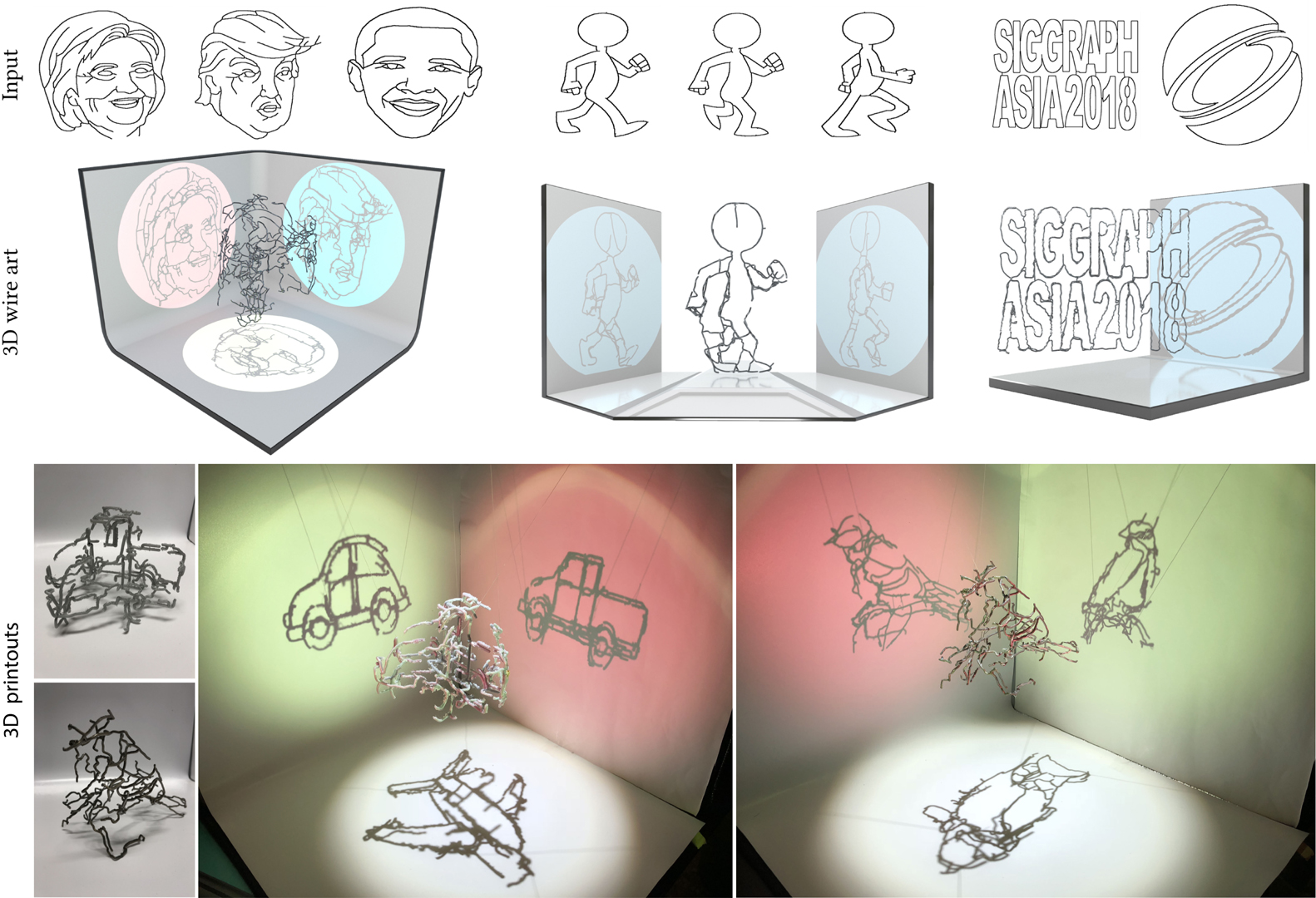
Wire art is the creation of three-dimensional sculptural art using wire strands. As the 2D projection of a 3D wire sculpture forms line drawing patterns, it is possible to craft multi-view wire sculpture art — a static sculpture with multiple (potentially very different) interpretations when perceived at different viewpoints. Artists can effectively leverage this characteristic and produce compelling artistic effects. However, the creation of such multi-view wire sculpture is extremely time-consuming even by highly skilled artists. In this paper, we present a computational framework for automatic creation of multi-view 3D wire sculpture. Our system takes two or three user-specified line drawings and the associated viewpoints as inputs. We start with producing a sparse set of voxels via greedy selection approach such that their projections on the virtual cameras cover all the contour pixels of the input line drawings. The sparse set of voxels, however, do not necessary form one single connected component. We introduce a constrained 3D pathfinding algorithm to link isolated groups of voxels into a connected component while maintaining the similarity between the projected voxels and the line drawings. Using the reconstructed visual hull, we extract a curve skeleton and produce a collection of smooth 3D curves by fitting cubic splines and optimizing the curve deformation to best approximate the provided line drawings. We demonstrate the effectiveness of our system for creating compelling multi-view wire sculptures in both simulation and 3D physical printouts.
References:
1. Marc Alexa and Wojciech Matusik. 2010. Reliefs as images. ACM Trans. Graph. (Proc. of SIGGRAPH) 29, 4 (2010), 60–1. Google ScholarDigital Library
2. Amit Bermano, Ilya Baran, Marc Alexa, and Wojciech Matusk. 2012. Shadowpix: Multiple images from self shadowing. In Comput. Graph. Forum (Proc. EUROGRAPHICS), Vol. 31. 593–602. Google ScholarDigital Library
3. Robert T Collins. 1996. A space-sweep approach to true multi-image matching. In Computer Vision and Pattern Recognition, 1996. Proceedings CVPR’96, 1996 IEEE Computer Society Conference on. IEEE, 358–363. Google ScholarDigital Library
4. Ricardo Fabbri and Benjamin Kimia. 2010. 3D curve sketch: Flexible curve-based stereo reconstruction and calibration. In CVPR.Google Scholar
5. Yasutaka Furukawa and Carlos Hernández. 2015. Multi-view stereo: A tutorial. Foundations and Trends® in Computer Graphics and Vision 9, 1–2 (2015), 1–148. Google ScholarDigital Library
6. Yasutaka Furukawa and Jean Ponce. 2010. Accurate, dense, and robust multiview stereopsis. IEEE Trans. Pattern Analysis Machine Intelligence 32, 8 (2010), 1362–1376. Google ScholarDigital Library
7. Michael Goesele, Noah Snavely, Brian Curless, Hugues Hoppe, and Steven M Seitz. 2007. Multi-view stereo for community photo collections. In ICCV.Google Scholar
8. Manuel Hofer, Michael Maurer, and Horst Bischof. 2017. Efficient 3D scene abstraction using line segments. Computer Vision and Image Understanding 157 (2017), 167–178. Google ScholarDigital Library
9. Po-Han Huang, Kevin Matzen, Johannes Kopf, Narendra Ahuja, and Jia-Bin Huang. 2018. DeepMVS: Learning Multi-view Stereopsis. In CVPR.Google Scholar
10. Emmanuel Iarussi, Wilmot Li, and Adrien Bousseau. 2015. WrapIt: computer-assisted crafting of wire wrapped jewelry. ACM Trans. Graph. (Proc. of SIGGRAPH Asia) 34, 6 (2015), 221. Google ScholarDigital Library
11. Jeroen Keiren, Freek van Walderveen, and Alexander Wolff. 2009. Constructability of trip-lets. In 25th European Workshop on Comp. Geom.Google Scholar
12. Andreas Kuhn, Heiko Hirschmüller, Daniel Scharstein, and Helmut Mayer. 2017. A tv prior for high-quality scalable multi-view stereo reconstruction. International Journal of Computer Vision 124, 1 (2017), 2–17. Google ScholarDigital Library
13. Ying-Miao Kuo, Hung-Kuo Chu, Ming-Te Chi, Ruen-Rone Lee, and Tong-Yee Lee. 2016. Generating Ambiguous Figure-Ground Images. IEEE Trans. Vis. Comput. Graph. PP (2016). Issue 99. Google ScholarDigital Library
14. A. Laurentini. 1994. The Visual Hull Concept for Silhouette-Based Image Understanding. IEEE Trans. Pattern Analysis Machine Intelligence 16, 2 (1994), 150–162. Google ScholarDigital Library
15. Svetlana Lazebnik, Yasutaka Furukawa, and Jean Ponce. 2007. Projective visual hulls. International Journal of Computer Vision 74, 2 (2007), 137–165. Google ScholarDigital Library
16. Lingjie Liu, Duygu Ceylan, Cheng Lin, Wenping Wang, and Niloy J. Mitra. 2017. Image-based Reconstruction of Wire Art. ACM Trans. Graph. (Proc. of SIGGRAPH) 36, 4 (2017), 63:1–63:11. Google ScholarDigital Library
17. L Liu, Erin W Chambers, David Letscher, and Tao Ju. 2010. A simple and robust thinning algorithm on cell complexes. In Comput. Graph. Forum (Proc. EUROGRAPHICS), Vol. 29. 2253–2260.Google ScholarCross Ref
18. Wojciech Matusik, Chris Buehler, Ramesh Raskar, Steven J Gortler, and Leonard McMillan. 2000. Image-based visual hulls. In Proc. of ACM SIGGRAPH. Google ScholarDigital Library
19. Eder Miguel, Mathias Lepoutre, and Bernd Bickel. 2016. Computational Design of Stable Planar-rod Structures. ACM Trans. Graph. (Proc. of SIGGRAPH) 35, 4, Article 86 (2016), 11 pages. Google ScholarDigital Library
20. Sehee Min, Jaedong Lee, Jungdam Won, and Jehee Lee. 2017. Soft shadow art. In Proc. of the Symposium on Computational Aesthetics. 3. Google ScholarDigital Library
21. Niloy J. Mitra and Mark Pauly. 2009. Shadow Art. ACM Trans. Graph. (Proc. of SIGGRAPH Asia) 28, 5 (2009), 156:1–156:7. Google ScholarDigital Library
22. Aude Oliva, Antonio Torralba, and Philippe G. Schyns. 2006. Hybrid Images. ACM Trans. Graph. (Proc. of SIGGRAPH) 25, 3 (2006), 527–532. Google ScholarDigital Library
23. Luke Olsen, Faramarz F Samavati, Mario Costa Sousa, and Joaquim A Jorge. 2009. Sketch-based modeling: A survey. Computers & Graphics 33, 1 (2009), 85–103. Google ScholarDigital Library
24. Jim Postell. 2012. Furniture design. John Wiley & Sons.Google Scholar
25. Alec Rivers, Frédo Durand, and Takeo Igarashi. 2010. 3D Modeling with Silhouettes. ACM Trans. Graph. (Proc. of SIGGRAPH) 29, 4, Article 109 (2010), 8 pages. Google ScholarDigital Library
26. Johannes L Schonberger and Jan-Michael Frahm. 2016. Structure-from-motion revisited. In CVPR.Google Scholar
27. Johannes L Schönberger, Enliang Zheng, Jan-Michael Frahm, and Marc Pollefeys. 2016. Pixelwise view selection for unstructured multi-view stereo. In ECCV.Google Scholar
28. Wire Sculpture. 2007. https://en.wikipedia.org/wiki/Wire_sculpture. (2007).Google Scholar
29. Guy Sela and Gershon Elber. 2007. Generation of view dependent models using free form deformation. The Visual Computer 23, 3 (2007), 219–229. Google ScholarDigital Library
30. Noah Snavely, Steven M Seitz, and Richard Szeliski. 2006. Photo tourism: exploring photo collections in 3D. In ACM Trans. Graph. (Proc. of SIGGRAPH), Vol. 25. 835–846. Google ScholarDigital Library
31. Richard Szeliski. 1993. Rapid octree construction from image sequences. CVGIP: Image understanding 58, 1 (1993), 23–32. Google ScholarDigital Library
32. Anil Usumezbas, Ricardo Fabbri, and Benjamin B Kimia. 2016. From multiview image curves to 3D drawings. In ECCV.Google Scholar
33. WigJig. 2015. https://www.wigjig.com/. (2015).Google Scholar
34. Jungdam Won and Jehee Lee. 2016. Shadow theatre: discovering human motion from a sequence of silhouettes. ACM Trans. Graph. (Proc. of SIGGRAPH) 35, 4 (2016), 147. Google ScholarDigital Library
35. Jonas Zehnder, Stelian Coros, and Bernhard Thomaszewski. 2016. Designing Structurally-sound Ornamental Curve Networks. ACM Trans. Graph. (Proc. of SIGGRAPH) 35, 4, Article 99 (2016), 10 pages. Google ScholarDigital Library