
“Multi-chart generative surface modeling”
Conference:
Type(s):
Title:
- Multi-chart generative surface modeling
Session/Category Title:
- Geometry generation
Presenter(s)/Author(s):
Moderator(s):
Abstract:
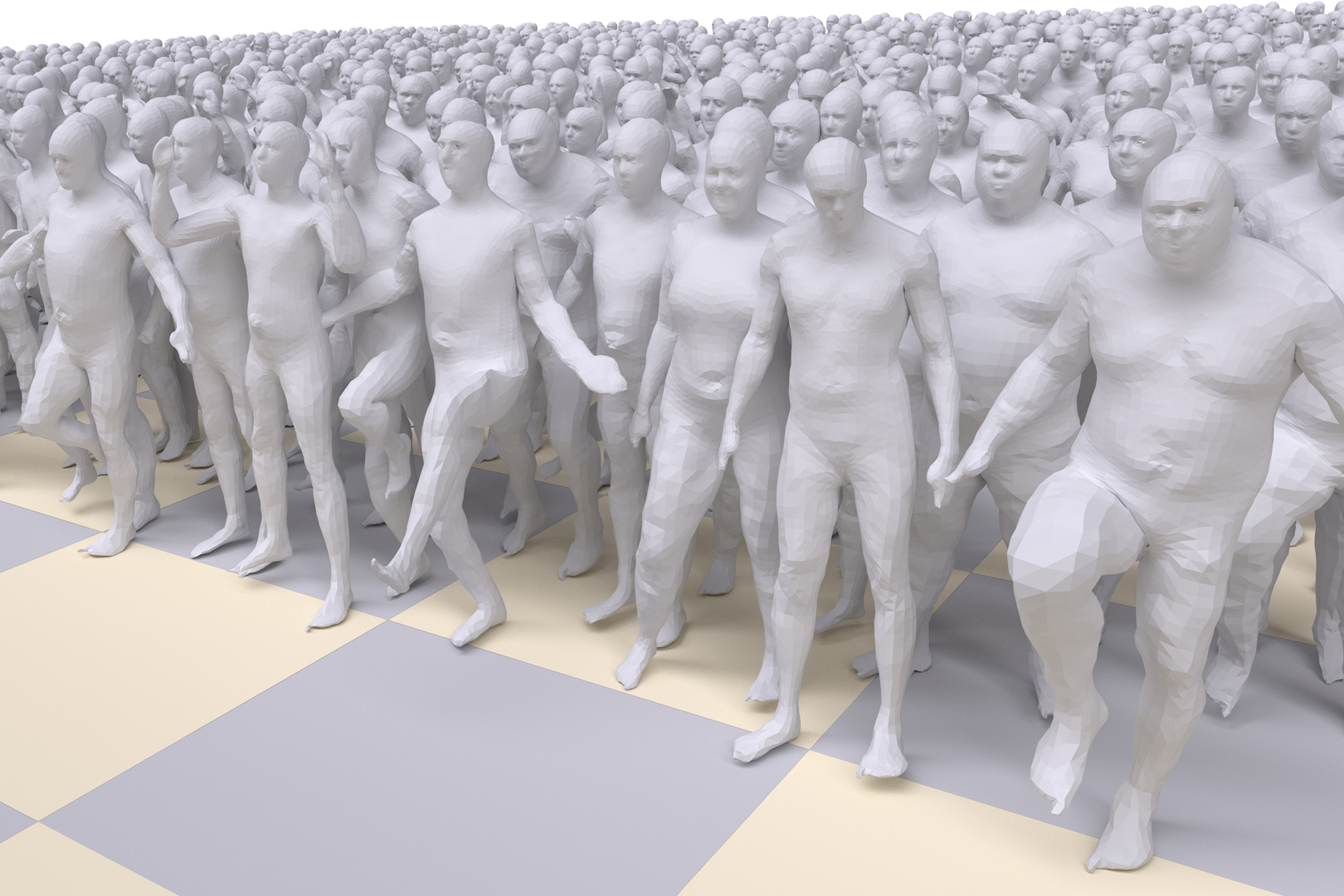
This paper introduces a 3D shape generative model based on deep neural networks. A new image-like (i.e., tensor) data representation for genus-zero 3D shapes is devised. It is based on the observation that complicated shapes can be well represented by multiple parameterizations (charts), each focusing on a different part of the shape. The new tensor data representation is used as input to Generative Adversarial Networks for the task of 3D shape generation.The 3D shape tensor representation is based on a multi-chart structure that enjoys a shape covering property and scale-translation rigidity. Scale-translation rigidity facilitates high quality 3D shape learning and guarantees unique reconstruction. The multi-chart structure uses as input a dataset of 3D shapes (with arbitrary connectivity) and a sparse correspondence between them. The output of our algorithm is a generative model that learns the shape distribution and is able to generate novel shapes, interpolate shapes, and explore the generated shape space. The effectiveness of the method is demonstrated for the task of anatomic shape generation including human body and bone (teeth) shape generation.
References:
1. Martín Abadi, Ashish Agarwal, Paul Barham, Eugene Brevdo, Zhifeng Chen, Craig Citro, Greg S. Corrado, Andy Davis, Jeffrey Dean, Matthieu Devin, Sanjay Ghemawat, Ian Goodfellow, Andrew Harp, Geoffrey Irving, Michael Isard, Yangqing Jia, Rafal Jozefowicz, Lukasz Kaiser, Manjunath Kudlur, Josh Levenberg, Dan Mané, Rajat Monga, Sherry Moore, Derek Murray, Chris Olah, Mike Schuster, Jonathon Shlens, Benoit Steiner, Ilya Sutskever, Kunal Talwar, Paul Tucker, Vincent Vanhoucke, Vijay Vasudevan, Fernanda Viégas, Oriol Vinyals, Pete Warden, Martin Wattenberg, Martin Wicke, Yuan Yu, and Xiaoqiang Zheng. 2015. TensorFlow: Large-Scale Machine Learning on Heterogeneous Systems. (2015). https://www.tensorflow.org/ Software available from tensorflow.org.Google Scholar
2. Brett Allen, Brian Curless, and Zoran Popović. 2003. The space of human body shapes: reconstruction and parameterization from range scans. In ACM transactions on graphics (TOG), Vol. 22. ACM, 587–594. Google ScholarDigital Library
3. Dragomir Anguelov, Praveen Srinivasan, Daphne Koller, Sebastian Thrun, Jim Rodgers, and James Davis. 2005. SCAPE: shape completion and animation of people. In ACM Transactions on Graphics (TOG), Vol. 24. ACM, 408–416. Google ScholarDigital Library
4. anonymous. 2018. Multi-chart Generative Surface Modeling. arXiv preprint arXiv:1806 (2018).Google Scholar
5. Federica Bogo, Javier Romero, Matthew Loper, and Michael J Black. 2014. FAUST: Dataset and evaluation for 3D mesh registration. In Proceedings of the IEEE Conference on Computer Vision and Pattern Recognition. 3794–3801. Google ScholarDigital Library
6. Federica Bogo, Javier Romero, Gerard Pons-Moll, and Michael J Black. 2017. Dynamic faust: Registering human bodies in motion. In Proc. the Conference on Computer Vision and Pattern Recognition.Google ScholarCross Ref
7. Doug M Boyer, Yaron Lipman, Elizabeth St Clair, Jesus Puente, Biren A Patel, Thomas Funkhouser, Jukka Jernvall, and Ingrid Daubechies. 2011. Algorithms to automatically quantify the geometric similarity of anatomical surfaces. Proceedings of the National Academy of Sciences 108, 45 (2011), 18221–18226.Google ScholarCross Ref
8. Michael M Bronstein, Joan Bruna, Yann LeCun, Arthur Szlam, and Pierre Vandergheynst. 2017. Geometric deep learning: going beyond euclidean data. IEEE Signal Processing Magazine 34, 4 (2017), 18–42.Google ScholarCross Ref
9. Richard Caron and Tim Traynor. 2005. The zero set of a polynomial. WSMR Report (2005), 05–02.Google Scholar
10. Angela Dai, Charles Ruizhongtai Qi, and Matthias Nießner. 2016. Shape completion using 3d-encoder-predictor cnns and shape synthesis. arXiv preprint arXiv:1612.00101 (2016).Google Scholar
11. Carl Doersch. 2016. Tutorial on variational autoencoders. arXiv preprint arXiv:1606.05908 (2016).Google Scholar
12. Haoqiang Fan, Hao Su, and Leonidas Guibas. 2016. A point set generation network for 3d object reconstruction from a single image. arXiv preprint arXiv:1612.00603 (2016).Google Scholar
13. Thomas Funkhouser, Michael Kazhdan, Philip Shilane, Patrick Min, William Kiefer, Ayellet Tal, Szymon Rusinkiewicz, and David Dobkin. 2004. Modeling by example. In ACM Transactions on Graphics (TOG), Vol. 23. ACM, 652–663. Google ScholarDigital Library
14. Matheus Gadelha, Subhransu Maji, and Rui Wang. 2016. 3d shape induction from 2d views of multiple objects. arXiv preprint arXiv:1612.05872 (2016).Google Scholar
15. Ian Goodfellow. 2016. NIPS 2016 tutorial: Generative adversarial networks. arXiv preprint arXiv:1701.00160 (2016).Google Scholar
16. Ian Goodfellow, Jean Pouget-Abadie, Mehdi Mirza, Bing Xu, David Warde-Farley, Sherjil Ozair, Aaron Courville, and Yoshua Bengio. 2014. Generative adversarial nets. In Advances in neural information processing systems. 2672–2680. Google ScholarDigital Library
17. Thibault Groueix, Matthew Fisher, Vladimir G. Kim, Bryan C. Russell, and Mathieu Aubry. 2018. AtlasNet: A Papier-Mâché Approach to Learning 3D Surface Generation. CVPR (2018).Google Scholar
18. Ishaan Gulrajani, Faruk Ahmed, Martin Arjovsky, Vincent Dumoulin, and Aaron Courville. 2017. Improved training of wasserstein gans. arXiv preprint arXiv:1704.00028 (2017). Google ScholarDigital Library
19. Evangelos Kalogerakis, Siddhartha Chaudhuri, Daphne Koller, and Vladlen Koltun. 2012. A probabilistic model for component-based shape synthesis. ACM Transactions on Graphics (TOG) 31, 4 (2012), 55. Google ScholarDigital Library
20. Tero Karras, Timo Aila, Samuli Laine, and Jaakko Lehtinen. 2017. Progressive growing of gans for improved quality, stability, and variation. arXiv preprint arXiv:1710.10196 (2017).Google Scholar
21. Or Litany, Alex Bronstein, Michael Bronstein, and Ameesh Makadia. 2017. Deformable Shape Completion with Graph Convolutional Autoencoders. arXiv preprint arXiv:1712.00268 (2017).Google Scholar
22. Jerry Liu, Fisher Yu, and Thomas Funkhouser. 2017. Interactive 3D Modeling with a Generative Adversarial Network. arXiv preprint arXiv:1706.05170 (2017).Google Scholar
23. Matthew Loper, Naureen Mahmood, Javier Romero, Gerard Pons-Moll, and Michael J Black. 2015. SMPL: A skinned multi-person linear model. ACM Transactions on Graphics (TOG) 34, 6 (2015), 248. Google ScholarDigital Library
24. Zhaoliang Lun, Matheus Gadelha, Evangelos Kalogerakis, Subhransu Maji, and Rui Wang. 2017. 3D Shape Reconstruction from Sketches via Multi-view Convolutional Networks. arXiv preprint arXiv:1707.06375 (2017).Google Scholar
25. Haggai Maron, Meirav Galun, Noam Aigerman, Miri Trope, Nadav Dym, Ersin Yumer, VLADIMIR G KIM, and Yaron Lipman. 2017. Convolutional Neural Networks on Surfaces via Seamless Toric Covers. SIGGRAPH. Google ScholarDigital Library
26. Charlie Nash and Chris KI Williams. 2017. The shape variational autoencoder: A deep generative model of part-segmented 3D objects. In Computer Graphics Forum, Vol. 36. Wiley Online Library, 1–12. Google ScholarDigital Library
27. Charles R Qi, Hao Su, Kaichun Mo, and Leonidas J Guibas. 2017. Pointnet: Deep learning on point sets for 3d classification and segmentation. Proc. Computer Vision and Pattern Recognition (CVPR), IEEE 1, 2 (2017), 4.Google Scholar
28. Ayan Sinha, Asim Unmesh, Qixing Huang, and Karthik Ramani. 2017. SurfNet: Generating 3D shape surfaces using deep residual networks. arXiv preprint arXiv:1703.04079 (2017).Google Scholar
29. Amir Arsalan Soltani, Haibin Huang, Jiajun Wu, Tejas D Kulkarni, and Joshua B Tenenbaum. 2017. Synthesizing 3d shapes via modeling multi-view depth maps and silhouettes with deep generative networks. In Proceedings of the IEEE Conference on Computer Vision and Pattern Recognition. 1511–1519.Google ScholarCross Ref
30. Maxim Tatarchenko, Alexey Dosovitskiy, and Thomas Brox. 2016. Multi-view 3d models from single images with a convolutional network. In European Conference on Computer Vision. Springer, 322–337.Google ScholarCross Ref
31. Maxim Tatarchenko, Alexey Dosovitskiy, and Thomas Brox. 2017. Octree Generating Networks: Efficient Convolutional Architectures for High-resolution 3D Outputs. arXiv preprint arXiv:1703.09438 (2017).Google Scholar
32. Carl Vondrick, Hamed Pirsiavash, and Antonio Torralba. 2016. Generating videos with scene dynamics. In Advances In Neural Information Processing Systems. 613–621. Google ScholarDigital Library
33. Weiyue Wang, Qiangui Huang, Suya You, Chao Yang, and Ulrich Neumann. 2017. Shape inpainting using 3d generative adversarial network and recurrent convolutional networks. arXiv preprint arXiv:1711.06375 (2017).Google Scholar
34. Walter Whiteley. 1996. Some matroids from discrete applied geometry. Contemp. Math. 197 (1996), 171–312.Google ScholarCross Ref
35. Jiajun Wu, Yifan Wang, Tianfan Xue, Xingyuan Sun, Bill Freeman, and Josh Tenenbaum. 2017. Marrnet: 3d shape reconstruction via 2.5 d sketches. In Advances in Neural Information Processing Systems. 540–550. Google ScholarDigital Library
36. Jiajun Wu, Chengkai Zhang, Tianfan Xue, Bill Freeman, and Josh Tenenbaum. 2016. Learning a probabilistic latent space of object shapes via 3d generative-adversarial modeling. In Advances in Neural Information Processing Systems. 82–90. Google ScholarDigital Library
37. Yipin Yang, Yao Yu, Yu Zhou, Sidan Du, James Davis, and Ruigang Yang. 2014. Semantic parametric reshaping of human body models. In 3D Vision (3DV), 2014 2nd International Conference on, Vol. 2. IEEE, 41–48. Google ScholarDigital Library
38. Manzil Zaheer, Satwik Kottur, Siamak Ravanbakhsh, Barnabas Poczos, Ruslan R Salakhutdinov, and Alexander J Smola. 2017. Deep sets. In Advances in Neural Information Processing Systems. 3394–3404. Google ScholarDigital Library
39. Rui Zhu, Hamed Kiani Galoogahi, Chaoyang Wang, and Simon Lucey. 2017. Rethinking Reprojection: Closing the Loop for Pose-aware Shape Reconstruction from a Single Image. arXiv preprint arXiv:1707.04682 (2017).Google Scholar



