“3D fabrication with universal building blocks and pyramidal shells”
Conference:
Type(s):
Title:
- 3D fabrication with universal building blocks and pyramidal shells
Session/Category Title:
- Fun in geometry & fabrication
Presenter(s)/Author(s):
Moderator(s):
Abstract:
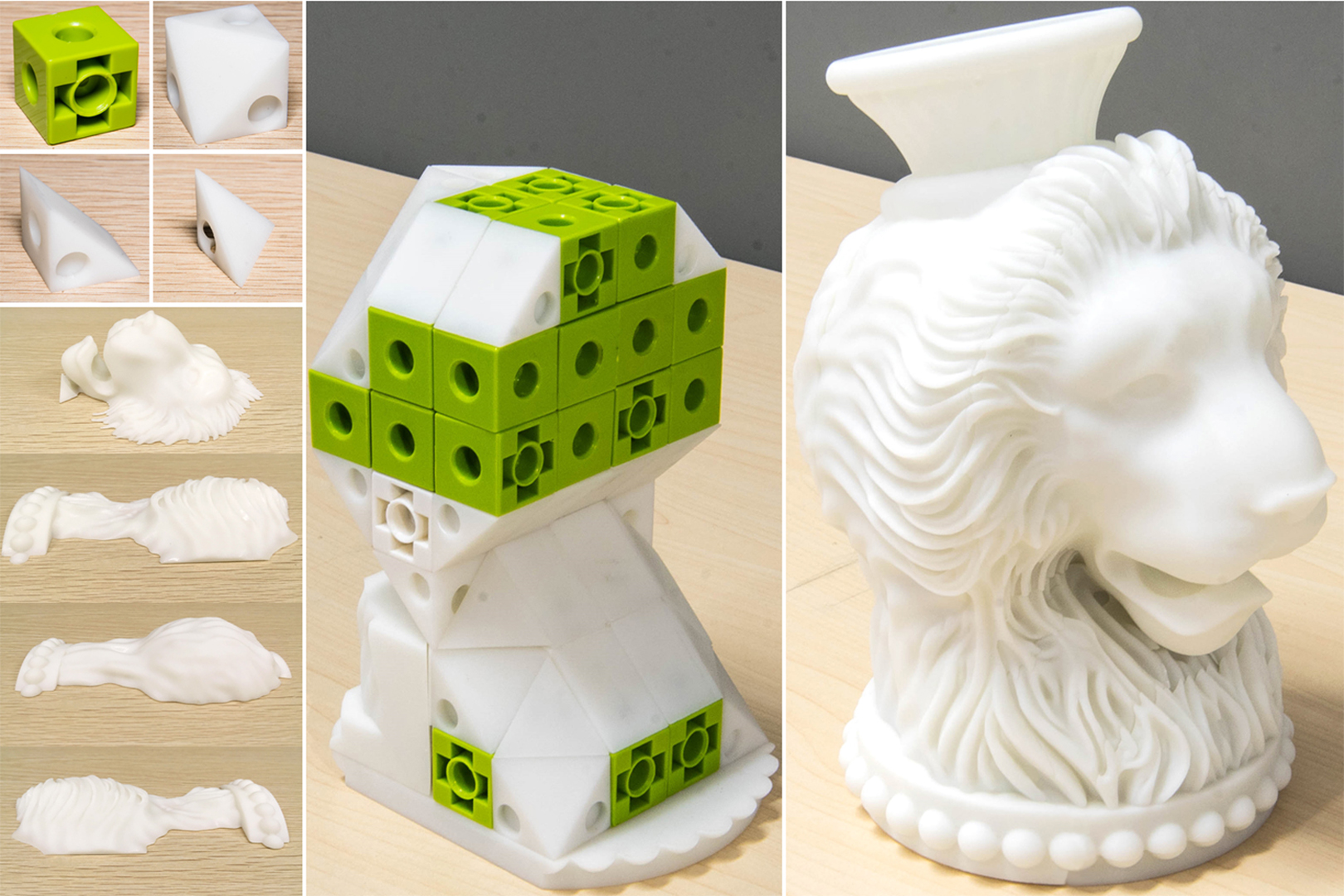
We introduce a computational solution for cost-efficient 3D fabrication using universal building blocks. Our key idea is to employ a set of universal blocks, which can be massively prefabricated at a low cost, to quickly assemble and constitute a significant internal core of the target object, so that only the residual volume need to be 3D printed online. We further improve the fabrication efficiency by decomposing the residual volume into a small number of printing-friendly pyramidal pieces. Computationally, we face a coupled decomposition problem: decomposing the input object into an internal core and residual, and decomposing the residual, to fulfill a combination of objectives for efficient 3D fabrication. To this end, we formulate an optimization that jointly minimizes the residual volume, the number of pyramidal residual pieces, and the amount of support waste when printing the residual pieces. To solve the optimization in a tractable manner, we start with a maximal internal core and iteratively refine it with local cuts to minimize the cost function. Moreover, to efficiently explore the large search space, we resort to cost estimates aided by pre-computation and avoid the need to explicitly construct pyramidal decompositions for each solution candidate. Results show that our method can iteratively reduce the estimated printing time and cost, as well as the support waste, and helps to save hours of fabrication time and much material consumption.
References:
1. Louis Bavoil and Kevin Myers. 2008. Order Independent Transparency with Dual Depth Peeling. Tech. rep., NVIDIA Corp.Google Scholar
2. Amit H. Bermano, Thomas Funkhouser, and Szymon Rusinkiewicz. 2017. State of the Art in Methods and Representations for Fabrication-Aware Design. Computer Graphics Forum (Eurographics) 36, 2 (2017), 509–535. STAR volume. Google ScholarDigital Library
3. Dustin Beyer, Serafima Gurevich, Stefanie Mueller, Hsiang-Ting Chen, and Patrick Baudisch. 2015. Platener: Low-fidelity Fabrication of 3D Objects by Substituting 3D Print with Laser-cut Plates (CHI ’15). 1799–1806. Google ScholarDigital Library
4. Xuelin Chen, Hao Zhang, Jinjie Lin, Ruizhen Hu, Lin Lu, Qixing Huang, Bedrich Benes, Daniel Cohen-Or, and Baoquan Chen. 2015. Dapper: Decompose-and-pack for 3D Printing. ACM Trans. on Graph. (SIGGRAPH Asia) 34, 6 (2015). Article No. 213. Google ScholarDigital Library
5. Michael Eigensatz, Martin Kilian, Alexander Schiftner, Niloy J. Mitra, Helmut Pottmann, and Mark Pauly. 2010. Paneling Architectural Freeform Surfaces. ACM Trans. on Graph. (SIGGRAPH) 29, 4 (2010). Article No. 45. Google ScholarDigital Library
6. Christer Ericson. 2004. Real-Time Collision Detection. CRC Press.Google Scholar
7. Cass Everitt. 2001. Interactive order-independent transparency. Tech. rep., NVIDIA Corp.Google Scholar
8. Chi-Wing Fu, Chi-Fu Lai, Ying He, and Daniel Cohen-Or. 2010. K-set Tilable Surfaces. ACM Trans. on Graph. (SIGGRAPH) 29, 4 (2010). Article No. 44. Google ScholarDigital Library
9. Philipp Herholz, Wojciech Matusik, and Marc Alexa. 2015. Approximating Free-form Geometry with Height Fields for Manufacturing. Computer Graphics Forum (Eurographics) 34, 2 (2015), 239–251. Google ScholarDigital Library
10. John Hertz, Richard G. Palmer, and Anders S. Krogh. 1991. Introduction to the Theory of Neural Computation (1st ed.). Perseus Publishing. Google ScholarDigital Library
11. Ruizhen Hu, Honghua Li, Hao Zhang, and Daniel Cohen-Or. 2014. Approximate Pyramidal Shape Decomposition. ACM Trans. on Graph. (SIGGRAPH Asia) 33, 6 (2014). Article No. 213. Google ScholarDigital Library
12. Alec Jacobson. 2017. Generalized Matryoshka: Computational Design of Nesting Objects. Computer Graphics Forum 36, 5 (2017), 27–35. Google ScholarDigital Library
13. Lin Lu, Andrei Sharf, Haisen Zhao, Yuan Wei, Qingnan Fan, Xuelin Chen, Yann Savoye, Changhe Tu, Daniel Cohen-Or, and Baoquan Chen. 2014. Build-to-last: Strength to weight 3D printed objects. ACM Trans. on Graph. (SIGGRAPH) 33, 4 (2014). Article No. 97. Google ScholarDigital Library
14. Linjie Luo, Ilya Baran, Szymon Rusinkiewicz, and Wojciech Matusik. 2012. Chopper: partitioning models into 3D-printable parts. ACM Trans. on Graph. (SIGGRAPH Asia) 31, 6 (2012). Article No. 129. Google ScholarDigital Library
15. Sheng-Jie Luo, Yonghao Yue, Chun-Kai Huang, Yu-Huan Chung, Sei Imai, Tomoyuki Nishita, and Bing-Yu Chen. 2015. Legolization: Optimizing LEGO Designs. ACM Trans. on Graph. 34, 6, Article 222 (2015), 222:1–222:12 pages. Google ScholarDigital Library
16. Stefanie Mueller, Tobias Mohr, Kerstin Guenther, Johannes Frohnhofen, and Patrick Baudisch. 2014. faBrickation: Fast 3D Printing of Functional Objects by Integrating Construction Kit Building Blocks (CHI ’14). 3827–3834. Google ScholarDigital Library
17. Romain Prévost, Emily Whiting, Sylvain Lefebvre, and Olga Sorkine-Hornung. 2013. Make it stand: balancing shapes for 3D fabrication. ACM Trans. on Graph. (SIGGRAPH) 32, 4 (2013). Article No. 81. Google ScholarDigital Library
18. Mayank Singh and Scott Schaefer. 2010. Triangle surfaces with discrete equivalence classes. ACM Trans. on Graph. (SIGGRAPH) 29, 4 (2010). Article No. 46. Google ScholarDigital Library
19. Peng Song, Bailin Deng, Ziqi Wang, Zhichao Dong, Wei Li, Chi-Wing Fu, and Ligang Liu. 2016. CofiFab: Coarse-to-Fine Fabrication of Large 3D Objects. ACM Trans. on Graph. (SIGGRAPH) 35, 4 (2016). Article No. 45. Google ScholarDigital Library
20. Ondrej Stava, Juraj Vanek, Bedrich Benes, Nathan Carr, and Radomír Měch. 2012. Stress relief: improving structural strength of 3D printable objects. ACM Trans. on Graph. (SIGGRAPH) 31, 4 (2012). Article No. 48. Google ScholarDigital Library
21. Ultimaker ltd. 2017. Cura Software. https://ultimaker.com/en/products/cura-softwareGoogle Scholar
22. Juraj Vanek, JA Galicia, Bedrich Benes, R Měch, N Carr, Ondrej Stava, and GS Miller. 2014. PackMerger: A 3D Print Volume Optimizer. Computer Graphics Forum 33, 6 (2014), 322–332. Google ScholarDigital Library
23. Lingfeng Wang and Emily Whiting. 2016. Buoyancy Optimization for Computational Fabrication. Computer Graphics Forum (Eurographics) 35, 2 (2016), 49–58.Google ScholarCross Ref
24. Weiming Wang, Tuanfeng Y Wang, Zhouwang Yang, Ligang Liu, Xin Tong, Weihua Tong, Jiansong Deng, Falai Chen, and Xiuping Liu. 2013. Cost-effective printing of 3D objects with skin-frame structures. ACM Trans. on Graph. (SIGGRAPH Asia) 32, 6 (2013). Article No. 177. Google ScholarDigital Library
25. Eric W. Weisstein. 2016. Space-Filling Polyhedron. From MathWorld—A Wolfram Web Resource. http://mathworld.wolfram.com/Space-FillingPolyhedron.html {Online; accessed 13-December-2016}.Google Scholar
26. Wikipedia. 2016. Prefabrication — Wikipedia, The Free Encyclopedia. https://en.wikipedia.org/w/index.php?title=Prefabrication {Online; accessed 4-December-2016}.Google Scholar
27. Miaojun Yao, Zhili Chen, Linjie Luo, Rui Wang, and Huamin Wang. 2015. Level-set-based Partitioning and Packing Optimization of a Printable Model. ACM Trans. on Graph. (SIGGRAPH Asia) 34, 6 (2015). Article No. 214. Google ScholarDigital Library
28. Xiaolong Zhang, Yang Xia, Jiaye Wang, Zhouwang Yang, Changhe Tu, and Wenping Wang. 2015. Medial axis tree – an internal supporting structure for 3D printing. Computer Aided Geometric Design 35 (2015), 149–162. Google ScholarDigital Library
29. Xuejin Zhao, Yayue Pan, Chi Zhou, Yong Chen, and Charlie C. L. Wang. 2013. An integrated CNC accumulation system for automatic building-around-inserts. Journal of Manufacturing Processes 15 (2013), 432–443.Google ScholarCross Ref
30. Henrik Zimmer, Florent Lafarge, Pierre Alliez, and Leif Kobbelt. 2014. Zometool shape approximation. Graphical Models 76, 5 (2014), 390–401. Google ScholarDigital Library