
“Light in power: a general and parameter-free algorithm for caustic design”
Conference:
Type(s):
Title:
- Light in power: a general and parameter-free algorithm for caustic design
Session/Category Title:
- Beyond light transport
Presenter(s)/Author(s):
Moderator(s):
Abstract:
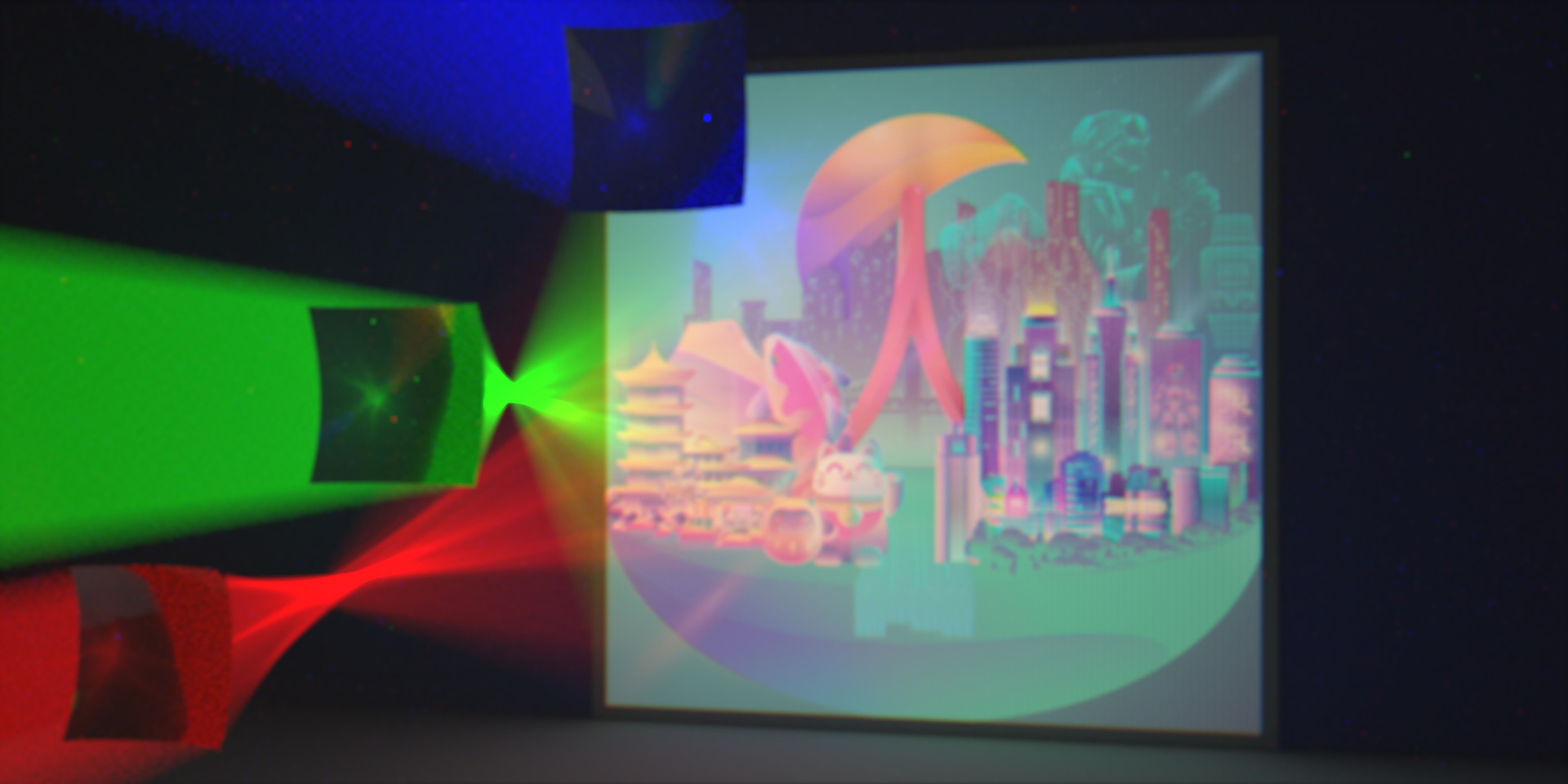
We present in this paper a generic and parameter-free algorithm to efficiently build a wide variety of optical components, such as mirrors or lenses, that satisfy some light energy constraints. In all of our problems, one is given a collimated or point light source and a desired illumination after reflection or refraction and the goal is to design the geometry of a mirror or lens which transports exactly the light emitted by the source onto the target. We first propose a general framework and show that eight different optical component design problems amount to solving a light energy conservation equation that involves the computation of visibility diagrams. We then show that these diagrams all have the same structure and can be obtained by intersecting a 3D Power diagram with a planar or spherical domain. This allows us to propose an efficient and fully generic algorithm capable to solve these eight optical component design problems. The support of the prescribed target illumination can be a set of directions or a set of points located at a finite distance. Our solutions satisfy design constraints such as convexity or concavity. We show the effectiveness of our algorithm on simulated and fabricated examples.
References:
1. Franz Aurenhammer. 1987. Power diagrams: properties, algorithms and applications. SIAM J. Comput. 16, 1 (1987), 78–96. Google ScholarDigital Library
2. L Caffarelli, S. Kochengin, and VI Oliker. 1999. On the numerical solution of the problem of reflector design with given far-field scattering data. Contemp. Math. 226 (1999), 13–32.Google ScholarCross Ref
3. Luis A Caffarelli, Cristian E Gutiérrez, and Qingbo Huang. 2008. On the regularity of reflector antennas. Annals of mathematics 167, 1 (2008), 299–323.Google ScholarCross Ref
4. L. A. Caffarelli and V. Oliker. 2008. Weak solutions of one inverse problem in geometric optics. Journal of Mathematical Sciences 154, 1 (2008), 39–49.Google ScholarCross Ref
5. F. Cork, D.F. Bettridge, and P.C. Clarke. 1977. Method of and mixture for aluminizing a metal surface. US Patent 4,009,146.Google Scholar
6. P. M. M. de Castro, Q. Mérigot, and B. Thibert. 2016. Far-field reflector problem and intersection of paraboloids. Numer. Math. 134, 2 (2016), 389–411. Google ScholarDigital Library
7. F. de Goes, K. Breeden, V. Ostromoukhov, and M. Desbrun. 2012. Blue noise through optimal transport. ACM Transactions on Graphics 31, 6 (2012), 171. Google ScholarDigital Library
8. M. Finckh, H. Dammertz, and H. Lensch. 2010. Geometry construction from caustic images. In Proceedings of the 11th European conference on Computer vision: Part V. Springer-Verlag, 464–477. Google ScholarDigital Library
9. T Glimm and V Oliker. 2003. Optical design of single reflector systems and the Monge-Kantorovich mass transfer problem. Journal of Mathematical Sciences 117, 3 (2003), 4096–4108.Google ScholarCross Ref
10. Cristian E Gutiérrez. 2016. The Monge-Ampère Equation. Vol. 89. Birkhäuser.Google Scholar
11. Cristian E Gutiérrez and Qingbo Huang. 2009. The refractor problem in reshaping light beams. Archive for rational mechanics and analysis 193, 2 (2009), 423–443.Google Scholar
12. Cristian E Gutiérrez and Federico Tournier. 2013. The parallel refractor. In From Fourier Analysis and Number Theory to Radon Transforms and Geometry. Springer, 325–334.Google Scholar
13. Thomas Kiser, Michael Eigensatz, Minh Man Nguyen, Philippe Bompas, and Mark Pauly. 2013. Architectural Caustics—Controlling Light with Geometry. In Advances in Architectural Geometry 2012. Springer, 91–106.Google Scholar
14. Jun Kitagawa, Quentin Mérigot, and Boris Thibert. 2016. A Newton algorithm for semi-discrete optimal transport. arXiv preprint arXiv:1603.05579 (2016).Google Scholar
15. B. Lévy. 2015. A numerical algorithm for L2 semi-discrete optimal transport in 3D. ESAIM: Mathematical Modelling and Numerical Analysis 49, 6 (2015), 1693–1715.Google ScholarCross Ref
16. S. Lloyd. 1982. Least squares quantization in PCM. IEEE transactions on information theory 28, 2 (1982), 129–137. Google ScholarDigital Library
17. Q. Mérigot. 2011. A multiscale approach to optimal transport. Computer Graphics Forum 30, 5 (2011), 1583–1592.Google ScholarCross Ref
18. J.-M. Mirebeau. 2015. Discretization of the 3d monge- ampere operator, between wide stencils and power diagrams. ESAIM: Mathematical Modelling and Numerical Analysis 49, 5 (2015), 1511–1523.Google ScholarCross Ref
19. M. Papas, W. Jarosz, We. Jakob, S. Rusinkiewicz, W. Matusik, and T. Weyrich. 2011. Goal-based Caustics. Computer Graphics Forum 30, 2 (2011), 503–511.Google ScholarCross Ref
20. G. Patow and X. Pueyo. 2005. A survey of inverse surface design from light transport behavior specification. Computer Graphics Forum 24, 4 (2005), 773–789.Google ScholarCross Ref
21. M. Piovarči, M. Wessely, M. Jagielski, M. Alexa, W. Matusik, and P. Didyk. 2017. Directional screens. In Proceedings of the 1st Annual ACM Symposium on Computational Fabrication. ACM, 1. Google ScholarDigital Library
22. CR Prins, Thije Boonkkamp, van J Jarno Roosmalen, WL IJzerman, and TW Tukker. 2013. A numerical method for the design of free-form reflectors for lighting applications. (2013). Technische Universiteit Eindhoven.Google Scholar
23. Y. Schwartzburg, R. Testuz, A. Tagliasacchi, and M. Pauly. 2014. High-contrast computational caustic design. ACM Transactions on Graphics (TOG) 33, 4 (2014), 74. Google ScholarDigital Library
24. X.J. Wang. 2004. On the design of a reflector antenna II. Calculus of Variations and Partial Differential Equations 20, 3 (2004), 329–341.Google ScholarCross Ref
25. T. Weyrich, P. Peers, W. Matusik, and S. Rusinkiewicz. 2009. Fabricating microgeometry for custom surface reflectance. ACM Transactions on Graphics 28, 3 (2009), 32. Google ScholarDigital Library
26. Yonghao Yue, Kei Iwasaki, Bing-Yu Chen, Yoshinori Dobashi, and Tomoyuki Nishita. 2012. Pixel art with refracted light by rearrangeable sticks. Computer Graphics Forum 31, 2pt3 (2012), 575–582. Google ScholarDigital Library
27. Yonghao Yue, Kei Iwasaki, Bing-Yu Chen, Yoshinori Dobashi, and Tomoyuki Nishita. 2014. Poisson-based continuous surface generation for goal-based caustics. ACM Transactions on Graphics 33, 3 (2014), 31. Google ScholarDigital Library



