
“Estimating dual-scale properties of glossy surfaces from step-edge lighting”
Conference:
Type(s):
Title:
- Estimating dual-scale properties of glossy surfaces from step-edge lighting
Session/Category Title:
- Cameras and Appearance
Presenter(s)/Author(s):
Abstract:
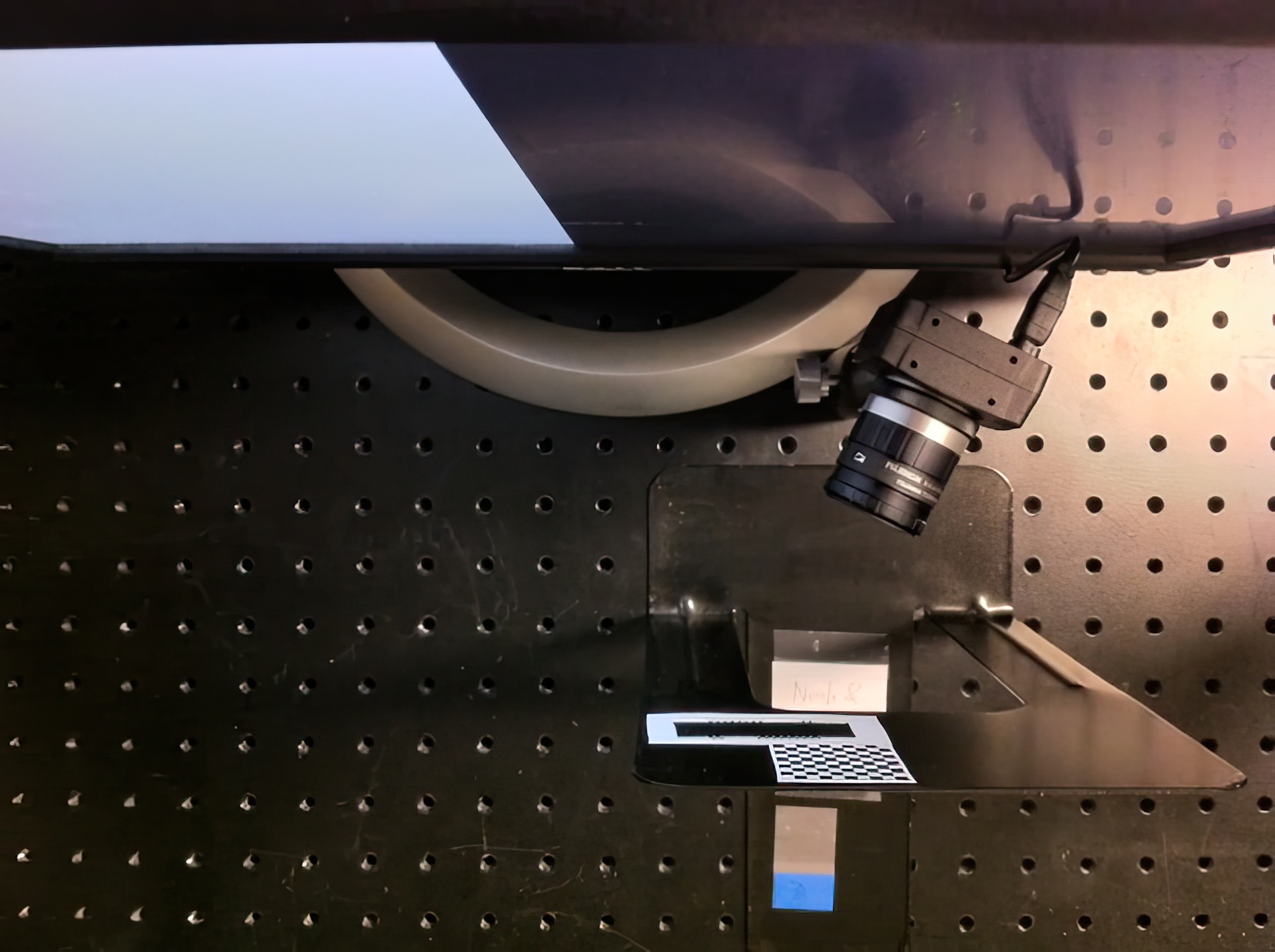
This paper introduces a rapid appearance capture method suited for a variety of common indoor surfaces, in which a single photograph of the reflection of a step edge is used to estimate both a BRDF and a statistical model for visible surface geometry, or mesostructure. It is applicable to surfaces with statistically stationary variation in surface height, even when these variations are large enough to produce visible texture in the image. Results are shown from a prototype system using a separate camera and LCD, demonstrating good visual matches for a range of man-made indoor materials.
References:
1. Bouguet, J., 2010. Camera calibration toolbox for Matlab. http://www.vision.caltech.edu/bouguetj/calib_doc/.Google Scholar
2. Chen, T., Goesele, M., and Seidel, H. P. 2006. Mesostructure from specularity. In Proc. IEEE Conf. Computer Vision and Pattern Recognition, 1825–1832. Google ScholarDigital Library
3. Cook, R. L., and Torrance, K. E. 1981. A reflectance model for computer graphics. Computer Graphics (Proc. SIGGRAPH) 15, 3, 307–316. Google ScholarDigital Library
4. Dana, K. J., van Ginneken, B., Nayar, S. K., and Koenderink, J. J. 1999. Reflectance and texture of real-world surfaces. ACM Trans. Graphics 18, 1, 1–34. Google ScholarDigital Library
5. Dong, Y., Wang, J., Tong, X., Snyder, J., Lan, Y., Ben-Ezra, M., and Guo, B. 2010. Manifold bootstrapping for SVBRDF capture. ACM Trans. Graphics 29, 4. Google ScholarDigital Library
6. Dror, R. O., Adelson, E. H., and Willsky, A. S. 2001. Recognition of surface reflectance properties from a single image under unknown real-world illumination. In Proc. IEEE Workshop on Identifying Objects across Variations in Lighting.Google Scholar
7. Francken, Y., Cuypers, T., and Bekaert, P. 2008. Mesostructure from specularity using gradient illumination. In Proc. Int. Workshop on Projector Camera Systems. Google ScholarDigital Library
8. Francken, Y., Cuypers, T., Mertens, T., Gielis, J., and Bekaert, P. 2008. High quality mesostructure acquisition using specularities. In Proc. IEEE Conf. Computer Vision and Pattern Recognition.Google Scholar
9. Galerne, B., Gousseau, Y., and Morel, J. 2011. Random phase textures: Theory and synthesis. IEEE Trans. Image Processing 20, 1, 257–267. Google ScholarDigital Library
10. Gardner, A., Tchou, C., Hawkins, T., and Debevec, P. 2003. Linear light source reflectometry. In Proc. SIGGRAPH, 749–758. Google ScholarDigital Library
11. Georghiades, A. S. 2003. Recovering 3-D shape and reflectance from a small number of photographs. In Proc. Eurographics Workshop on Rendering, 230–240. Google ScholarDigital Library
12. Ghosh, A., Chen, T., Peers, P., Wilson, C. A., and Debevec, P. 2009. Estimating specular roughness and anisotropy from second order spherical gradient illumination. Computer Graphics Forum 28, 4, 1161–1170. Google ScholarDigital Library
13. Ghosh, A., Chen, T., Peers, P., Wilson, C. A., and Debevec, P. 2010. Circularly polarized spherical illumination reflectometry. ACM Trans. Graphics 29, 6, 162–173. Google ScholarDigital Library
14. Han, C., Sun, B., Ramamoorthi, R., and Grinspun, E. 2007. Frequency domain normal map filtering. ACM Trans. Graph. 26, 3. Google ScholarDigital Library
15. Johnson, M. K., and Adelson, E. H. 2009. Retrographic sensing for the measurement of surface texture and shape. In Proc. IEEE Conf. Computer Vision and Pattern Recognition, 1070–1077.Google Scholar
16. Julesz, B. 1962. Visual pattern discrimination. IRE Trans. Information Theory 8, 2, 84–92.Google ScholarCross Ref
17. Kautz, J., Vázquez, P.-P., Heidrich, W., and Seidel, H.-P. 2000. A unified approach to prefiltered environment maps. In Proc. Eurographics Workshop on Rendering, 185–196. Google ScholarDigital Library
18. Marschner, S. R., Westin, S. H., Lafortune, E. P., Torrance, K. E., and Greenberg, D. P. 1999. Image-based BRDF measurement including human skin. In Proc. Eurographics Workshop on Rendering, 139–152. Google ScholarDigital Library
19. Ngan, A., Durand, F., and Matusik, W. 2005. Experimental analysis of BRDF models. In Proc. Eurographics Symposium on Rendering, 117–126. Google ScholarDigital Library
20. Paterson, J. A., Claus, D., and Fitzgibbon, A. W. 2005. BRDF and geometry capture from extended inhomogeneous samples using flash photography. Computer Graphics Forum 24, 3, 383–391.Google ScholarCross Ref
21. Perlin, K. 1985. An image synthesizer. Computer Graphics (Proc. SIGGRAPH) 19, 3, 287–296. Google ScholarDigital Library
22. Pharr, M., and Humphreys, G. 2010. Physically Based Rendering: From Theory to Implementation, 2nd ed. Morgan Kaufmann. Google ScholarDigital Library
23. Ramamoorthi, R., and Hanrahan, P. 2001. A signal-processing framework for inverse rendering. In Proc. SIGGRAPH, 117–128. Google ScholarDigital Library
24. Randen, T., and Husoy, J. H. 1999. Filtering for texture classification: A comparative study. IEEE Trans. Pattern Analysis and Machine Intelligence 21, 4, 291–310. Google ScholarDigital Library
25. Romeiro, F., and Zickler, T. 2010. Blind reflectometry. In Proc. European Conf. Computer Vision. Springer, 45–58. Google ScholarDigital Library
26. Torrance, K. E., and Sparrow, E. M. 1967. Theory for off-specular reflection from roughened surfaces. Journal of the Optical Society of America 57, 9, 1105–1112.Google ScholarCross Ref
27. Tuceryan, M., and Jain, A. K. 1993. Texture analysis. In Handbook of Pattern Recognition and Computer Vision. World Scientific, ch. 2.1. Google ScholarDigital Library
28. Wang, J., and Dana, K. J. 2006. Relief texture from specularities. IEEE Trans. Pattern Analysis and Machine Intelligence 28, 3, 446–457. Google ScholarDigital Library
29. Ward, G. J. 1992. Measuring and modeling anisotropic reflection. Computer Graphics (Proc. SIGGRAPH) 26, 2, 265–272. Google ScholarDigital Library
30. Woodham, R. J. 1980. Photometric method for determining surface orientation from multiple images. Optical Engineering 19, 1, 139–144.Google ScholarCross Ref
31. X-Rite, I., 2011. MA98 portable multi-angle spectrophotometer. www.xrite.com/product_overview.aspx?ID=1148.Google Scholar
32. Yu, Y., Debevec, P., Malik, J., and Hawkins, T. 1999. Inverse global illumination: Recovering reflectance models of real scenes from photographs. In Proc. SIGGRAPH, 215–224. Google ScholarDigital Library
33. Zickler, T., Ramamoorthi, R., Enrique, S., and Belhumeur, P. N. 2006. Reflectance sharing: Predicting appearance from a sparse set of images of a known shape. IEEE Trans. Pattern Analysis and Machine Intelligence 28, 8, 1287–1302. Google ScholarDigital Library



