
“Interactive hybrid simulation of large-scale traffic”
Conference:
Type(s):
Title:
- Interactive hybrid simulation of large-scale traffic
Session/Category Title:
- Contact, Collision and Congestion
Presenter(s)/Author(s):
Abstract:
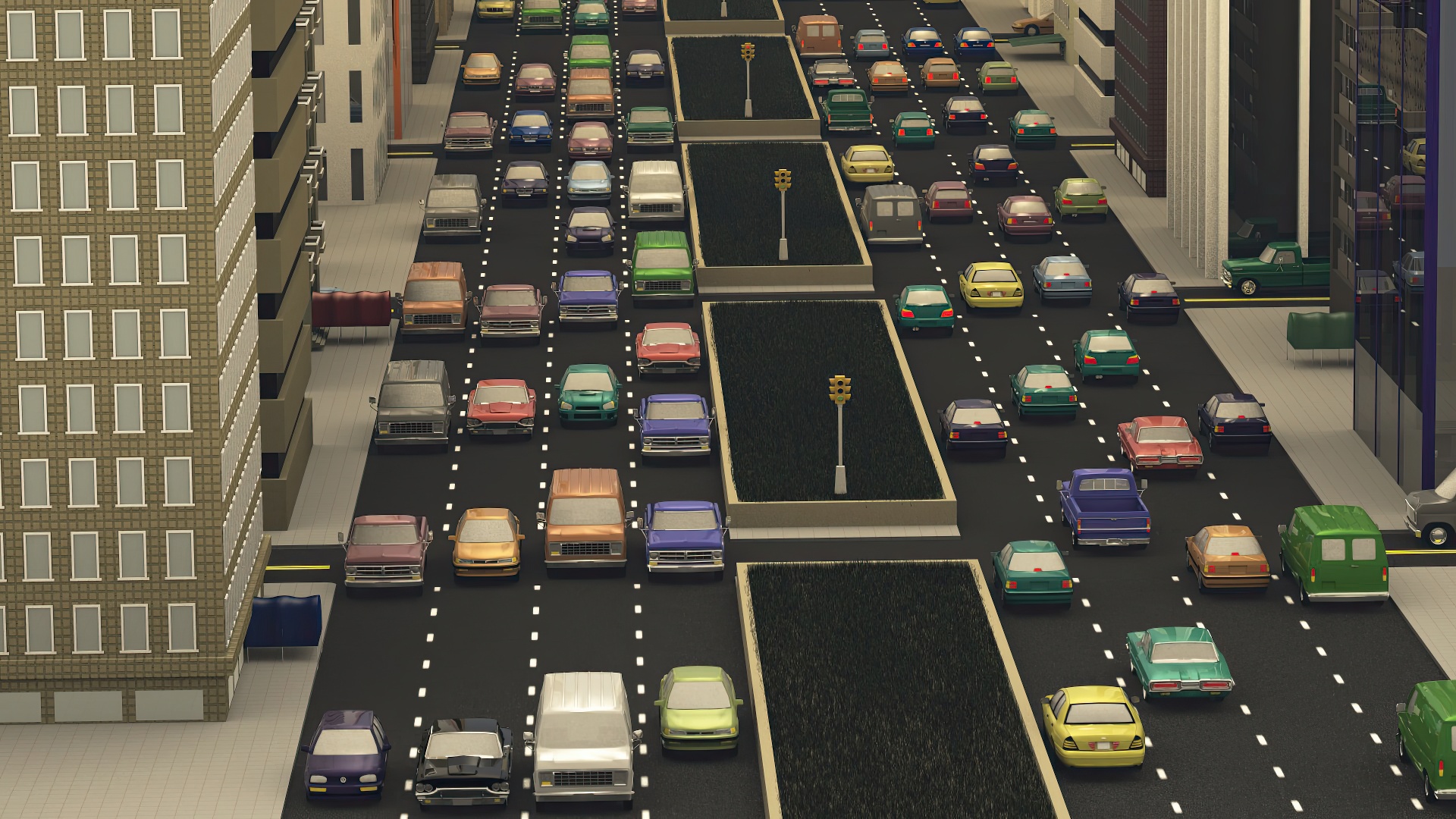
We present a novel, real-time algorithm for modeling large-scale, realistic traffic using a hybrid model of both continuum and agent-based methods for traffic simulation. We simulate individual vehicles in regions of interest using state-of-the-art agent-based models of driver behavior, and use a faster continuum model of traffic flow in the remainder of the road network. Our key contributions are efficient techniques for the dynamic coupling of discrete vehicle simulation with the aggregated behavior of continuum techniques for traffic simulation. We demonstrate the flexibility and scalability of our interactive visual simulation technique on extensive road networks using both real-world traffic data and synthetic scenarios. These techniques demonstrate the applicability of hybrid techniques to the efficient simulation of large-scale flows with complex dynamics.
References:
1. Algers, S., Bernauer, E., Boero, M., Breheret, L., Taranto, C. D., Dougherty, M., Fox, K., and Gabard, J. F. 1997. SMARTEST project: Review of micro-simulation models. EU project No: RO-97-SC 1059.Google Scholar
2. Aw, A., and Rascle, M. 2000. Resurrection of “second order” models of traffic flow. SIAM journal on applied mathematics 60, 916–938. Google ScholarDigital Library
3. Burggraf, O. 1966. Analytical and numerical studies of the structure of steady separated flows. J. of Fluid Mechanics 24, 01, 113–151.Google ScholarCross Ref
4. Chen, L., Özsu, M., and Oria, V. 2005. Robust and fast similarity search for moving object trajectories. In SIGMOD, ACM, 491–502. Google ScholarDigital Library
5. Chen, G., Esch, G., Wonka, P., Mueller, P., and Zhang, E. 2008. Interactive procedural street modeling. In SIGGRAPH 2008, ACM, New York, NY, USA. Google ScholarDigital Library
6. Cremer, J., Kearney, J., and Willemsen, P. 1997. Directable behavior models for virtual driving scenarios. Trans. Soc. Comput. Simul. Int. 14, 2, 87–96. Google ScholarDigital Library
7. Daganzo, C. 1995. Requiem for second-order fluid approximations of traffic flow. Trans. Research Part B 29, 4, 277–286.Google ScholarCross Ref
8. Devroye, L. 1986. Non-Uniform Random Variate Generatiom. Springer-Verlag.Google Scholar
9. Donikian, S., Moreau, G., and Thomas, G. 1999. Multimodal driving simulation in realistic urban environments. Progress in System and Robot Analysis and Control Design (LNCIS) 243, 321–332.Google Scholar
10. Galin, E., Peytavie, A., Maréchal, N., and Guérin, E. 2010. Procedural generation of roads. In Eurographics 2010.Google Scholar
11. Gerlough, D. L. 1955. Simulation of freeway traffic on a general-purpose discrete variable computer. PhD thesis, UCLA.Google Scholar
12. Go, J., Vu, T., and Kuffner, J. 2005. Autonomous behaviors for interactive vehicle animations. In Intl. J. of Graphical Models. Google ScholarDigital Library
13. Guy, S., Chhugani, J., Curtis, S., Dubey, P., Lin, M. C., and Manocha, D. 2010. PLEdestrians: A Least-Effort Approach to Crowd Simulation. In EG/ACM SCA. Google ScholarDigital Library
14. Helbing, D. 2001. Traffic and related self-driven many-particle systems. Reviews of Modern Physics 73, 4, 1067–1141.Google ScholarCross Ref
15. Hirschfelder, J. O., Curtiss, C. F., and Bird, R. B. 1964. The Molecular Theory of Gases and Liquids, revised edition ed. Wiley-Interscience.Google Scholar
16. Hochbaum, D. S., and Shmoys, D. B. 1987. Using dual approximation algorithms for scheduling problems: Theoretical and practical results. Journal of the ACM 34, 1 (January), 144–162. Google ScholarDigital Library
17. Kim, K., Oh, S., Lee, J., and Essa, I. 2009. Augmenting aerial earth maps with dynamic information. In IEEE International Symposium on Mixed and Augmented Reality. Google ScholarDigital Library
18. Lebacque, J., Mammar, S., and Haj-Salem, H. 2007. The Aw–Rascle and Zhangs model: Vacuum problems, existence and regularity of the solutions of the Riemann problem. Trans. Research Part B 41, 7, 710–721.Google ScholarCross Ref
19. Lewis, P. A. W., and Shedler, G. S. 1979. Simulation of non-homogeneous poisson processes by thinning. Naval Research Logistics Quaterly 26, 403–413.Google ScholarCross Ref
20. Lighthill, M. J., and Whitham, G. B. 1955. On kinematic waves. ii. a theory of traffic flow on long crowded roads. Proceedings of the Royal Society of London A229, 1178 (May), 317–345.Google Scholar
21. 2011. MITSIM. MIT Intelligent Transportation Systems.Google Scholar
22. Morse, M., and Patel, J. 2007. An efficient and accurate method for evaluating time series similarity. In ACM SIGMOD, ACM, 569–580. Google ScholarDigital Library
23. Nagel, K., and Schreckenberg, M. 1992. A cellular automaton model for freeway traffic. Journal de Physique I 2, 12 (December), 2221–2229.Google Scholar
24. Narain, R., Golas, A., Curtis, S., and Lin, M. C. 2009. Aggregate dynamics for dense crowd simulation. ACM SIGGRAPH Asia. Google ScholarDigital Library
25. Newell, G. 1961. Nonlinear effects in the dynamics of car following. Operations Research 9, 2, 209–229.Google ScholarDigital Library
26. Pausch, R., Crea, T., and Conway, M. 1992. A literature survey for virtual environments – military flight simulator visual systems and simulator sickness. Presence: Teleoperators and Virtual Environments 1, 3, 344–363. Google ScholarDigital Library
27. Payne, H. J. 1971. Models of freeway traffic and control. Mathematical Models of Public Systems 1, 51–60. Part of the Simulation Councils Proceeding Series.Google Scholar
28. Pelechano, N., Allbeck, J. M., and Badler, N. I. 2008. Virtual Crowds: Methods, Simulation and Control. Morgan and Claypool Publishers. Google ScholarDigital Library
29. Pettré, J., Kallmann, M., and Lin, M. C. 2008. Motion planning and autonomy for virtual humans. In ACM SIGGRAPH 2008 classes, 1–31. Google ScholarDigital Library
30. Reggio, G., 1982. Koyaanisqatsi. Film, Oct. MGM Studios.Google Scholar
31. Reynolds, C. 1987. Flocks, herds and schools: A distributed behavioral model. In SIGGRAPH, ACM New York, NY, USA, 25–34. Google ScholarDigital Library
32. Richards, P. I. 1956. Shock waves on the highway. Operations Research 4, 1, 42–51.Google ScholarDigital Library
33. Sewall, J., Wilkie, D., Merrell, P., and Lin, M. C. 2010. Continuum traffic simulation. In Eurographics 2010.Google Scholar
34. Sewall, J., van den Berg, J., Lin, M. C., and Manocha, D. 2011. Virtualized traffic: Reconstructing traffic flows from discrete spatiotemporal data. IEEE TVCG 17, 26–37. doi = http://doi.ieeecomputersociety.org/10.1109/TVCG.2010.27. Google ScholarDigital Library
35. 2009. SUMO — Simulation of Urban MObility, October.Google Scholar
36. Treiber, M., Hennecke, A., and Helbing, D. 2000. Congested traffic states in empirical observations and microscopic simulations. Physical Review E 62, 2, 1805–1824.Google ScholarCross Ref
37. Treuille, A., Cooper, S., and Popović, Z. 2006. Continuum crowds. In SIGGRAPH, ACM New York, NY, USA, 1160–1168. Google ScholarDigital Library
38. Wang, H., Kearney, J., Cremer, J., and Willemsen, P. 2005. Steering behaviors for autonomous vehicles in virtual environments. In Proc. IEEE Virtual Reality Conf., 155–162. Google ScholarDigital Library
39. Whitham, G. B. 1974. Linear and nonlinear waves. John Wiley and Sons, New York, New York.Google Scholar
40. Wilkie, D., Sewall, J., and Lin, M. C. 2011. Transforming gis data into functional road models for large-scale traffic simulation. IEEE TVCG. doi = http://doi.ieeecomputersociety.org/10.1109/TVCG.2011.116. Google ScholarDigital Library
41. Zhang, H. 2002. A non-equilibrium traffic model devoid of gaslike behavior. Trans. Research Part B 36, 3, 275–290.Google ScholarCross Ref



