“Multi-resolution isotropic strain limiting”
Conference:
Type(s):
Title:
- Multi-resolution isotropic strain limiting
Session/Category Title:
- From rigid to soft
Presenter(s)/Author(s):
Moderator(s):
Abstract:
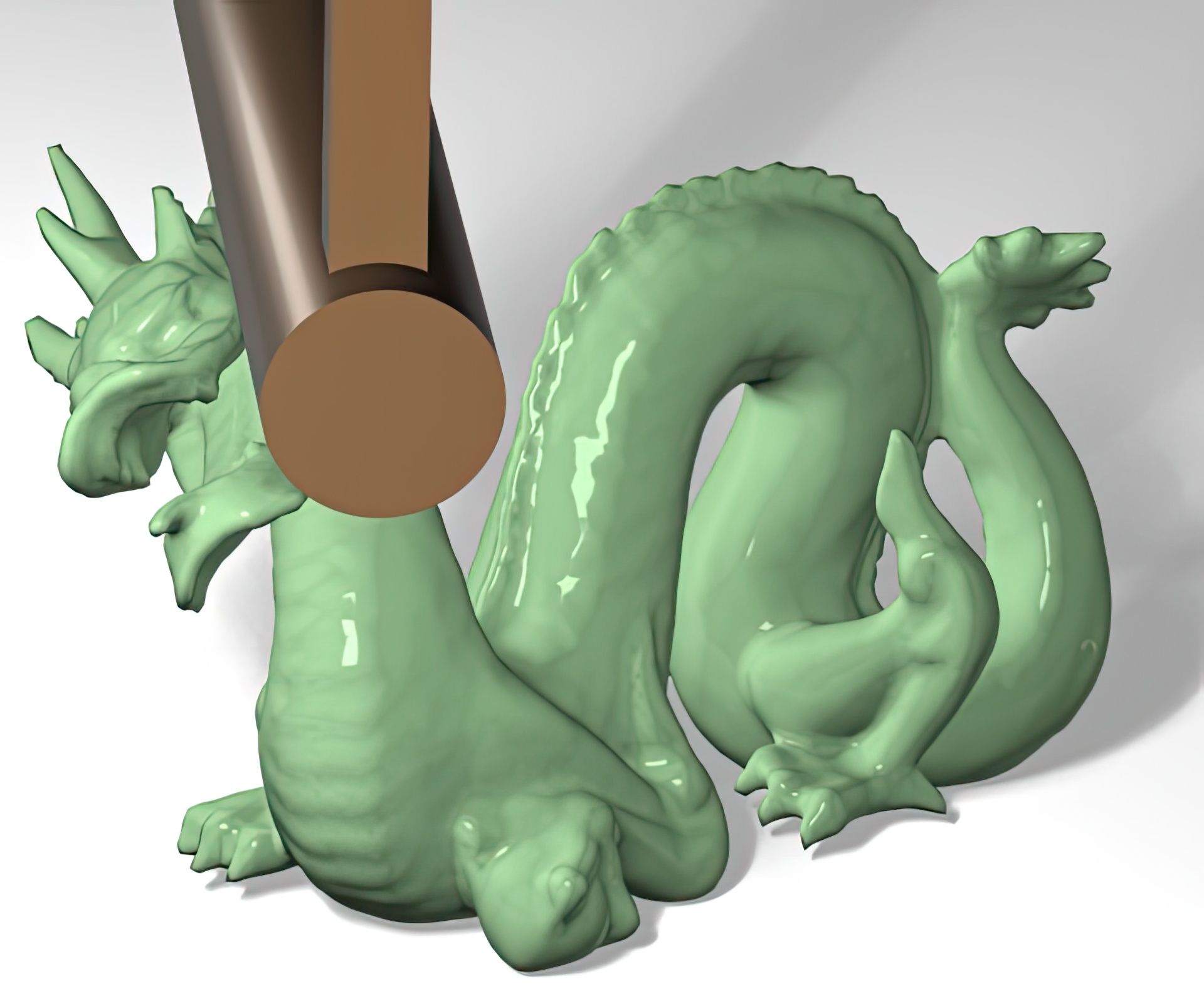
In this paper we describe a fast strain-limiting method that allows stiff, incompliant materials to be simulated efficiently. Unlike prior approaches, which act on springs or individual strain components, this method acts on the strain tensors in a coordinate-invariant fashion allowing isotropic behavior. Our method applies to both two-and three-dimensional strains, and only requires computing the singular value decomposition of the deformation gradient, either a small 2×2 or 3×3 matrix, for each element. We demonstrate its use with triangular and tetrahedral linear-basis elements. For triangulated surfaces in three-dimensional space, we also describe a complementary edge-angle-limiting method to limit out-of-plane bending. All of the limits are enforced through an iterative, non-linear, Gauss-Seidel-like constraint procedure. To accelerate convergence, we propose a novel multi-resolution algorithm that enforces fitted limits at each level of a non-conforming hierarchy. Compared with other constraint-based techniques, our isotropic multi-resolution strain-limiting method is straightforward to implement, efficient to use, and applicable to a wide range of shell and solid materials.
References:
1. Bridson, R., Marino, S., and Fedkiw, R. 2003. Simulation of clothing with folds and wrinkles. In Proc. of SCA 2003, 28–36. Google ScholarDigital Library
2. Chentanez, N., Alterovitz, R., Ritchie, D., Cho, L., Hauser, K. K., Goldberg, K., Shewchuk, J. R., and O’Brien, J. F. 2009. Interactive simulation of surgical needle insertion and steering. In Proc. of ACM SIGGRAPH 2009. Google ScholarDigital Library
3. Choi, M.-H., Hong, M., and Welch, S. 2004. Modeling and simulation of sharp creases. In ACM SIGGRAPH 2004 Sketches, 95. Google ScholarDigital Library
4. Desbrun, M., Schröder, P., and Barr, A. 1999. Interactive animation of structured deformable objects. In Proc. of Graphics interface 1999, 1–8. Google ScholarDigital Library
5. English, E., and Bridson, R. 2008. Animating developable surfaces using nonconforming elements. In Proc. of ACM SIGGRAPH 2008, vol. 27, 1–5. Google ScholarDigital Library
6. Etzmuß, O., Keckeisen, M., and Straßer, W. 2003. A fast finite element solution for cloth modelling. In Proc. of Pacific Graphics 2003, 244. Google ScholarDigital Library
7. Forsyth, C. J., and Simpson, J. 2008. Everything changes once you hang: Flesh hook suspension. Deviant Behavior 29, 4 (May), 367–387.Google ScholarCross Ref
8. Garg, A., Grinspun, E., Wardetzky, M., and Zorin, D. 2007. Cubic shells. In Proc. of SCA 2007, 91–98. Google ScholarDigital Library
9. Garland, M., and Heckbert, P. S. 1997. Surface simplification using quadric error metrics. In Proc. of ACM SIGGRAPH 1997, 209–216. Google ScholarDigital Library
10. Gibson, S. F. F., and Mirtich, B. 1997. A survey of deformable modeling in computer graphics. Tech. rep., Mitsubishi Electric Research Laboratories.Google Scholar
11. Goldenthal, R., Harmon, D., Fattal, R., Bercovier, M., and Grinspun, E. 2007. Efficient Simulation of Inextensible Cloth. In Proc. of ACM SIGGRAPH 2007, vol. 26, 49. Google ScholarDigital Library
12. Goodfellow, G. E. 1887. Notes on the impenetrability of silk to bullets. Southern California Practitioner.Google Scholar
13. Grinspun, E., Hirani, A. N., Desbrun, M., and Schröder, P. 2003. Discrete shells. In Proc. of SCA 2003, 62–67. Google ScholarDigital Library
14. Irving, G., Teran, J., and Fedkiw, R. 2004. Invertible finite elements for robust simulation of large deformation. In Proc. of SCA 2004, 131–140. Google ScholarDigital Library
15. Irving, G., Schroeder, C., and Fedkiw, R. 2007. Volume conserving finite element simulations of deformable models. In Proc. of ACM SIGGRAPH 2007, ACM, New York, NY, USA, vol. 26, 13. Google ScholarDigital Library
16. Klingner, B. M., and Shewchuk, J. R. 2007. Agressive tetrahedral mesh improvement. In Proceedings of the 16th International Meshing Roundtable, 3–23.Google Scholar
17. Müller, M., and Gross, M. 2004. Interactive virtual materials. In Proceedings of Graphics Interface 2004, 239–246. Google ScholarDigital Library
18. Müller, M. 2008. Hierarchical position based dynamics. In Proc. of Virtual Reality Interactions and Physical Simulations.Google Scholar
19. Nealen, A., Müller, M., Keiser, R., Boxerman, E., and Carlson, M. 2005. Physically based deformable models in computer graphics. Tech. rep., Eurogrphics 2005 state of the art report.Google Scholar
20. O’Brien, J. F., and Hodgins, J. K. 1999. Graphical modeling and animation of brittle fracture. In Proc. of ACM SIGGRAPH 1999, 137–146. Google ScholarDigital Library
21. Otaduy, M. A., Germann, D., Redon, S., and Gross, M. 2007. Adaptive deformations with fast tight bounds. In Proc. of SCA 2007. Google ScholarDigital Library
22. Provot, X. 1995. Deformation constraints in a mass-spring model to describe rigid cloth behavior. In Graphics Interface ’95, 147–154.Google Scholar
23. Si, H., 2010. A quality tetrahedral mesh generator and a 3d delaunay triangulator. http://tetgen.berlios.de/.Google Scholar
24. Teran, J., Blemker, S., Hing, V. N. T., and Fedkiw, R. 2003. Finite volume methods for the simulation of skeletal muscle. In Proc. of SCA 2003, 68–74. Google ScholarDigital Library
25. Terzopoulos, D., Platt, J., Barr, A., and Fleischer, K. 1987. Elastically deformable models. In Proceedings of ACM SIGGRAPH 1987, vol. 21, 205–214. Google ScholarDigital Library
26. Thomaszewski, B., Pabst, S., and Strasser, W. 2009. Continuum-based strain limiting. In Proc. of Eurographics 2009, vol. 28, 569–576.Google Scholar
27. Tsiknis, K. D., 2006. Better cloth through unbiased strain limiting and physics-aware subdivision. Master thesis, The University of British Columbia.Google Scholar
28. Volino, P., Magnenat-Thalmann, N., and Faure, F. 2009. A simple approach to nonlinear tensile stiffness for accurate cloth simulation. ACM Trans. Graph. 28, 4, 1–16. Google ScholarDigital Library