
“VWind: Virtual Wind Sensation to the Ear by Cross-Modal Effects of Audio-Visual, Thermal, and Vibrotactile Stimuli” by Hosoi, Ban, Ito and Warisawa
Conference:
Experience Type(s):
Title:
- VWind: Virtual Wind Sensation to the Ear by Cross-Modal Effects of Audio-Visual, Thermal, and Vibrotactile Stimuli
Organizer(s)/Presenter(s):
Description:
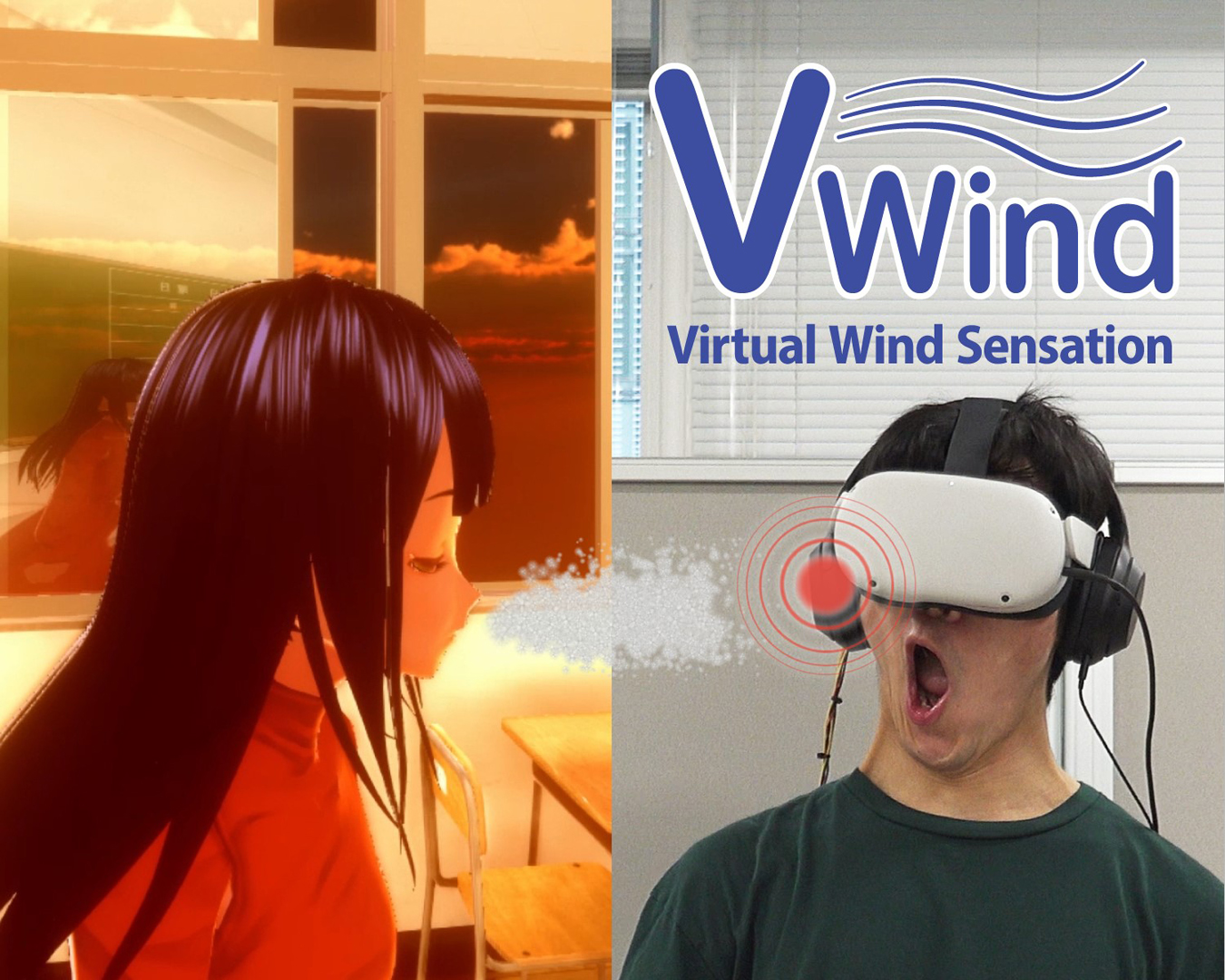
We propose to present virtual wind sensation by cross-modal effects. We developed VWind, a wearable headphone-type device to give vibrotactile and thermal stimuli in addition to visual scenarios and binaural sounds. We prepared the demonstrations as if users were blown to the ear or exposed to freezing winds.
References:
[1] Shimon Akiyama, Katsunari Sato, 2013. ThermOn: Thermo-Musical Interface for an Enhanced Emotional Experience. In Proc. of the 2013 International Symposium on Wearable Computers(ISWC ’13). 45–52. https://doi.org/10.1145/2493988.2494326
[2] Teng Han, Sirui Wang, 2020. Mouillé: Exploring Wetness Illusion on Fingertips to Enhance Immersive Experience in VR. In Proc. of the 2020 CHI Conference on Human Factors in Computing Systems(CHI ’20). 1–10. https://doi.org/10.1145/3313831.3376138
[3] Morton L. Heilig. 1962. Sensorama simulator. US Patent 3050870.
[4] Yuichiro Kojima, Yuki Hashimoto, 2009. A Novel Wearable Device to Present Localized Sensation of Wind. In Proc. of the International Conference on Advances in Computer Enterntainment Technology(ACE ’09). 61–65. https://doi.org/10.1145/1690388.1690399
[5] Taeyong Moon and Gerard J. Kim. 2004. Design and Evaluation of a Wind Display for Virtual Reality. In Proc. of the ACM Symposium on Virtual Reality Software and Technology(VRST ’04). 122–128. https://doi.org/10.1145/1077534.1077558
[6] Takuji Narumi, Akagawa Tomohiro, 2009. Characterizing the Space by Thermal Feedback through a Wearable Device. In Virtual and Mixed Reality, Randall Shumaker (Ed.). 355–364. https://doi.org/10.1007/978-3-642-02771-0_40
[7] Roshan Lalintha Peiris, Liwei Chan, 2018. LiquidReality: Wetness Sensations on the Face for Virtual Reality. In Haptics: Science, Technology, and Applications. 366–378. https://doi.org/10.1007/978-3-319-93399-3_32
[8] Nimesha Ranasinghe, Pravar Jain, Shienny Karwita, 2017. Ambiotherm: Enhancing Sense of Presence in Virtual Reality by Simulating Real-World Environmental Conditions. In Proc. of the 2017 CHI Conference on Human Factors in Computing Systems. 1731–1742. https://doi.org/10.1145/3025453.3025723
[9] Michael Rietzler, Katrin Plaumann, 2017. VaiR: Simulating 3D Airflows in Virtual Reality. In Proc. of the 2017 CHI Conference on Human Factors in Computing Systems(CHI ’17). 5669–5677. https://doi.org/10.1145/3025453.3026009
[10] Masatoshi Suzuki and Akihiro Matsuura. 2019. Windtherm: A Wearable VR Device That Provides Temperature-Controlled Wind. In Proc. of Virtual Reality International Conference (VRIC). 39–44. https://doi.org/10.20870/IJVR.2019.0.2920
[11] Robert B. Welch and David H. Warren. 1980. Immediate perceptual response to intersensory discrepancy. Psychological Bulletin 88, 3 (1980), 638–667. https://doi.org/10.1037/0033-2909.88.3.638
[12] Jiayi Xu, Yoshihiro Kuroda, 2019. Non-contact Cold Thermal Display by Controlling Low-temperature Air Flow Generated with Vortex Tube. In 2019 IEEE World Haptics Conference (WHC). 133–138. https://doi.org/10.1109/WHC.2019.8816089



