
“Digital F(r)ictions: Reimagining Colombian Art and its Territory” by Guzmán, Schaerf, Castillo and Neri
Conference:
Type(s):
Title:
- Digital F(r)ictions: Reimagining Colombian Art and its Territory
Session/Category Title:
- Culture and Computation
Presenter(s)/Author(s):
Moderator(s):
Abstract:
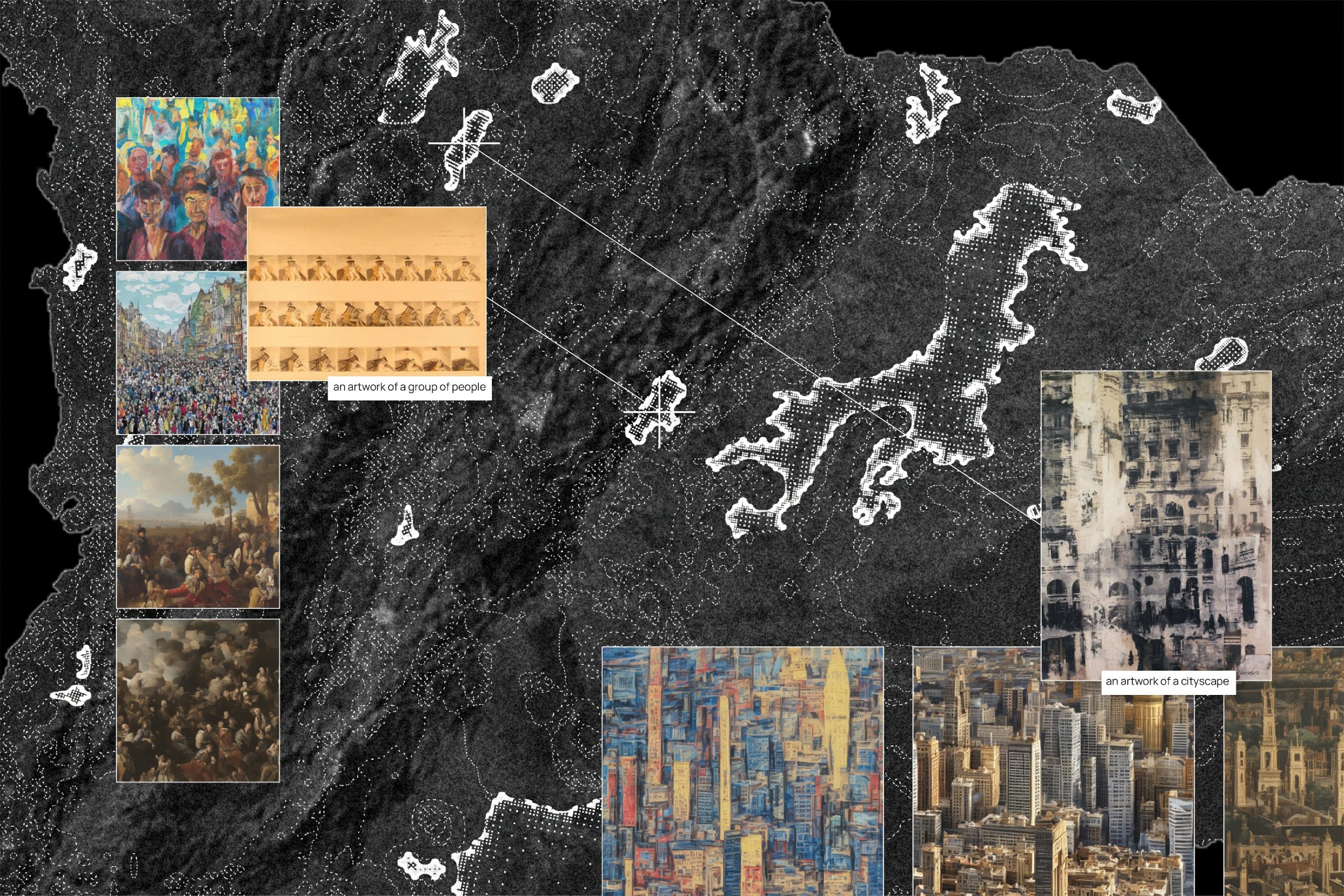
Digital F(r)ictions is an interactive web-based artwork that re-imagines the territory of Colombia as a hybrid double of the country’s artistic and environmental landscape. It creates a fiction of a new territory that goes beyond the satellite map, an intentional friction between different ways of seeing and representing Colombian territory. Juxtaposing to the “data colonialism” of mainstream artificial intelligence (AI) gaze, it fine-tunes Stable Diffusion on the Modern Art Museum of Bogotá (MAMBO) collection, alongside works from three additional Colombian artistic traditions. For each MAMBO artwork, the anchor of our work, it generates four distinct visual interpretations using CLIP embeddings, each embodying an alternative, situated way of seeing that embraces four Colombian artistic traditions: colonial, modern, pre-Hispanic, and street art. This paper details our technical approach: (1) semantic alignment between artworks and ecological layers, (2) LoRA fine-tuning for Stable Diffusion models, and (3) interface design enabling interactive exploration. Inspired by Latin American theorists and concepts of “digital pluriversality,” our work seeks to disrupt monolithic narratives of cultural memory. By integrating AI models of CLIP, BLIP, and Stable Diffusion, the project generates an alternative cartography of Colombia where artwork semantics align with ecological layers, and multiple re-imagined interpretations of the MAMBO collection, challenging the homologation of mainstream AI while exploring decolonial approaches to technology.
References:
[1] Ramy Al-Sehrawy, Bimal Kumar, and Richard Watson. 2021. A Digital Twin Uses Classification System for Urban Planning & City Infrastructure Management. Journal of Information Technology in Construction 26 (Nov. 2021), 832–862.
[2] B Danette Allen. 2021. Digital twins and living models at NASA. In Proceedings of the Digital Twin Summit. NASA Langley Research Center, NASA, Hampton, VA, USA, 1–10. https://ntrs.nasa.gov/citations/20210023699 NASA Technical Reports Server, Document ID: 20210023699.
[3] Homi K. Bhabha. 2012. The Location of Culture (2 ed.). Routledge, London.
[4] Andrés Burbano. 2023. Different Engines: Media Technologies from Latin America. Routledge, London, UK.
[5] Nick Couldry and Ulises A. Mejias. 2019. Data Colonialism: Rethinking Big Data’s Relation to the Contemporary Subject. Television & New Media 20, 4 (May 2019), 336–349.
[6] Tianhu Deng, Keren Zhang, and Zuo-Jun (Max) Shen. 2021. A Systematic Review of a Digital Twin City: A New Pattern of Urban Governance toward Smart Cities. Journal of Management Science and Engineering 6, 2 (June 2021), 125–134.
[7] A. Deprêtre, F. Jacquinod, and A. Mielniczek. 2022. EXPLORING DIGITAL TWIN ADAPTATION TO THE URBAN ENVIRONMENT: COMPARISON WITH CIM TO AVOID SILO-BASED APPROACHES. ISPRS Annals of the Photogrammetry, Remote Sensing and Spatial Information Sciences V-4-2022 (May 2022), 337–344.
[8] Li Deren, Yu Wenbo, and Shao Zhenfeng. 2021. Smart City Based on Digital Twins. Computational Urban Science 1, 1 (Dec. 2021), 4.
[9] Néstor García Canclini, Christopher L. Chiappari, and Néstor García Canclini. 2008. Hybrid Cultures: Strategies for Entering and Leaving Modernity (nachdr. ed.). Univ. of Minnesota Press, Minneapolis, Minn.
[10] Orit Halpern, Patrick Jagoda, Jeffrey West Kirkwood, and Leif Weatherby. 2022. Surplus Data: An Introduction. Critical Inquiry 48, 2 (Jan. 2022), 197–210.
[11] Donna Haraway. 1988. Situated Knowledges: The Science Question in Feminism and the Privilege of Partial Perspective. Feminist Studies 14, 3 (1988), 575. jstor:3178066
[12] Inna Kizhner, Melissa Terras, Maxim Rumyantsev, Valentina Khokhlova, Elisaveta Demeshkova, Ivan Rudov, and Julia Afanasieva. 2021. Digital Cultural Colonialism: Measuring Bias in Aggregated Digitized Content Held in Google Arts and Culture. Digital Scholarship in the Humanities 36, 3 (Oct. 2021), 607–640.
[13] Junnan Li, Dongxu Li, Silvio Savarese, and Steven Hoi. 2023. Blip-2: Bootstrapping language-image pre-training with frozen image encoders and large language models. In International conference on machine learning. PMLR, 19730–19742.
[14] Jurij Michajlovič Lotman. 2000. Universe of the Mind: A Semiotic Theory of Culture (1. u.s. paperback print ed.). Indiana Univ. Press, Bloomington.
[15] Ivo Mesquita, Adriano Pedrosa, Raul Antelo, and Paulo Herkenhoff (Eds.). 2000. F(r)icciones. Versiones del sur. Museo Reina Sofía, Madrid. 254 pages. NIPO: 181-01-004-3.
[16] Walter Mignolo and Rolando Vazquez. 2013. Decolonial AestheSis: Colonial Wounds/Decolonial Healings. Social Text: Periscope. https://socialtextjournal.org/periscope_article/decolonial-aesthesis-colonial-woundsdecolonial-healings/
[17] Walter D. Mignolo. 2011. The Darker Side of Western Modernity: Global Futures, Decolonial Options. Duke University Press, Durham, NC. jstor:10.2307/j.ctv125jqbw
[18] Tillmann Ohm, Mar Canet Sola, Andres Karjus, and Maximilian Schich. 2023. Collection Space Navigator: An Interactive Visualization Interface for Multidimensional Datasets. In Proceedings of the 16th International Symposium on Visual Information Communication and Interaction(VINCI 2023). ACM, Guangzhou, China, 1–5.
[19] Alec Radford, Jong Wook Kim, Chris Hallacy, Aditya Ramesh, Gabriel Goh, Sandhini Agarwal, Girish Sastry, Amanda Askell, Pamela Mishkin, Jack Clark, et al. 2021. Learning transferable visual models from natural language supervision. In International conference on machine learning. PmLR, 8748–8763.
[20] Ludovica Schaerf, Pepe Ballesteros, Valentine Bernasconi, Iacopo Neri, and Dario Negueruela del Castillo. 2024. AI Art Curation: Re-imagining the city of Helsinki in occasion of its Biennial. arxiv:https://arXiv.org/abs/2306.03753 [cs.AI] https://arxiv.org/abs/2306.03753
[21] Annalaura Vuoto, Marco Francesco Funari, and Paulo B. Lourenço. 2024. Shaping Digital Twin Concept for Built Cultural Heritage Conservation: A Systematic Literature Review. International Journal of Architectural Heritage 18, 11 (Nov. 2024), 1762–1795.
[22] Siegfried Zielinski. 2008. Deep time of the media: Toward an archaeology of hearing and seeing by technical means. The MIT Press, Cambridge, MA.



