
“Algorithmic Miner: Humanity in Service – An AI-Driven VR Journey Into Machine Logic” by Sun, Wei and Hui
Conference:
Type(s):
Title:
- Algorithmic Miner: Humanity in Service - An AI-Driven VR Journey Into Machine Logic
Session/Category Title:
- Culture and Computation
Presenter(s)/Author(s):
Moderator(s):
Abstract:
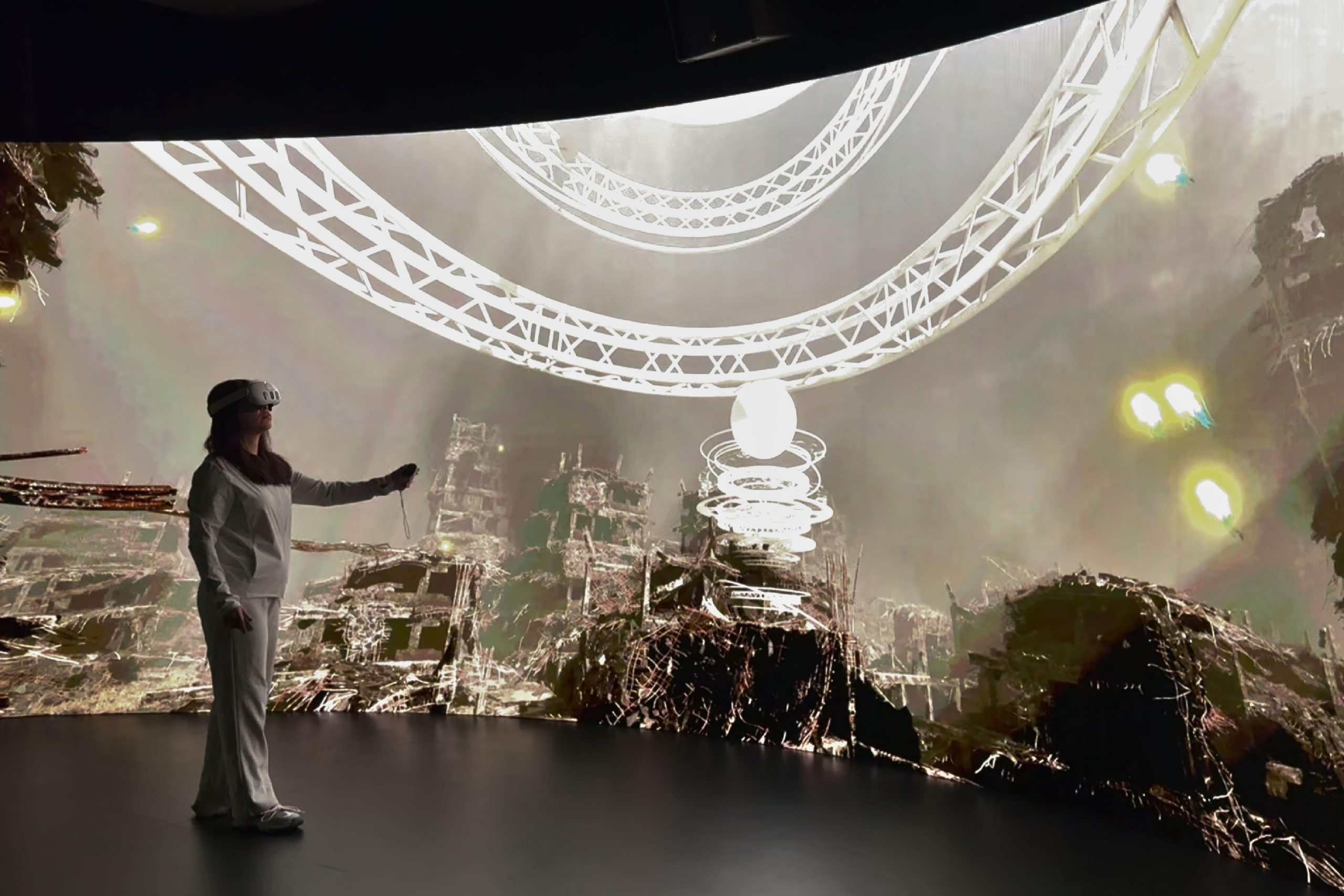
Algorithmic Miner is a VR-based interactive art installation that critically explores the exploitation and marginalization of data annotation workers, whose labor is fundamental to the advancement of artificial intelligence (AI) and machine learning (ML). These essential yet often invisible laborers function as the “resource mine” within the technological infrastructure, embodying the commodification and alienation of human labor as described by Marx and Heidegger’s concept of “enframing.” The installation symbolically reconstructs the monotonous nature of data annotation tasks through immersive VR interactions. Participants engage in repetitive image and text annotation tasks, mirroring the tedious and dehumanizing aspects of real-world data labeling. The object recognition component introduces a “reverse scenario” where human agency is subordinated to AI logic, compelling participants to alter their virtual environment in accordance with machine directives. As participants complete these tasks, their efforts materialize as golden jellyfish, ascending to a virtual utopia composed of gleaming steel and lush natural landscapes. This transformation symbolizes the abstraction and exploitation of human creativity within AI-driven systems. Algorithmic Miner envisions a future where machine logic dominates discourse, dictating human creativity and redefining reality, resonating with Baudrillard’s notion of the “hyperreal simulacrum.” By exposing the hidden labor and ethical implications inherent in the tech industry, the installation urges audiences to reconsider the complex interplay between society, the environment, and technology. It invites reflection on the human costs associated with technological advancement, highlighting the need for a more equitable and conscious integration of human labor within AI systems.
References:
[1] Mohammad Amir Anwar and Mark Graham. 2020. Digital labour at economic margins: African workers and the global information economy. Review of African Political Economy 47, 163 (2020), 95–105.
[2] Stephanie Balters and Martin Steinert. 2017. Capturing emotion reactivity through physiology measurement as a foundation for affective engineering in engineering design science and engineering practices. Journal of Intelligent Manufacturing 28 (2017), 1585–1607.
[3] Jean Baudrillard. 1994. Simulacra and simulation. U of Michigan P (1994).
[4] Florian Christoph Bruggisser, Chris Elvis Leisi, Pascal Lund-Jensen, Martin Fröhlich, and Christopher Lloyd Salter. 2024. reconFIGURE: Confronting Audiences with Digital Doppelgängers. Proceedings of the ACM on Computer Graphics and Interactive Techniques 7, 4 (2024), 1–10.
[5] Antonio A Casilli. 2024. Digital Labor and the Inconspicuous Production of Artificial Intelligence. arXiv preprint arXiv:https://arXiv.org/abs/2410.05910 (2024).
[6] Ka Chi Chan. 2024. ’Sisyphus’: A Robotic Vignette of Systemic Conflict and Democratic Endeavors. Proceedings of the ACM on Computer Graphics and Interactive Techniques 7, 4 (2024), 1–6.
[7] Andrew Crane. 2013. Modern slavery as a management practice: Exploring the conditions and capabilities for human exploitation. Academy of Management Review 38, 1 (2013), 49–69.
[8] Andrew Feenberg. 2017. Technosystem: The social life of reason. Harvard University Press.
[9] Michel Foucault. 2020. Power/knowledge. In The new social theory reader. Routledge, 73–79.
[10] Michel Foucault. 2023. Discipline and punish. In Social theory re-wired. Routledge, 291–299.
[11] Jérémy Frey, Christian Mühl, Fabien Lotte, and Martin Hachet. 2013. Review of the use of electroencephalography as an evaluation method for human-computer interaction. arXiv preprint arXiv:https://arXiv.org/abs/1311.2222 (2013).
[12] Christian Fuchs and Sebastian Sevignani. 2013. What is digital labour? What is digital work? What’s their difference? And why do these questions matter for understanding social media? TripleC: Communication, capitalism & critique. Open access journal for a global sustainable information society 11, 2 (2013), 237–293.
[13] Ziyao Gao, Yiwen Zhang, Ling Li, Theodoros Papatheodorou, and Wei Zeng. 2024. AI-rays: Exploring Bias in the Gaze of AI Through a Multimodal Interactive Installation. In SIGGRAPH Asia 2024 Art Papers. 1–7.
[14] Xiaoting Han and Chenjun Yin. 2023. Mapping the manosphere. Categorization of reactionary masculinity discourses in digital environment. Feminist media studies 23, 5 (2023), 1923–1940.
[15] Donna Haraway. 2013. A cyborg manifesto: Science, technology, and socialist-feminism in the late twentieth century. In The transgender studies reader. Routledge, 103–118.
[16] Martin Heidegger. 1977. The question concerning technology. New York 214 (1977), 2013.
[17] Jiayang Huang, Yue Huang, David Yip, and Varvara Guljajeva. 2024. Ephemera: Language as a Virus-AI-driven Interactive and Immersive Art Installation. Proceedings of the ACM on Computer Graphics and Interactive Techniques 7, 4 (2024), 1–8.
[18] Fredric Jameson. 2007. Archaeologies of the future: The desire called utopia and other science fictions. Verso Books.
[19] Bruno Latour. 2007. Reassembling the social: An introduction to actor-network-theory. Oup Oxford.
[20] Weixin Liang, Girmaw Abebe Tadesse, Daniel Ho, Li Fei-Fei, Matei Zaharia, Ce Zhang, and James Zou. 2022. Advances, challenges and opportunities in creating data for trustworthy AI. Nature Machine Intelligence 4, 8 (2022), 669–677.
[21] Simon Lindgren. 2023. Critical theory of AI. John Wiley & Sons.
[22] Herbert Marcuse. 2005. Heideggerian marxism. U of Nebraska Press.
[23] Herbert Marcuse. 2013. One-dimensional man: Studies in the ideology of advanced industrial society. Routledge.
[24] Karl Marx. 2022. Alienated labour. In Working in America. Routledge, 13–20.
[25] Rachid M’Rabty. 2023. Disconsolate Dreamers: On Pessimism and Utopia. John Hunt Publishing.
[26] Emil Øversveen. 2022. Capitalism and alienation: Towards a Marxist theory of alienation for the 21st century. European Journal of Social Theory 25, 3 (2022), 440–457.
[27] John Preston. 2022. Artificial intelligence in the capitalist university: Academic labour, commodification, and value. Taylor & Francis.
[28] Annabel Rothschild, Ding Wang, Niveditha Jayakumar Vilvanathan, Lauren Wilcox, Carl DiSalvo, and Betsy DiSalvo. 2024. The Problems with Proxies: Making Data Work Visible through Requester Practices. In Proceedings of the AAAI/ACM Conference on AI, Ethics, and Society, Vol. 7. 1255–1268.
[29] Andrew Smart, Ding Wang, Ellis Monk, M. C. D’iaz, Atoosa Kasirzadeh, Erin van Liemt, and Sonja Schmer-Galunder. 2024. Discipline and Label: A WEIRD Genealogy and Social Theory of Data Annotation. ArXiv abs/2402.06811 (2024). https://api.semanticscholar.org/CorpusID:267627149
[30] Asmita Bhutani Vij. 2023. Women Workers Behind the AI Revolution: The Production and Reproduction of Data Annotation Platforms. Ph. D. Dissertation. University of Toronto (Canada).
[31] Zheng Wei, Yuzheng Chen, Wai Tong, Xuan Zong, Huamin Qu, Xian Xu, and Lik-Hang Lee. 2024. Hearing the Moment with MetaEcho! From Physical to Virtual in Synchronized Sound Recording. In Proceedings of the 32nd ACM International Conference on Multimedia. 6520–6529.
[32] Zheng Wei, Jia Sun, Junxiang Liao, Lik-Hang Lee, Chan In Sio, Pan Hui, Huamin Qu, Wai Tong, and Xian Xu. 2025. Illuminating the Scene: How Virtual Environments and Learning Modes Shape Film Lighting Mastery in Virtual Reality. IEEE Transactions on Visualization and Computer Graphics (2025).
[33] Ding wen Wang, Shantanu Prabhat, and Nithya Sambasivan. 2022. Whose AI Dream? In search of the aspiration in data annotation. Proceedings of the 2022 CHI Conference on Human Factors in Computing Systems (2022). https://api.semanticscholar.org/CorpusID:247593858
[34] Michael Wheeler. 2011. Martin heidegger. (2011).
[35] David Gray Widder, Sarah West, and Meredith Whittaker. 2023. Open (for business): Big tech, concentrated power, and the political economy of open AI. Concentrated Power, and the Political Economy of Open AI (August 17, 2023) (2023).
[36] Stephen Wilson. 2003. Information arts: intersections of art, science, and technology. MIT press.
[37] Ryszard W Wolny. 2017. Hyperreality and simulacrum: Jean Baudrillard and European postmodernism. European Journal of Interdisciplinary Studies 3, 3 (2017), 75–79.
[38] Xian Xu, Wai Tong, Zheng Wei, Meng Xia, Lik-Hang Lee, and Huamin Qu. 2025. Transforming cinematography lighting education in the metaverse. Visual Informatics 9, 1 (2025), 1–17.
[39] Xiaoyun Zhong, Xuanyang Huang, Rui Hu, and Shuang Wu. 2024. Abutting Tokyo: AI-Driven Cognitive Distortion in VR Urban Visualization. In SIGGRAPH Asia 2024 Art Papers. 1–5.
[40] Shoshana Zuboff. 2019. The age of surveillance capitalism: The fight for a human future at the new frontier of power, edn. PublicAffairs, New York (2019).



